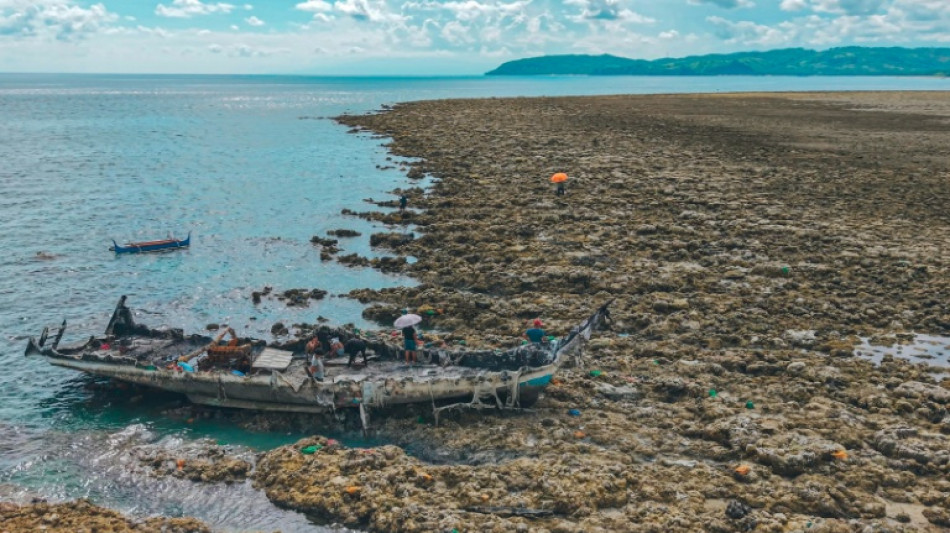
Deadly Philippines quake turns seabed into shore / Photo: © AFP

 Reigning champ Knicks earn first win against Pistons

 Runners swap streets for shopping malls as haze chokes Singapore

 Billionaire Ambani's Jio to debut after record India IPO

 UK set for cautious budget as borrowing costs climb

 Anthropic's record IPO faces some big questions

 US Fed expected to hold rates steady ahead of key midterm elections

 Can this Latin Grammy-winner help Democrats win back Congress?

 Tuvalu has 'limited' power to halt its fossil fuel investments: NZ govt papers seen by AFP
 Palestinian activist Khalil returns to Columbia after US detention

 Trump drastically loosens oil and gas methane rules

 French Senate weighs bill to make protesters pay for unrest damage

 'A very sad day': Arteta despair as Arsenal stunned by Fleetwood
 Charles tackles thorny legacy of slavery on Caribbean trip

 Former Grand Slam winner Wawrinka ends tennis career

 Brazil's Flavio Bolsonaro flees to US after election loss

 'Faerie' nights: 'ACOTAR' fans finally get their book

 American woman convicted of getting military training from Islamic State

 Israel opposition holds narrow edge over Netanyahu in first projections

 Floriani hits maiden goal as Lazio go top
 Trump set to drastically loosen oil and gas sector's methane rules

 Storied Paris department store seeks bankruptcy protection

 Xhaka, Embolo can return to Swiss squad after fake Covid docs affair

 Allegri suspended for two Serie A games after red card

 Flight data, satellite images reveal growing US role at Ecuador base

 McInnes feels 'guilt' ahead of Hearts return with Rangers

Arsenio Butil Jr. fell to his knees and began to pray when last week's deadly 7.8-magnitude earthquake began shaking his home on the coast of the southern Philippines.
When he opened his eyes, he saw a once-familiar shoreline changing in real time, with swathes of previously submerged coral suddenly pushing above the waterline.
The June 8 quake, driven by a shifting of the nearby Cotabato Trench, toppled buildings, triggered landslides and killed at least 76 people on the southern island of Mindanao.
The tectonic forces at work also thrust chunks of the island's coastline upward in a phenomenon known as "coastal uplift", leaving stretches of shore unrecognisable to families who have spent their whole lives there.
During a visit to the area, AFP saw fishing boats that had once been at the water's edge on the wrong side of a wall of jagged, now-dead coral stretching for kilometres in both directions.
Butil Jr, a fisherman and pastor living in Sarangani province's Glan, told AFP the June 8 quake was the largest that he had ever felt.
"The people were extremely panicked," he said.
"What I saw at the shoreline was that the water receded. After a while, I saw it... slowly returning. And then it receded again. Maybe three or four times," Butil said.
"The fish were dying and floating."
The Cotabato Trench, which lies as close as 50 kilometres off Mindanao, is the site of frequent seismic activity, including a "swarm" of thousands of mostly small tremors recorded in January.
A UN disaster risk reduction report released in mid-May hinted they could be a precursor to a large earthquake.
"What they see now is their new coastline," Nane Danlag of the Philippines' seismology centre told AFP from her office in General Santos City on Friday, adding the change was permanent.
"The (seabed) went up two meters," Danlag said, extending the shore by 200 metres (650 feet) in some areas according to initial assessments.
Pointing at a map, she said the affected area stretched between two towns nearly 100 kilometres (62 miles) apart.
As shocking as the changes to the coastline appeared, the shifting of the earth's crust that created it was a "natural movement", she said.
"This has been going on for thousands of years."
- 'What everyone fears' -
In the hills above a neighbouring village, about 100 men, women and children who fled to higher ground when the earthquake struck were still living in an encampment visited by AFP.
Datu Atom Malimpnig, a Maguindanaon chieftain, said the newly formed coastline had left the group of fishermen and their families hesitant to return to their now-destroyed homes.
Many remain convinced a tsunami could yet strike, he said, as government aid workers ladled rice porridge into bowls for the evacuees.
"(The seabed) rose... It's not the same as it was before," Malimpnig said.
"What if the sea surges forward? That is what everyone fears," he said, adding their new home atop the hill felt far safer.
Ten kilometres away, Edzel Baylon, a staffer at the Isla Jardin del Mar resort, bemoaned a newly changed landscape that spelled trouble for a destination that touted a white sand beach holiday experience.
"It has a huge effect on the resort, because the main draw for customers is the sea," she said, pointing at an idyllic beachfront now separated from the water by exposed coral.
"Sadly, today, our sea has become shallow. It's no longer suitable for swimming."
Since the June 8 quake, more than 8,500 aftershocks have shaken the region, according to the seismology agency.
In Glan, residents were thinking about next steps, but not yet ready to attempt to rebuild their destroyed homes, said Butil Jr, the pastor.
"The ground there is cracked, and the cracks are long. That is why this area would be very dangerous if another earthquake as strong follows," he said.
Minutes later, a 5.4 tremor shook the ground underneath his feet.
L.Meier--VB