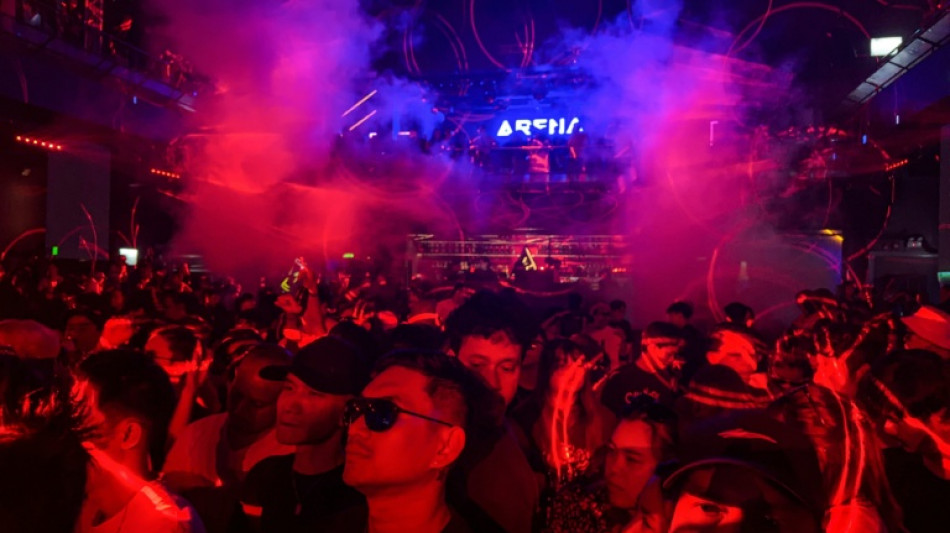
Yangon's furtive party scene belies junta claims of normality / Photo: © AFP

 India's 'Cockroach' movement vows to protest until education minister resigns
 South Korea president urges regulator action on leveraged stock funds
 For Ukraine's drones, names are part of the battle
 Countries move to ban social media for children
 Asia stocks up as chip stocks recover, oil eases
 Desperate Rohingya risk deadly voyages as trafficking surges

 French lawmakers expected to approve social media ban for under-15s

 'All these rashes': chickenpox surges in Gaza camps

 Australia's Cummins, Hazlewood, Lyon back for Bangladesh Test series
 Rubio in Philippines as US condemns 'dangerous' China actions
 Unnatural physique turns Evenepoel into a Tour de France contender
 'Sit down!' Australian politician berates dog on live TV

 Argentina squad returns, without Messi, after World Cup final loss
 New strikes as Trump warns Iran will pay for US troop deaths
 Spain stars lap up adulation of estimated two million on World Cup parade
 Business of Dance Mentees and Enola Bedard Join Shakira for the FIFA World Cup Halftime Show
 "The pain is immense," says Messi of World Cup defeat
 US judge suspends Paramount's acquisition of Warner Bros.
 Chess legend Judit Polgar rejects becoming Hungary's president

 Ceferin skipped World Cup final reportedly to show disapproval of FIFA
 Judge approved night-time Tour de France doping tests

 Chile declares state of emergency over deadly rainfall
 Kevin Keegan: The 'Mighty Mouse' who conquered Europe
 'Not another one': UK voters fatigued by seventh PM in a decade
 DeChambeau threatened to call Trump over British Open penalty: reports
In a blaring nightclub in wartime Myanmar, partied-out revellers doze until dawn by the dancefloor, wary of journeying home despite the end of a post-coup curfew.
Lasers streak the smoke-filled air and music is cranked up to 150 decibels, according to one DJ -- as loud as a jet engine at take-off -- but the weekend clubbers slumbering on sofas dotted around the warehouse-sized Yangon venue do not stir.
"That became a habit, they're used to it," said one 29-year-old veteran of the capital's elite party scene, who like other interviewees requested anonymity for security reasons.
The frenzied but furtive social scene contradicts the message from Myanmar authorities that the country is back to normal.
Five years after a military coup, they point out that they have held elections, installed a new government and ended Yangon's lingering 1:00 am to 3:00 am curfew.
But the polls were tightly curbed, excluding deposed leader Aung San Suu Kyi, and the commander of the putsch remains in charge as civilian president.
Meanwhile, the civil war sparked by his coup rages on.
Youngsters living under pressure want to let go but avoid being on the streets late -- many fear that the military or other armed groups may arbitrarily detain them or abduct them for conscription.
Since the coup, the rate of young people feeling "unsafe" or "very unsafe" walking alone at night has more than doubled to 40 percent, according to a 2025 UN report.
Yangon's streets are deserted by late evening.
Singer Sae Sar -- who performs under a stage name -- said such stresses fuel the appetite for nightlife even as they restrain it, giving Yangon's social scene its contradictory quality.
"I know my fans are tired all day," said the 24-year-old, adding: "If they keep all their feelings inside, it can cause many problems."
- 'Life is short' -
A night out may begin on Chinatown's neon-lit 19th Street, where beer bars spill onto the kerb.
The avenue is jammed on weekends, a rare artery of late-night action surrounded by streets abandoned to stray dogs as midnight approaches.
"Life is short as a drying drop of water. Don't be sad," a singer's voice wafts into the street.
"Things will get better. Try just to be happy."
Myanmar's 2021 coup saw pro-democracy protests violently put down by security forces and a dusk-to-dawn curfew imposed.
It was eventually winnowed to the wee hours before being lifted in December -- an apparent concession ahead of polls analysts dismissed as lip service to democracy.
Six months on there are "no more, but no less" people out at night, said one young woman hawking sachets of hangover remedy.
"People just want to be happy, even though they are worried," she said. "They're still going home early."
- Post-coup hangover -
When 19th Street quiets down around midnight, the party shifts to the Sanchaung area. Once a hotbed of post-coup protests, it has since thrived as a nightlife hive.
After the rallies were snuffed out, many activists joined factions fighting the military in a civil war which has killed tens of thousands, displaced more than 3.7 million people and left half the nation in poverty.
"Even when curfews were in place, young people were still out at night," said one 31-year-old Yangon DJ.
He reasoned authorities did not arrest them because people out partying "won't focus on the resistance".
But everyone AFP spoke to said post-coup nightlife carries a different energy.
Party narcotics have exploded on the scene: ketamine, ecstasy and "happy water" drug cocktails that often contain both stimulants and sedatives in unpredictable proportions, with clashing effects.
"These days people judge whether a DJ is good or bad based entirely on how well the music complements their drug high," the DJ lamented. "It is supply and demand."
In the club, the demand for escape from the outside world ends only at dawn -- when partiers stumble home, still suffering from a post-coup hangover.
F.Mueller--VB