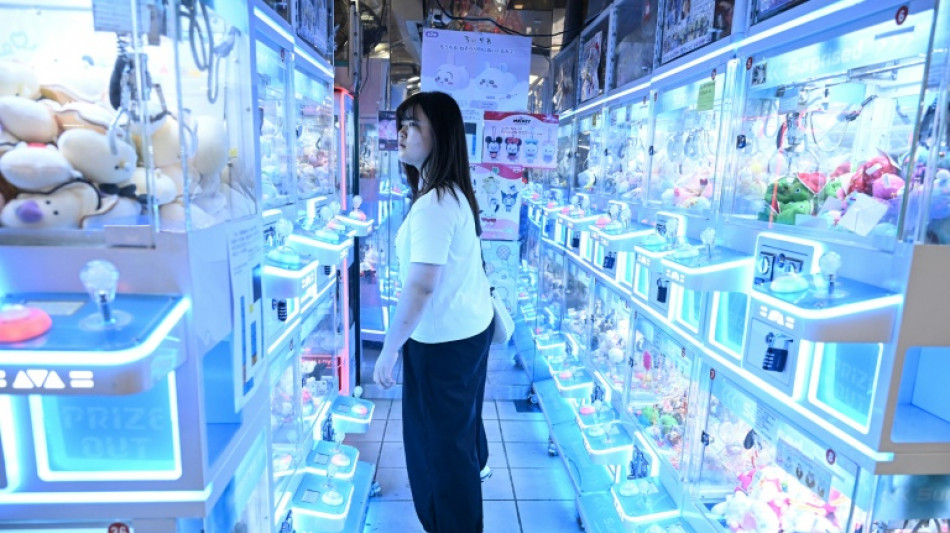
'Totally hooked': Hong Kong targets claw machine addiction / Photo: © AFP

 Evenepoel wins Tour de France individual time-trial
 Tropical Storm Bertha strengthens, threatening Gulf coast of US
 Microsoft strikes deal for Mistral's AI computing power
 Dutch students unveil 'world-first' solar-powered ambulance
 French lawmakers set to ban social media for under-15s in European first
 UK PM Burnham unveils energy tax cut, tells ministers to cut living costs

 Pharma heavyweights clash over anti-obesity drug ads

 Hungary raids Orban's Fidesz party servers in graft probe

 General Motors lifts 2026 outlook despite hit from electric retreat
 Uproar in France over reintroduction of bee-harming pesticides

 Kuwaitis ration electricity as Iran hits power grid
 Former Man Utd boss Ferguson salutes old rival Keegan
 UK PM Burnham's new cabinet to meet as he announces tax cut

 Former MotoGP champion Quartararo to make Honda switch

 Oleksandr Syrsky, Ukraine's under-fire commander-in-chief

 New UK govt tackles cost of living with energy tax cut

 China summons Philippine ambassador over clash in disputed waters

 Panama, China renew maritime port agreement

 De Gaulle returns to unite the French -- at the cinema

 North Korea reaffirms support for Moscow over Ukraine
 South China Sea rivalry looms over ASEAN meeting
 Arrogance or pride? Argentina grapples with World Cup villain label
 Fires in Brazil's Amazon dropped to historic low in 2025

 French youth social media ban meets age check conundrum

 Lebanon's Aoun to meet Trump as pressure builds to disarm Hezbollah

Claw machine lover Neiki Lee carefully lowers the metal jaws of a crane with a joystick into a pool of prizes, only to have the small toy slip from its clutches again and again.
Dozens of stores filled with claw machines have sprung up on streets and in malls across Hong Kong's finance hub in recent years, promising players a treasure trove of prizes and a sense of fulfilment.
The colourfully lit machines, often seen drawing people like moths to a flame, have come under regulatory scrutiny this month, as officials raised addiction concerns over the seemingly harmless games.
Lee, 48, admitted that she was "totally hooked" and that "this is definitely gambling", adding that she bets at least five Hong Kong dollars every time she attempts to win a higher-value plush toy.
- 'Sunk cost fallacy' -
An office clerk, Lee said she has spent around HK$100,000 (US$12,800) on claw machines over two years -- roughly half her annual salary.
"For a HK$70 toy, you might eventually spend 700, or even 1,700, and still not be able to grab it," Lee told AFP.
"I really want to give it up. Every day I scold myself and tell myself to quit: no more, no more."
Player Tommy Yu, 23, said he sometimes spends hundreds of dollars a day on it despite saying some machines have "traps" built-in.
"When you put money in but don't get anything back, you feel like you've lost out," he said.
"Yet it keeps driving you to play."
Gambling counsellor Chu Ho Ming told AFP that "the more (the players) invest, the harder it is to leave empty-handed and walk away".
"This is the sunk cost fallacy," he said, adding that "it keeps the addictive behaviour loop".
Chu said his team have noticed an increase in youth playing games with "gambling elements".
- Too late? -
Claw machine operators have been able to expand and operate largely unrestricted, after a court ruled in 2022 they are not required to possess public entertainment licenses.
But after a sharp rise in the number of public complaints related to so-called claw machine gambling over the last two years, Hong Kong authorities proposed this month to tighten regulations over prize-based arcades, calling the situation after the 2022 ruling "not ideal".
The design and business models of such gaming machines are "extremely diverse", officials said, adding that they were committed to tackle the "deep-seated issues".
Some lawmakers have suggested capping the prize value at HK$300 or below, in line with countries including Britain and Singapore.
Matthew Chan, who owns three claw machine shops in town, told AFP tighter regulation was needed as the industry "was heading in the wrong direction".
Chan bemoaned the government's slowness to act, citing that Taiwan's machines must offer a "guaranteed prize" if a certain amount of money is spent.
"The market already saw a downsize... (Hong Kong's) consumers have lost confidence in it," he said, adding that some machine operators were ramping up the difficulty and keeping players hooked.
But player Lee said she believed operators would find ways to evade any regulation enacted.
"It's impossible that a law... can be applied in a way that is both flawless and fair" for the industry, she said.
"It is difficult to root out addiction problems simply by passing a law."
M.Vogt--VB