No way home for Eid as jihadists cut off Mali capital / Photo: © AFP

 Google-parent Alphabet beats expectations, cloud revenue nearly doubles
 US announces civilian nuclear deal with Saudi Arabia

 Tesla shares dip after profit misses expectations

 Red Sox tie club record with 15th straight MLB win

 US eyes offshore nuclear reactors
 The Sterling Announces Luxury Cocktail Lounge Concept and Investor Showcase in Orlando

 Inter Miami signs Brazil veteran Casemiro but MLS probes deal

 White House accuses China's Moonshot of stealing Anthropic AI
 Pogacar sweating on Yates's fitness ahead of Tour Queen stage
 Ukrainian soldiers and civilians welcome new army commander

 UK fintech Revolut valuation soars to $115 bn: source

 German FM, on Africa tour, eyes business ties amid US, China pressure

 Rubio says at ASEAN meeting he expects 'positive' US visit by China's Xi

 Philipsen wins Tour de France 17th stage

 DonnaPro Introduces AI-Trained Executive Assistants for European CEOs

 Happy birthday, George! UK prince becomes a teenager

 Oil prices jump on Mideast war, stock markets diverge
 US hits Iranian island, says war cost at $37.5 bn
 Metal mining's carbon footprint far larger than thought: study
 TokenInsight Q2 2026 Report: TradFi Momentum Lifts MEXC to No. 2 in Commodity Perpetuals

 Leonardo chief sees potential for Germany to join GCAP fighter jet project

 Louvre heist gallery reopens to public, but with nothing to steal

 Ukraine's new army chief: who is Mykhailo Drapaty?

 India student protests keep up pressure on Modi government

 Italian FA chief says in touch with Guardiola over coaching vacancy
Hemmed in by a jihadist blockade of the Malian capital, Muslims in Bamako have been forced to spend Eid away from their families this year.
Originally from the central city of Mopti, Alpha Amadou, 40, has had to give up his usual journey home for the major holiday, known locally as Tabaski.
"For the first time in 30 years living in Bamako, I'll be celebrating Eid here this year," he told AFP.
Since late April, fighters from Al-Qaeda's Sahel branch have imposed a road blockade on the main routes into Bamako, torching dozens of buses and freight trucks.
Though the blockade is only partial, images of charred vehicles have deterred many transport services from operating and travellers from heading back to their villages.
In Mali, Tabaski goes far beyond religion. It is a major social tradition, one of the few times when families, often scattered by work for months, come together.
But in Bamako's bus stations, the usual pre-holiday rush has given way to an eerie calm. Alongside insecurity, fuel shortages have also hit the transport sector.
"Not only do we lack diesel to keep running, but we've also lost buses in recent incidents. It's a huge economic blow," said the owner of a local travel agency, speaking anonymously.
"Normally, we could transport more than 50,000 people from Bamako to other regions in a week for Tabaski. This year, we're not planning any trips," added a manager at another transport company.
For Wara Bagayoko, the ritual has always been the same: pack up the family car and head to Segou in central Mali to celebrate together.
But this time, he will stay behind, as even private cars have become targets.
"It will be the first time in 30 years I won't celebrate in my village. The road is too dangerous," he said.
"Before, about 20 of us would travel together on motorbikes to Sikasso (in the south) to celebrate," added Oumar Diarra. "This year, we'll stay in Bamako."
A few minibuses still slip into the city, taking backroads or travelling with a military escort.
- Sheep in short supply -
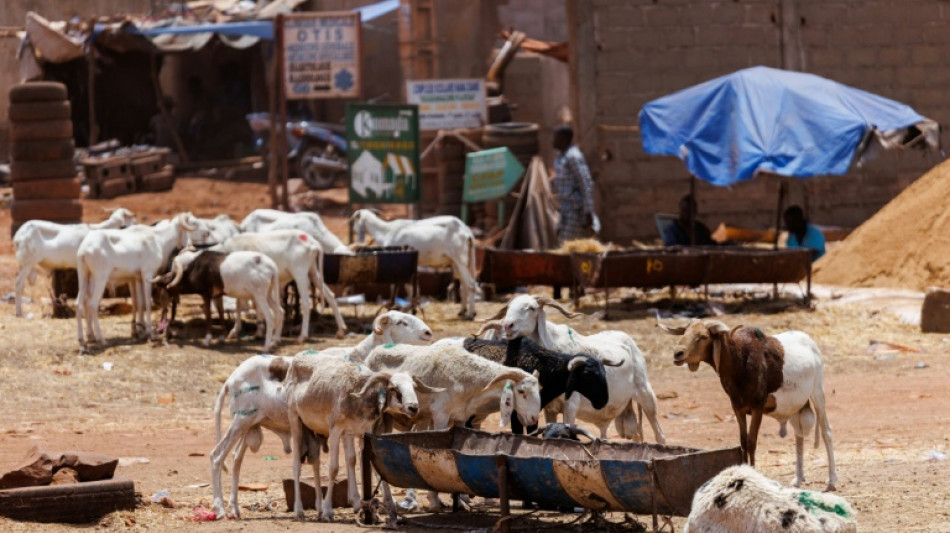
The disruption to transport is also choking the livestock trade, which is essential for the traditional Tabaski sacrifice.
Because of the blockade, herders and traders are struggling to bring animals to Bamako, the country's main consumer market.
The cost of transporting one animal, usually around 2,500 to 2,750 CFA francs (almost $5), has jumped this year to between 15,000 and 18,000 CFA francs ($26-$31), said transporter Alassane Maiga.
As a result, sheep are scarce and far more expensive in a country where the monthly minimum wage is just 40,000 CFA francs.
"Many trucks of sheep have been burned by jihadists... Normally, I'd have more than 1,000 animals, but today, not a single one," said Bamako vendor Hama Ba.
"Sheep we used to buy for 75,000 francs are now going for 300,000. Before, there was plenty to choose from, but now they've almost vanished from Bamako," said Iyi, who was searching for one he could afford.
- Power cuts -
The security crisis is creeping into daily life, as basic services break down in the city.
Bamako is struggling with prolonged power outages and major shortages of drinking water.
Festive outfits known as "Selifini" remain unfinished in tailors' workshops, held up by the frequent power cuts.
"We tried using a small solar panel," said dressmaker Alou Diallo. "But it can't replace electricity."
Families are also worried about storing food for the celebration.
"How are we supposed to keep meat without electricity? Buying an expensive sheep only to lose it within 24 hours due to power cuts is a real fear," said a mother on the outskirts of Sirakoro.
In recent days, authorities have announced the arrival of hundreds of fuel tankers in the capital, offering some hope of relief.
But for many, the road home for Eid has already shut.
L.Stucki--VB