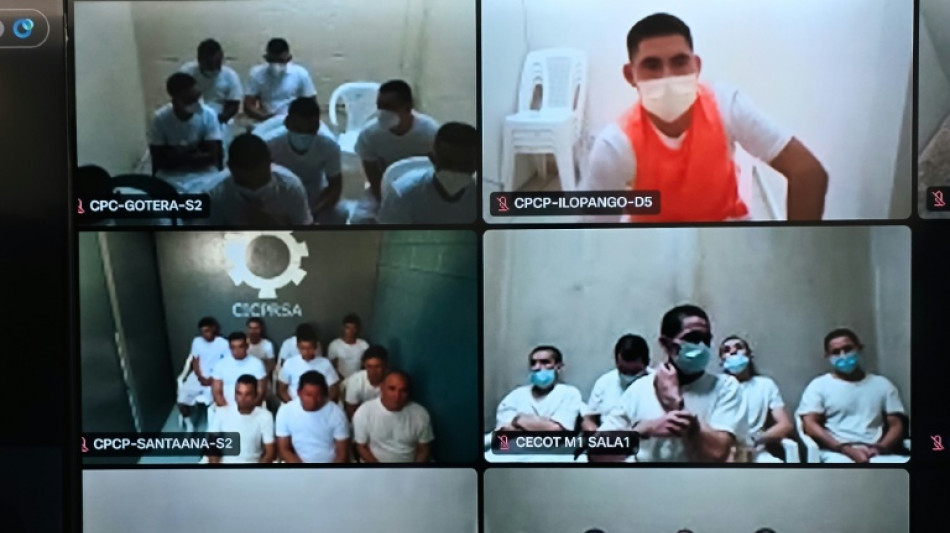
In El Salvador's mass trials, 'the innocent pay for the guilty' / Photo: © El Salvador Attorney General's Office/AFP

 EU fines Google 890 mn euros, risking US fury

 France evacuates thousands of tourists as fire rages in pine forest

 French Jewish DJ sues after activists disrupt stage show: lawyer

 Nokia says AI, cloud boosted sales in second quarter

 Repsol says profit more than triples on higher oil prices

 TotalEnergies says profit doubled on Mideast war

 Giant swing on Swiss peak aims to boost summer tourism as Alps warm
 ASEAN to call for open straits as US-Iran war casts shadow

 AI catches up with humans to score 100% at top maths contest

 South Korea election office raided in fake turnout figures probe: investigators
 Killer whales: orcas blow fish to bits 'for fun', study finds
 Deadly wildfires force thousands from homes in parts of Europe

 Tech bounce lifts Asia stocks, oil extends gains on US-Iran fears

 Surrounded by militias, Sudanese fear endless cycle of war

 Commonwealth Games 'where champions are made' despite slimmed down model, argues president
 Trump family project in Albania has already caused 'irreparable' damage: NGOs

 Bollywood blast master keeps it real with fire and fury

 Tearful fights, edible offerings: A glimpse into the Maradona trial

 What's the deal with peptides? The hyped market under US review

 Tesla shares fall as Musk touts ambitious -- and costly -- plans
 Houthis claim Red Sea tanker strikes as US hits Iran again

 Wildfires ravage parts of southern France, Italy and Spain

 Alphabet beats expectations in second quarter, cloud revenue nearly doubles

 Trump threatens Iran infrastructure, Tehran vows 'eye for eye'

 US teen withdraws lawsuit against Meta over social media addiction

Wearing white uniforms, their heads shaved, rows of bewildered-looking men are beamed by video link from prisons across El Salvador into a courtroom conducting a mass trial of alleged gang members.
Four years after President Nayib Bukele declared war against gangs in the Central American nation, the fates of thousands of prisoners are being decided en masse with the single swing of a judge's gavel.
Williams Diaz, a 35-year-old air conditioning technician, is one of more than 91,000 people rounded up under a state of emergency -- in place since 2022 -- who will be judged with scores of others in a faceless court by an anonymous judge.
He was arrested by soldiers over three years ago while on his way to work and taken to Bukele's showpiece Terrorism Confinement Center (CECOT), a brutal prison where over 10,000 suspected gang members are crammed into overcrowded cells.
His mother Gladis Villatoro fears that her Williams, the father of a six-year-old boy, will be tainted when he goes on trial for alleged membership of one of the gangs that terrorized El Salvador before Bukele's crackdown.
"If they convict one, they convict the whole lot...the innocent will pay for the guilty," Villatoro, who sells tortillas for a living, said at her modest home 20 kilometers (12 miles) east of the capital San Salvador.
A short drive away, Reynaldo Santos, a soft-spoken 58-year-old baker, fears his son Jonathan could also be sent to prison for years without getting a chance to defend himself.
- 'Like Russian roulette' -
Jonathan, a 24-year-old factory worker, was arrested at home while playing the wildly popular video game Fortnite, which police said denoted a penchant for gang activities.
He was released pending trial, but he could be rearrested at any time.
"It's like Russian roulette, it's a nightmare," his father said.
Bukele's mass incarceration policy has seen around 1.4 percent of El Salvador's population locked up without due process, creating a logistical headache for the country's courts.
In an attempt to clear the backlog, the Attorney General's Office vowed to accelerate the mass trials begun in 2024, cloaked in secrecy, by finalizing 3,000 indictments in the first three months of 2026.
Human rights groups have expressed outrage over the trials, arguing that collective justice violates the defendants' rights to a fair trial.
Vice President Felix Ulloa has touted the approach as "innovative."
But the stakes for the accused, mostly from low-income families, couldn't be higher.
Last week, El Salvador's Legislative Assembly increased the maximum sentence for "terrorists" -- which the government labels gang members -- from 60 years to life imprisonment, including for minors.
Ulloa said sentences would vary, according to the defendant's rank within an alleged gang cell.
Criminal lawyer Roxana Cardona warned that the trials would turn El Salvador's prisons into "human pits."
AFP has reached out to the prosecutor's office and Salvadoran government for comment on the trials, but has yet to receive a response.
- Conviction conveyor belt -
Information about the trials is difficult to access.
The cases are kept under seal, meaning the details are not available to the public.
Prosecutors have grouped the detainees by alleged gang cell, according to their purported areas of operation.
Jonathan and around 80 other prisoners are accused of being part of Mara Salvatrucha, one of Central America's most feared crime syndicates.
Williams meanwhile is accused of being a member of the rival Barrio 18 gang.
According to documents seen by AFP, neither have any prior convictions.
"There is a presumption of guilt, not innocence," a lawyer defending 45 prisoners, who spoke on condition of anonymity for fear of reprisal, told AFP.
The mass trials were made possible by reforms to El Salvador's law on organized crime, which banished the individualization of criminal responsibility and eliminated the preliminary court hearings used to determine whether there is enough evidence to bring a case to trial.
The resulting proceedings "are a mere formality...a massive conviction factory," said one lawyer who represented a produce vendor sentenced in February to 30 years in prison, alongside 163 others.
Before each trial, an imprisoned gang member, his face concealed, testifies about the accused in order -- and receives a reduced sentence in return, several defense lawyers said.
The lawyers added that informants often fail to provide any evidence of their claims -- but their testimony guarantees a conviction regardless.
In some cases, the defense attorneys are not summoned to the mass hearings or made aware of the charges against their clients.
The produce vendor's lawyer saw him for barely a minute before the trial.
"I only managed to ask him how he was and tell him, 'Your family loves you and knows you're innocent,'" the lawyer recalled.
- Swamped public defenders -
Bukele, a staunch ally of US President Donald Trump, has become a folk hero at home and across much of Latin America for dramatically curbing gang violence.
He has shrugged off criticism from legal experts who say his crackdown may have led to crimes against humanity, arguing that the ends justified the means.
New York-based watchdog Human Rights Watch (HRW) has documented arrests in El Salvador based on anonymous phone calls, neighborhood disputes, or over-zealous police officers aiming to meet arrest quotas, for which they receive bonuses.
For Juan Pappier, HRW's deputy director for the Americas, the ensuing trials "lack the basic guarantees of due process, which increases the risk of convicting innocent people."
Villatoro and Santos have gone into debt to pay for private legal aid for their children rather than rely on court-appointed attorneys, who are swamped with cases.
Villatoro's anguish has grown since she learned that her son is in kidney failure.
"It's been a year since then, and I don't know how he is," she said, whispering so her 6-year-old grandson would not hear.
She recalled Bukele's ominous prediction that suspects who enter his flagship Terrorism Confinement Center will "never" leave, but is still praying for "a miracle."
Santos said Jonathan, who suffers from anxiety and depression, merely wanted a chance to prove his innocence.
"We want this nightmare to end," he said.
R.Buehler--VB