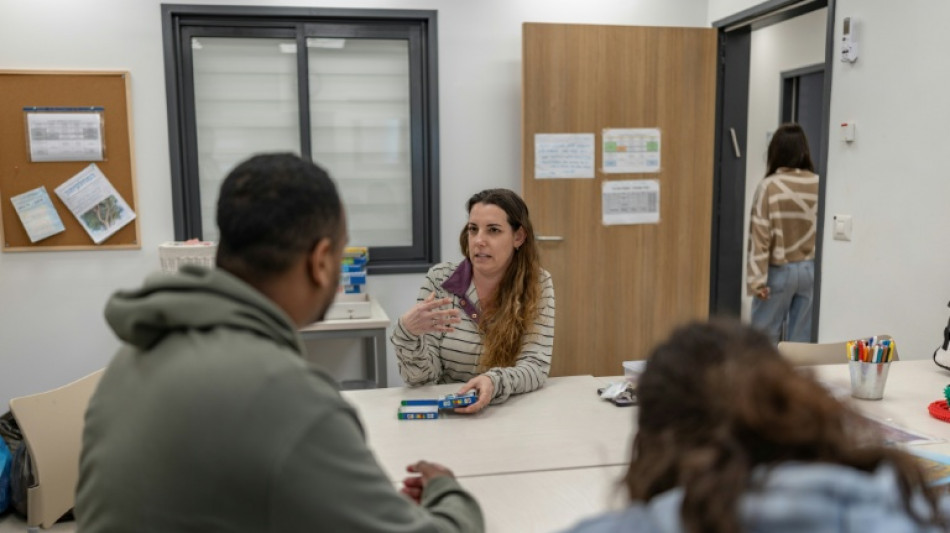
In Israel, air raid sirens spark anxiety and dilemmas / Photo: © AFP

 ASEAN calls for open straits as US-Iran war casts shadow

 Ford and Geely to form joint venture at struggling Spain plant

 Russia warns US against Ukraine arms sales in Manila meeting
 New UK PM announces tax cut for struggling pubs

 Supporters flood India's 'cockroach' protesters with food

 Modi vows punishment for exam leaks fuelling India protests

 Norway set to make formal complaint to FIFA over Balogun red card saga
 Floods in northeast India kill at least 41

 Nestle siphons off bottled water business into joint venture

 Hundreds hospitalised in Japan heatwave 'disaster'

 Renault says sales stalled in first half

 EasyJet says profits nosedive on Mideast war

 Modi vows punishment for exam fraud fuelling India protests

 Six candidates in race to lead UN set for televised debate

 Comic-Con kicks off with Marvel's return
 Dutch riders dreaming of crazy party corner of Alpe d'Huez

 Houthis target Red Sea shipping as US hits Iran
 Record-equalling Red Sox streak halted at 15 wins

 Messi-less Miami beat Fire 3-2 to spoil Lewandowski's MLS debut
 Mercedes expect Hungary challenge from Hamilton and Ferrari

 In Ghana, one man's race to save critically endangered fish
 Wilson captain, Slipper absent in Kiss's first Wallabies squad
 New Mideast fighting puts eurozone rate-setters on alert

 Venezuelans search for animal companions lost in the quakes

 Argentine Football Association says US did not detain its president

Acutely sensitive to noise because of childhood trauma, Nili stresses when air raid sirens send her into a crowded shelter where her own "internal war" overlaps with the one raging outside.
The experience of Nili, whose name has been changed for this article, highlights the particular vulnerability of people with mental health conditions when dealing with the Middle East war, triggered on February 28 by US-Israeli strikes on Iran.
With every siren warning, the same anguish returns for the 21-year-old, who has spent nine months at the Shalvata Mental Health Centre in the central town of Hod HaSharon, run by Israel's largest healthcare provider, Clalit Health Services.
"It's unpleasant and unfamiliar to be in a relatively small room with many people you don't know, men and women together, usually quite crowded," she told AFP during a visit to the centre.
"We're in Israel, and there's a war outside. But there are also people who have been dealing with their own internal war for many years," she added.
The anxiety of war is also something felt acutely by Israelis living with disabilities, who number about 1.32 million people, or around 13 percent of the population, according to a 2025 report by the Central Bureau of Statistics.
For 16-year-old Rhea Azmanov, who has a cognitive disability, the uncertainty creates layers of additional challenges.
"All kids with disabilities really need routine" to give them a sense of stability and certainty, her father, Ziv Azmanov, told AFP.
"So when there is no normal routine, as in the current circumstances, it creates with her a lot of stress and anxiety."
The Azmanov family does not have a "mamad" or reinforced room in their apartment in the central city of Raanana, and must use their building's shelter each time a siren sounds the warning of incoming missiles.
"She's very uncomfortable. She hates crowded places. So sometimes instead of going down, we have to stand outside," said her mother, Veena Azmanov, who noted that the noise inside the shelter, combined with the wail of sirens and boom of missile interceptions, can elevate stress.
And for people with reduced mobility, accessibility challenges become more extreme during wartime "because everything is more accelerated", said Yoav Braver, who heads training at Beit Issie Shapiro, one of Israel's leading centres for people with disabilities.
Braver said that public information mapping accessible shelters was hard to come by, and even people with mamads in their homes could struggle to get there in the 90-second window afforded by the longest air raid warnings.
Caregivers often shoulder a particularly heavy burden during wartime, Braver said, adding that Beit Issie Shapiro had set up a hotline offering advice for professionals or family members.
"Burnout is a main issue that we deal with in times of war," he said.
- 'Ethical dilemmas' -
For medical staff caring for psychiatric patients such as Nili, and those with more severe conditions like schizophrenia and personality disorders, seemingly impossible choices can surface between ensuring their own safety or staying with the most vulnerable.
Merav Agsham, head nurse of the psychiatric unit at Shalvata, described these as daily "ethical dilemmas" when the sirens sound.
"Come out, please," she recently begged a patient having a psychotic episode, as he was taking a shower and refused to head for the shelter.
"Eventually I went down without him," the 38-year-old mother told AFP, but recalled she had a lump in her throat.
"If something will happen, how can I live with that? They're my responsibility," she said.
Agsham said that sometimes patients refused to take shelter by insisting that there was no danger and nothing would happen to them.
Other times, patients would argue "I don't mind if the missile will come down on me, and I will die. I want to die."
At night everything becomes more complicated, said the centre's director Shlomo Mendlovic.
Medicated patients sleep deeply and are hard to wake, while others are restrained to prevent violence.
Mendlovic said staff must find their own balance between respecting the patients' autonomy, choosing to stay with those under their care, or ensuring their own safety.
"I would prefer that everyone will go to the shelter," he said, but added he was proud to see the dedication of staff who chose to stay with patients.
Uri Nitzan, director of the depression and crisis intervention ward at Shalvata, said the centre prioritised dialogue, encouragement and support.
"In moments of crisis, you can feel that... there is a good relationship," he said.
F.Stadler--VB