Deja vu as volcano erupts again near Iceland capital / Photo: © POOL/AFP/File

 Iraq's holy cities host funeral processions for Khamenei
 Rescuers search for missing in China storms after 100,000 evacuated

 Ex-Australia cricketer MacGill loses appeal against cocaine conviction
 Oil prices extend rally as US strikes on Iran revive geopolitical fears
 Iraq's holy cities to host funeral processions for Khamenei
 In Venezuela's quake ruins, a baby is born
 What to know about the total solar eclipse due in August
 Trump, NATO allies to begin key talks at Turkey summit

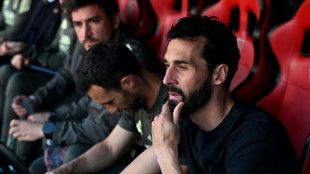 Former Real Madrid coach Arbeloa named Fulham manager
 Messi inspires Argentina great escape over Egypt, Swiss advance

 US strikes Iran after Hormuz attacks, Tehran threatens response

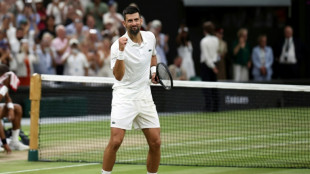
 Djokovic wins five-hour epic to earn Sinner showdown at Wimbledon

 US strikes Iran after Hormuz tanker attacks: military

 Messi 'didn't want to go home' as Argentina comeback stuns Egypt
 Netflix strikes deals in short-form video push
 The height factor: how a small building survived Venezuela's quakes

 Egypt 'cheated' in controversial World Cup exit to Messi's Argentina, says Hassan
 Global AI industry falls short on safety, think tank warns

 'History made': Egyptian pride despite World Cup heartbreak
 How rescuers carried out 180-hour 'miracle' amid Venezuela's ruins
 Victorious Belgian footballers troll Trump with YMCA dance

 Scotland boss Townsend expects Russell will face Springboks
 Messi inspires Argentina great escape over Egypt

 Zverev, Cobolli targeting rematch at Wimbledon
 Colombia president-elect accuses outgoing leader of 'coup' plotting

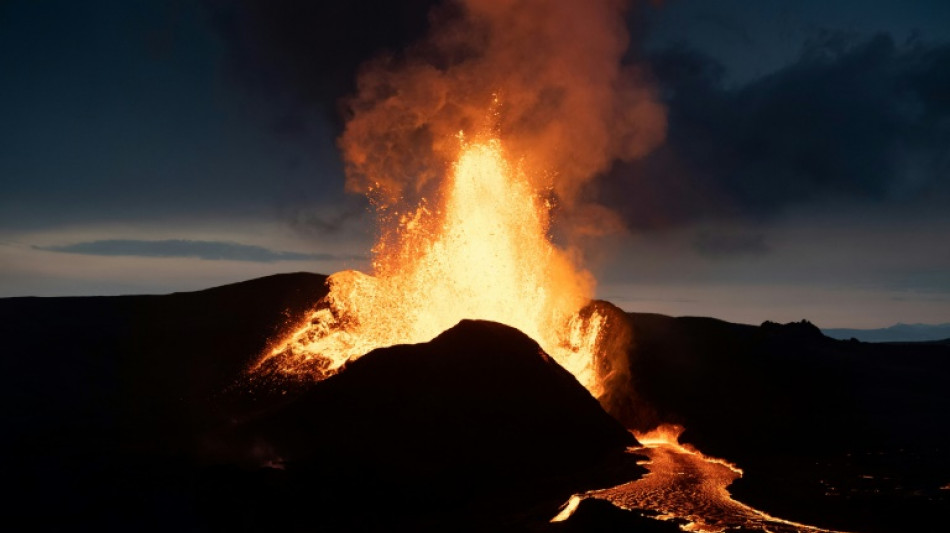
A volcano erupted in Iceland near the capital Reykjavik on Wednesday, the Icelandic Meteorological Office (IMO) said as live images on local media showed lava spewing out of a fissure in the ground.
The eruption was some 40 kilometres (25 miles) from Reykjavik, near the site of the Mount Fagradalsfjall volcano in southwestern Iceland that erupted for six months in March-September 2021, mesmerising tourists and spectators who flocked to the scene.
This time, a strip of glowing red lava could be seen gushing from the ground, spreading into a blanket of smouldering black rock as it cooled and as blue smoke rose up from the hilly landscape on the Reykjanes peninsula.
Curious onlookers quickly made their way to the scene, bewitched by the sight of the bubbling lava and the intense roar that could be heard rising up from the ground as the lava erupted, an AFP reporter at the scene said.
The IMO, which monitors seismic activity, estimated the size of the fissure at about 300 meters (yards). It said the eruption started in the Meradalir valley, less than one kilometre from the scene of last year's eruption.
Wednesday's eruption came after a period of intense seismic activity, with about 10,000 earthquakes detected since Saturday, including two with a magnitude of at least 5.0.
While there was no ash plume, the IMO said it was "possible that pollution can be detected due to the gas release".
Gases from a volcanic eruption -- especially sulphur dioxide -- can be elevated in the immediate vicinity, and may pose a danger to health and even be fatal.
Gas pollution can also be carried by the wind.
"Risk to populated areas and critical infrastructure is considered very low and there have been no disruptions to flights", the Icelandic foreign ministry said on Twitter.
More than an hour after the start of the eruption, a commercial passenger jet could be seen flying over the eruption site at low altitude heading for Reykjavik's main airport Keflavik.
- Tourist magnet -
Last year's eruption saw more than 140 million cubic metres of magma spilled into the area over a period of six months before it was officially declared over after nine months, in December 2021.
Relatively easy to access, the site became a major tourist attraction, drawing more than 350,000 visitors, according to the Icelandic Tourist Board.
On Wednesday, rescue teams and police rushed to the scene of the latest eruption to assess the danger and possible gas contamination, and discouraged people from visiting.
Iceland President Gudni Johannesson, who happened to be driving near the scene of Wednesday's eruption when it occurred, echoed that appeal.
"I just want people to be careful and know more before they go there into the unknown. If this eruption will be anything like the last one, there will be enough time, so there is no need to rush," he told the English-language media Iceland Monitor.
- Awakening -
Mount Fagradalsfjall belongs to the Krysuvik volcanic system on the Reykjanes peninsula in southwestern Iceland.
Iceland has 32 volcanic systems currently considered active, the highest number in Europe. The country has had an eruption every five years on average.
Wednesday's eruption was the country's seventh in 21 years.
However, until last year, the Reykjanes peninsula had not experienced an eruption since the 13th century, when a volcano erupted for 30 years from 1210 to 1240.
After last year's eruption, geophysicists had said it could signal the beginning of a new period of eruptions lasting centuries.
A vast island near the Arctic Circle, Iceland straddles the Mid-Atlantic Ridge, a crack on the ocean floor separating the Eurasian and North American tectonic plates.
The shifting of these plates is in part responsible for Iceland's intense volcanic activity.
L.Janezki--BTB