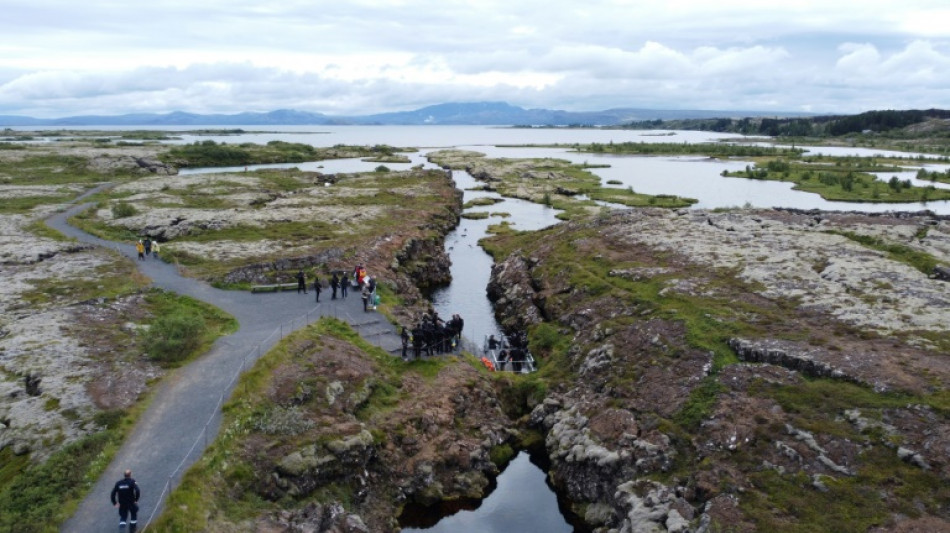
'Incredible' icy dip between two continents in Iceland / Photo: © AFP

 Rescuers search for missing in China storms after 100,000 flee

 OpenAI to launch new model after US freeze

 UK museums at 'sharp end' of climate change challenge

 In Mauritania, Imraguen people's desert-ocean paradise under threat

 Iraq's holy cities host funeral processions for Khamenei

 Rescuers search for missing in China storms after 100,000 evacuated

 Ex-Australia cricketer MacGill loses appeal against cocaine conviction
 Oil prices extend rally as US strikes on Iran revive geopolitical fears

 Iraq's holy cities to host funeral processions for Khamenei
 In Venezuela's quake ruins, a baby is born

 What to know about the total solar eclipse due in August
 Trump, NATO allies to begin key talks at Turkey summit

 Former Real Madrid coach Arbeloa named Fulham manager

 Messi inspires Argentina great escape over Egypt, Swiss advance

 US strikes Iran after Hormuz attacks, Tehran threatens response

 Djokovic wins five-hour epic to earn Sinner showdown at Wimbledon

 US strikes Iran after Hormuz tanker attacks: military

 Messi 'didn't want to go home' as Argentina comeback stuns Egypt

 Netflix strikes deals in short-form video push
 The height factor: how a small building survived Venezuela's quakes

 Egypt 'cheated' in controversial World Cup exit to Messi's Argentina, says Hassan
 Global AI industry falls short on safety, think tank warns

 'History made': Egyptian pride despite World Cup heartbreak

 How rescuers carried out 180-hour 'miracle' amid Venezuela's ruins

 Victorious Belgian footballers troll Trump with YMCA dance

In between North American and Eurasian tectonic plates, Iceland's Silfra fissure is one of the world's most famous dive sites, popular with tourists who venture into its icy waters.
Visibility underwater can exceed 100 metres (330 feet) and the spectacle of light and darkness is hypnotic.
"When we entered the water, it was...," says Icelandic tourist Brynjolfur Bragason before pausing.
"Incredible," adds his wife Hildur Orradottir.
In the heart of Thingvellir National Park, on the edge of one of Iceland's largest lakes, corridors of submerged rocks form deep cavities in between the two continents, which move away from each other by about two centimetres every year.
The orange reflections are mixed with various shades of blue in the more than 60-metre-deep rift, located in the southwestern part of the Atlantic island.
The beige sand and the phosphorescent green of the algae add to the colours.
"It looks like hair," says Camille Lund, a French-American tourist.
- 'Tingling' feeling -
The fissure and the entire surrounding valley lie on the Mid-Atlantic Ridge, which runs through the island, making it one of the most active volcanic areas on Earth.
Silfra was formed by an earthquake more than two centuries ago as a result of a tectonic drift, and the clear waters come from the nearby Langjokull glacier, the second largest ice cap in the country.
Water travels for several decades through a tunnel of underground aquifers around 50 kilometres long.
"This whole filtration system through the volcanic rocks... gives us super clear water," Thomas Gov, a diving instructor from Toulouse in the south of France, told AFP.
Taking a dip in Silfra requires a lot of preparation: dry suit, diving gloves, swimming hat, mask, snorkel and fins.
The equipment allows you to stay dry and float peacefully on the surface in water that stays between two and three degrees Celsius (35.6-37.4 degrees Fahrenheit) all year round.
Only part of the face and hands are exposed to the icy water.
"You can feel it in your lips right away: they go numb after a while and they are like tingling," says New Yorker Ian Zavatti, 13, standing next to his father.
Snorkelling is the most popular activity, but the more experienced and certified can dive with a scuba tank to a depth of 18 metres.
P.Anderson--BTB