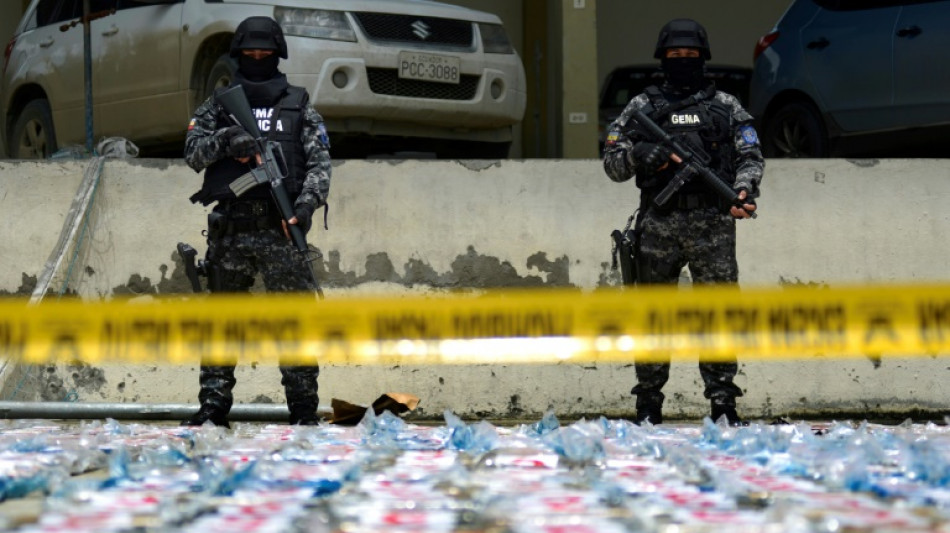
Ecuador terrorized by Mexican-led drug trafficking explosion / Photo: © AFP/File

 Rescuers search for missing in China storms after 100,000 flee

 OpenAI to launch new model after US freeze

 UK museums at 'sharp end' of climate change challenge

 In Mauritania, Imraguen people's desert-ocean paradise under threat
 Iraq's holy cities host funeral processions for Khamenei

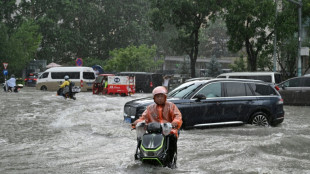 Rescuers search for missing in China storms after 100,000 evacuated

 Ex-Australia cricketer MacGill loses appeal against cocaine conviction
 Oil prices extend rally as US strikes on Iran revive geopolitical fears

 Iraq's holy cities to host funeral processions for Khamenei
 In Venezuela's quake ruins, a baby is born

 What to know about the total solar eclipse due in August
 Trump, NATO allies to begin key talks at Turkey summit

 Former Real Madrid coach Arbeloa named Fulham manager

 Messi inspires Argentina great escape over Egypt, Swiss advance

 US strikes Iran after Hormuz attacks, Tehran threatens response

 Djokovic wins five-hour epic to earn Sinner showdown at Wimbledon

 US strikes Iran after Hormuz tanker attacks: military

 Messi 'didn't want to go home' as Argentina comeback stuns Egypt

 Netflix strikes deals in short-form video push

 The height factor: how a small building survived Venezuela's quakes

 Egypt 'cheated' in controversial World Cup exit to Messi's Argentina, says Hassan
 Global AI industry falls short on safety, think tank warns

 'History made': Egyptian pride despite World Cup heartbreak

 How rescuers carried out 180-hour 'miracle' amid Venezuela's ruins

 Victorious Belgian footballers troll Trump with YMCA dance

Once a relatively peaceful neighbor of major cocaine producers Colombia and Peru, Ecuador has become a battleground for criminal gangs looking to control the drug trafficking trade, analysts and authorities say.
The violence is grim and takes multiple forms: car bombs, prison massacres and bodies hanging from bridges have become commonplace. Decapitated heads are found in the streets.
The South American country of 18 million -- which for years was merely a transit point in the narcotics trade -- has become a "sanctuary for organized crime," former military intelligence chief Mario Pazmino told AFP.
"The explosions and assassinations that we see are messages of terror to tell us that they, not the police, control a strategic area," he added.
In 2020, Ecuador ranked third behind Colombia and the United States in terms of the amount of cocaine seized, accounting for 6.5 percent of the global total, according to the UN Office against Drugs and Crime.
Hundreds of tons of cocaine leave its ports every year to be distributed around the world, although most of it heads to the United States and Belgium.
In a 2019 report, Ecuadoran intelligence said there were at least 26 criminal gangs fighting for control of the lucrative market, but officials now say that number could have risen. Many of those criminal groups work with Mexican cartels.
And as drug trafficking activity intensifies, so too does criminality.
Ecuador's murder rate in 2021 was 14 per 100,000 inhabitants, almost double that of the previous year, according to the interior ministry.
- Criminals 'deviated to drug trafficking' -
To understand how drug trafficking mutated in Ecuador, one must look back to the start of the 2000s.
"In those years, Ecuador began a tough campaign to eradicate coca plantations," explained Pazmino.
Coca leaf is the main ingredient used to make cocaine.
But just like in other countries, the initiative failed -- whenever authorities would destroy crops, growers would simply move to a new area and start again.
A decade later, Ecuador even registered a record area of coca plantations.
The failed anti-drugs policy encouraged Mexican cartels such as the Sinaloa, Gulf Clan and Los Zetas to move into Ecuador, just as they had already done in Colombia.
Ecuador's dollarized economy facilitated the cocaine trade, allowing for easy money laundering of profits, while weak institutions and criminal groups ready to cooperate created a perfect opportunity to cash in for those involved.
At the origin of the Mexican infiltration was Jorge Luis Zambrano, known as 'Rasquina' and the leader of the Los Choneros gang, according to former prisons director Alexandra Zumarraga.
In 2010, Zambrano offered protection to the Sinaloa cartel, which burst into the strategically located coastal province of Manabi.
There were also "members of the Latin Kings and Netas gangs ... who turned to drug trafficking," said a human rights activist who works with youth groups and requested anonymity due to death threats.
For Martha Macias, the former director of Guayaquil's biggest penitentiary, "the drug traffickers of today are the grandchildren of the Latin Kings and Netas who operated in Quito and Guayaquil, and focused on robberies and contract killings."
The prison formerly run by Macias is where the majority of prison massacres since February 2021 have taken place, leaving almost 400 inmates dead.
Rival drug cartels often operate from within the prison walls, meaning their turf wars can unfold on the inside.
- 'They saw an opportunity' -
Until his murder in 2020, Zambrano was the overall leader of Ecuador's criminal gangs, which according to authorities counted up to 25,000 members -- in a country that has just 50,000 police.
His slaying sparked a leadership battle both inside and outside the prisons.
With the proliferation of organized crime, some local gangs, such as the Lobos and Los Tiguerones, morphed into micro-cartels.
"They saw an opportunity, buying drugs and processing them in the country, to then export them," said Pazmino.
Both gangs work with Mexico's Jalisco New Generation cartel, and have been responsible for deadly prison riots.
Since the start of 2021, some 300 tons of drugs have been confiscated in Ecuador, Interior Minister Patricio Carrillo said.
But authorities are struggling to keep up with the cartels' expanding business.
Less than 30 percent of the drugs passing through Ecuador's ports and airports are seized, despite a record 210 tons being impounded last year.
"Around 700 tons of cocaine a year comes into Ecuador from neighboring countries" Colombia and Peru, said Pazmino.
A.Gasser--BTB