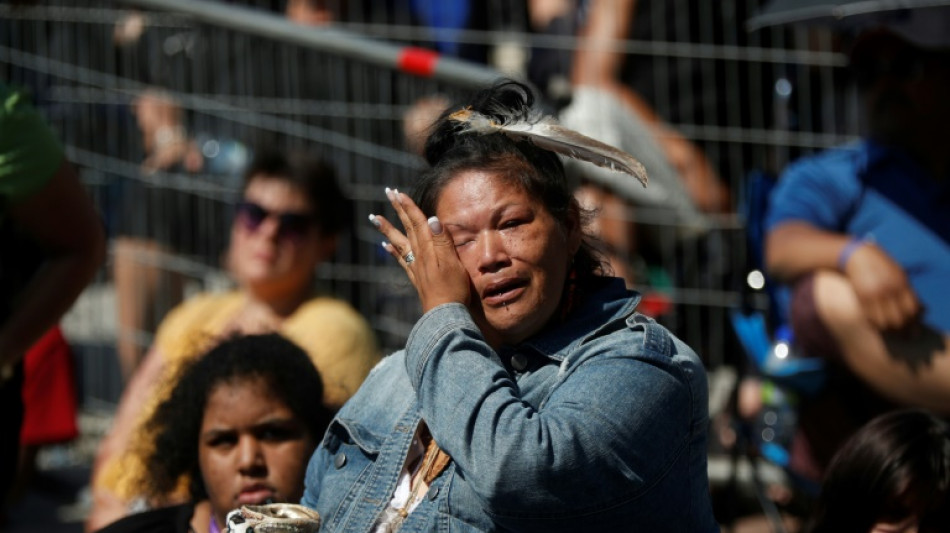
For abuse survivors struggling to heal, Pope's visit to Canada 'not enough' / Photo: © AFP

 Rescuers search for missing in China storms after 100,000 flee
 OpenAI to launch new model after US freeze
 UK museums at 'sharp end' of climate change challenge
 In Mauritania, Imraguen people's desert-ocean paradise under threat
 Iraq's holy cities host funeral processions for Khamenei
 Rescuers search for missing in China storms after 100,000 evacuated

 Ex-Australia cricketer MacGill loses appeal against cocaine conviction
 Oil prices extend rally as US strikes on Iran revive geopolitical fears
 Iraq's holy cities to host funeral processions for Khamenei
 In Venezuela's quake ruins, a baby is born

 What to know about the total solar eclipse due in August
 Trump, NATO allies to begin key talks at Turkey summit
 Former Real Madrid coach Arbeloa named Fulham manager
 Messi inspires Argentina great escape over Egypt, Swiss advance
 US strikes Iran after Hormuz attacks, Tehran threatens response
 Djokovic wins five-hour epic to earn Sinner showdown at Wimbledon
 US strikes Iran after Hormuz tanker attacks: military
 Messi 'didn't want to go home' as Argentina comeback stuns Egypt
 Netflix strikes deals in short-form video push
 The height factor: how a small building survived Venezuela's quakes
 Egypt 'cheated' in controversial World Cup exit to Messi's Argentina, says Hassan
 Global AI industry falls short on safety, think tank warns

 'History made': Egyptian pride despite World Cup heartbreak
 How rescuers carried out 180-hour 'miracle' amid Venezuela's ruins
 Victorious Belgian footballers troll Trump with YMCA dance
As Pope Francis in his vestments prepared to celebrate mass inside a Canadian shrine on Thursday, a young Indigenous woman stood outside in a bright orange beaded dress stitched with dozens of tiny metallic cones.
Abigail Brooks is a jingle dress dancer -- an Indigenous woman whose dancing while wearing the traditional dress is believed to carry healing powers.
"It's very important to be here especially in my jingle dress to offer strength, and any emotional and traditional support that our survivors and elders will need," the 23-year-old told AFP outside Sainte-Anne-de-Beaupre, on the banks of the St Lawrence River in Quebec, in eastern Canada.
Thousands of mainly Indigenous people gathered to see the pope there. Nearby, volunteers burned sage leaves before waving the smoke with feathers, a traditional ritual to heal psychological trauma. A healer recited incantations and held a woman's arm, while a tear rolled down her cheek.
Healing has been a major theme of the pope's visit to Canada this week, where he has begged forgiveness from the country's First Nations, Metis and Inuit people for decades of abuse at Catholic-run schools.
For nearly a century, up until the 1990s, Canada's government sent some 150,000 Indigenous children into Church-run residential schools, where they were cut off from their families, language and culture.
The point was to stamp out their Indigenous identity. On top of the trauma of separation many children endured physical and sexual abuse, and thousands are believed to have died of disease, malnutrition or neglect.
The trauma has lingered for generations. The pope's apology, for many, has been overwhelming.
"It's been a shared experience of a release of emotion," 19-year-old Wocawson told AFP at Sainte-Anne-de-Beaupre, describing "lots of tears, you know, lots of anger, but... lots of love. It's beautiful."
"The truth is out in the open with all the accumulated suffering. Everyone has lived too long in shame," said Ghislain Picard, regional chief of the Assembly of First Nations of Quebec-Labrador.
But for many, including Brooks, the apology is "not enough."
"Nothing was said about the sexual abuses," she said. "We can't accept reconciliation until he acknowledges that."
She also called for Indigenous people to be allowed access to records of what happened in the schools to "really understand the depth of what happened to our people" -- and for the pope to return Indigenous artefacts currently held by the Vatican Museums.
"That's going to be a part of reconciliation, to give us back what's ours," Brooks says.
- 'It won't heal me' -
The young dancer is not alone in her demands. Over and over again, Indigenous people have made clear that they see the pope's visit as only the beginning.
In one of the most dramatic images of his trip so far, as the pope began celebrating mass in Sainte-Anne-de-Beaupre Wednesday, demonstrators unfurled a banner just in front of the altar behind which he stood.
It read "Rescind the doctrine" -- referring to the Doctrine of Discovery, the 15th century papal edicts that empowered European powers to colonize non-Christian lands and people.
Everywhere the pope has gone in Canada, voices have called out for it to be lifted.
The writing on the banner was facing away from the pontiff, and it was calmly removed shortly after.
Francis has made no public mention yet of the doctrine, the artefacts or sexual abuse on his trip.
But Prime Minister Justin Trudeau released a statement Thursday saying he had discussed with the pope the need for the Church "to take concrete action to repatriate Indigenous artefacts, provide access to residential schools documents, address the Doctrine of Discovery."
He did not give further details, and while the pope has spoken of his "deep shame" and his "firm desire to respond" to Indigenous suffering, it was unclear what further steps he might take.
For some, perhaps there is no way through the devastation.
Jimmy Papatie, a 58-year-old survivor of one of the schools, spoke to AFP through tears.
"I have lived my whole life in fear because of what I experienced at the residential school," he said by telephone from his home in Quebec.
"I am convinced that I will never heal... the Pope's visit -- if people need to hear it, fine. But it won't heal me."
Brooks, the dancer, says her dress was "specifically made for our survivors and the ones that didn't come home."
"Each jingle that we tie, we pray for our survivors," she said.
"It's a very powerful dress."
C.Meier--BTB