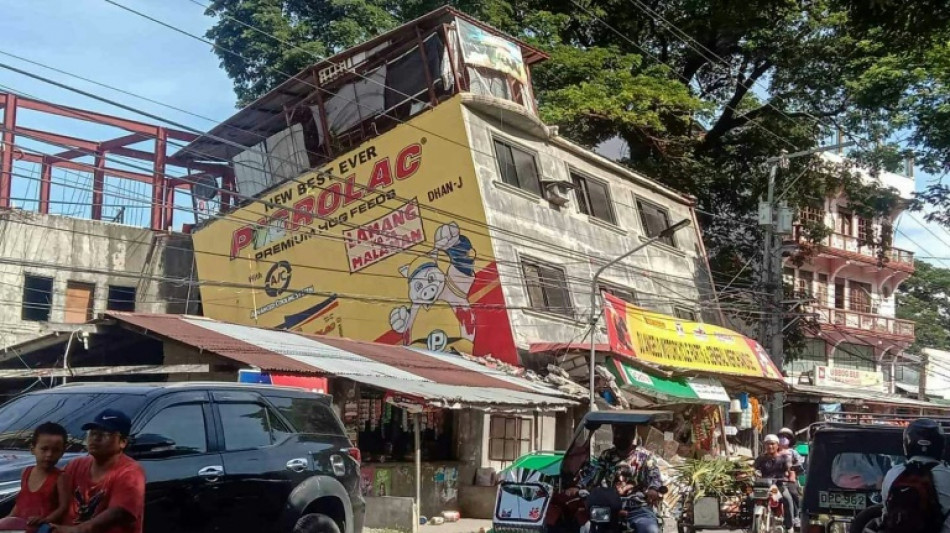
Hundreds of aftershocks shake earthquake-hit northern Philippines / Photo: © Office of Abra Representative Ching Bernos/AFP

 Rescuers search for missing in China storms after 100,000 flee

 OpenAI to launch new model after US freeze

 UK museums at 'sharp end' of climate change challenge
 In Mauritania, Imraguen people's desert-ocean paradise under threat

 Iraq's holy cities host funeral processions for Khamenei

 Rescuers search for missing in China storms after 100,000 evacuated

 Ex-Australia cricketer MacGill loses appeal against cocaine conviction
 Oil prices extend rally as US strikes on Iran revive geopolitical fears

 Iraq's holy cities to host funeral processions for Khamenei
 In Venezuela's quake ruins, a baby is born

 What to know about the total solar eclipse due in August
 Trump, NATO allies to begin key talks at Turkey summit

 Former Real Madrid coach Arbeloa named Fulham manager

 Messi inspires Argentina great escape over Egypt, Swiss advance

 US strikes Iran after Hormuz attacks, Tehran threatens response

 Djokovic wins five-hour epic to earn Sinner showdown at Wimbledon

 US strikes Iran after Hormuz tanker attacks: military

 Messi 'didn't want to go home' as Argentina comeback stuns Egypt

 Netflix strikes deals in short-form video push
 The height factor: how a small building survived Venezuela's quakes

 Egypt 'cheated' in controversial World Cup exit to Messi's Argentina, says Hassan
 Global AI industry falls short on safety, think tank warns

 'History made': Egyptian pride despite World Cup heartbreak

 How rescuers carried out 180-hour 'miracle' amid Venezuela's ruins
 Victorious Belgian footballers troll Trump with YMCA dance

Anxious residents slept outside after hundreds of aftershocks rattled the earthquake-hit northern Philippines, locals said Thursday, as President Ferdinand Marcos Jr flew to the region to inspect the damage.
Five people were killed and more than 150 injured when a 7.0-magnitude quake struck the lightly populated province of Abra on Wednesday morning, authorities said.
The powerful quake rippled across the mountainous region, toppling buildings, triggering landslides and shaking high-rise towers hundreds of kilometres away in the capital Manila.
"Aftershocks happen almost every 20 minutes, 15 minutes since yesterday," said Reggi Tolentino, a restaurant owner in Abra's provincial capital Bangued.
"Many slept outside last night, almost every family."
Hundreds of buildings were damaged or destroyed, roads were blocked by landslides and power was knocked out in affected provinces.
But in Abra, which felt the full force of the quake, overall damage had been "very minimal", police chief Colonel Maly Cula told AFP.
"We don't have a lot of people in evacuation sites although many people are staying in the streets because of the aftershocks," Cula said.
"Abra is back to normal."
More than 800 aftershocks have been recorded since the quake hit, including 24 that were strong enough to feel, the local seismological agency said.
In Vigan City, a UNESCO World Heritage site and tourist destination in Ilocos Sur province, centuries-old structures built during the Spanish colonial period were damaged.
Governor Jeremias Singson told Teleradyo that 460 buildings in the province had been affected, including the Bantay Bell Tower, which partially crumbled.
"Our tourism industry and small business owners were really affected," Singson said.
The Philippines is regularly rocked by quakes due to its location on the Pacific "Ring of Fire", an arc of intense seismic activity that stretches from Japan through Southeast Asia and across the Pacific basin.
Wednesday's quake was one of the strongest recorded in the Philippines in recent years and was felt across swathes of Luzon island, the most populous in the archipelago.
In October 2013, a magnitude 7.1 earthquake struck Bohol Island in the central Philippines, killing more than 200 people and triggering landslides.
Old churches in the birthplace of Catholicism in the Philippines were badly damaged. Nearly 400,000 were displaced and tens of thousands of houses were damaged.
The powerful quake altered the island's landscape and a "ground rupture" pushed up a stretch of earth by about three metres, creating a wall of rock above the epicentre.
In 1990, a 7.8-magnitude earthquake in the northern Philippines created a ground rupture stretching over a hundred kilometres.
Fatalities were estimated to reach over 1,200, with major damage to buildings in Manila.
L.Janezki--BTB