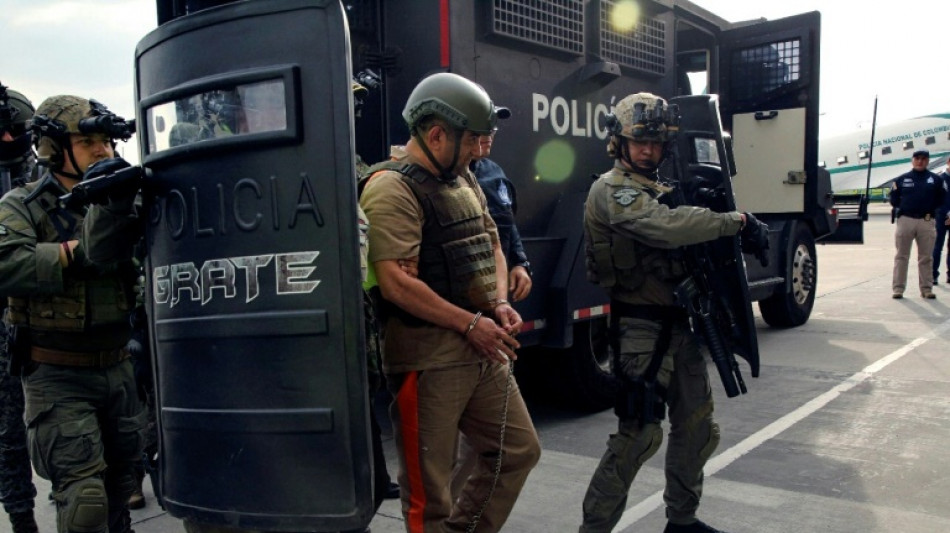
Cartel steps up police attacks as Colombia power transfer nears / Photo: © Colombian Presidency/AFP/File

 Rescuers search for missing in China storms after 100,000 flee

 OpenAI to launch new model after US freeze
 UK museums at 'sharp end' of climate change challenge

 In Mauritania, Imraguen people's desert-ocean paradise under threat
 Iraq's holy cities host funeral processions for Khamenei
 Rescuers search for missing in China storms after 100,000 evacuated
 Ex-Australia cricketer MacGill loses appeal against cocaine conviction
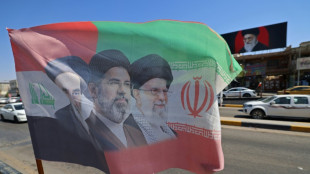 Oil prices extend rally as US strikes on Iran revive geopolitical fears

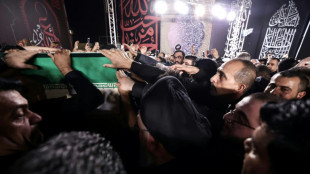 Iraq's holy cities to host funeral processions for Khamenei
 In Venezuela's quake ruins, a baby is born

 What to know about the total solar eclipse due in August
 Trump, NATO allies to begin key talks at Turkey summit
 Former Real Madrid coach Arbeloa named Fulham manager
 Messi inspires Argentina great escape over Egypt, Swiss advance
 US strikes Iran after Hormuz attacks, Tehran threatens response
 Djokovic wins five-hour epic to earn Sinner showdown at Wimbledon

 US strikes Iran after Hormuz tanker attacks: military

 Messi 'didn't want to go home' as Argentina comeback stuns Egypt
 Netflix strikes deals in short-form video push
 The height factor: how a small building survived Venezuela's quakes
 Egypt 'cheated' in controversial World Cup exit to Messi's Argentina, says Hassan
 Global AI industry falls short on safety, think tank warns

 'History made': Egyptian pride despite World Cup heartbreak
 How rescuers carried out 180-hour 'miracle' amid Venezuela's ruins

 Victorious Belgian footballers troll Trump with YMCA dance
A dozen police officers have been killed, and dozens more injured in recent weeks by Colombia's most powerful drug gang, the Gulf Clan.
The group has been sowing terror in the country since May, when its boss Dario Antonio Usuga, known as "Otoniel," was extradited to the United States to face trafficking charges.
But those attacks have intensified even more recently as Colombia approaches the transfer of power on August 7 from conservative President Ivan Duque to leftist former guerrilla Gustavo Petro, who has vowed to negotiate with criminal gangs in a bid to end a decades-long conflict in exchange for more lenient sanctions.
"They are (carrying out attacks) with the sole intention of positioning themselves for political negotiations. This cannot be accepted," warned Defense Minister Diego Molano.
Since the beginning of the year, 25 police officers have been killed by the Gulf Clan, almost half of them in the last month, according to officials. Another 60 officers have been injured in dozens of attacks using firearms and explosives.
And three police officers were killed just this week in separate attacks by suspected gang members, according to officials.
"They attack patrols from behind ... it's unacceptable," said Molano.
Officials say the Gulf Clan, which is made up of former members of right-wing paramilitaries, has launched an "armed strike" following Otoniel's extradition.
According to police, the Clan is offering between $1,000 and $5,000 for each murder of a member of the security forces.
It's a tactic reminiscent of that used by late cocaine kingpin Pablo Escobar in the 1990s as part of his "pistol plan" open war against the state.
At least five Clan members have been killed and a dozen captured in the police counter-offensive.
- Potential surrender -
Since the historic victory by a left-wing candidate in June's presidential election run-off, security forces have been targeted in 75 attacks by Clan members and other groups, according to the Center for Conflict Analysis Resources (CERAC).
The clan "is escalating violence to present itself, in an eventual negotiation, as a group that can offer de-escalation," CERAC director Jorge Restrepo told AFP.
Otoniel had indicated in 2018 that he was willing to turn himself in and Colombia's then-president Juan Manuel Santos, who had won the Nobel Peace Prize for signing a peace deal with the Revolutionary Armed Forces of Colombia rebels, began organizing the process.
But it never came to fruition and the Clan continued to traffic cocaine.
When authorities captured the drug lord in October after months of hunting him through the jungle, Duque declared the end of the Gulf Clan, but the cartel has since been more active than ever.
According to independent estimates, the Clan can count on 3,000 fighters and collaborators.
Last week, a letter began circulating in which the Clan and other armed groups involved in the cocaine trade declared they were ready to call a ceasefire on August 7 ahead of an eventual disarmament.
Authorities have not confirmed the authenticity of the letter, but foreign minister-elect Alvaro Leyva said he was aware of the document.
However, a collective surrender seems far-fetched "unless there is a big enough incentive for these groups to turn themselves in ... something that would allow them to avoid extradition or keep their wealth," said Restrepo.
Petro has also opened up the possibility of suspending the extradition of drug-traffickers that "peacefully dismantle" their operations.
He has admitted, though, that it depends on "a negotiation with the United States," which has not commented on the possibility.
Despite almost five decades fighting drug trafficking together with American authorities, Colombia remains the world's largest producer of cocaine, and the United States its biggest consumer.
A.Gasser--BTB