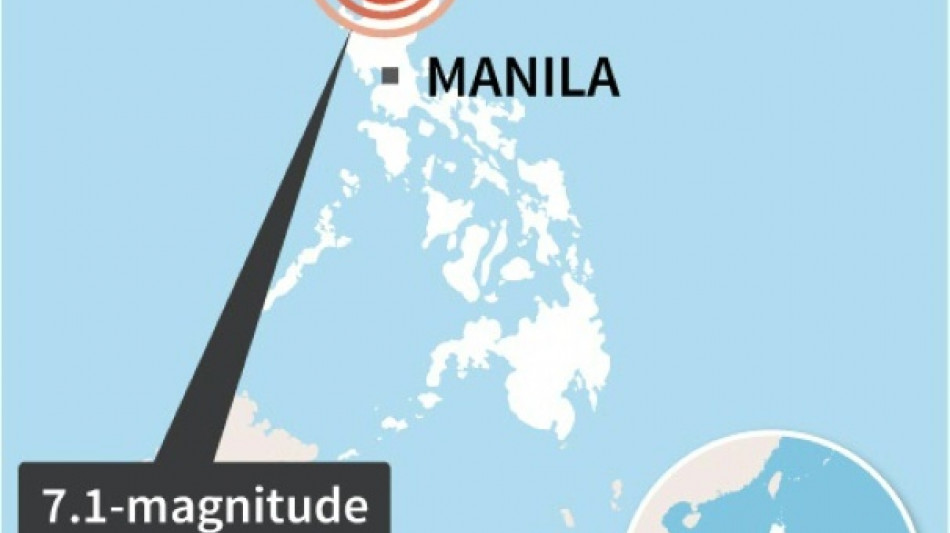
7.1-magnitude earthquake hits northern Philippines: USGS / Photo: © AFP

 Rescuers search for missing in China storms after 100,000 flee

 OpenAI to launch new model after US freeze

 UK museums at 'sharp end' of climate change challenge
 In Mauritania, Imraguen people's desert-ocean paradise under threat

 Iraq's holy cities host funeral processions for Khamenei

 Rescuers search for missing in China storms after 100,000 evacuated

 Ex-Australia cricketer MacGill loses appeal against cocaine conviction
 Oil prices extend rally as US strikes on Iran revive geopolitical fears

 Iraq's holy cities to host funeral processions for Khamenei
 In Venezuela's quake ruins, a baby is born

 What to know about the total solar eclipse due in August
 Trump, NATO allies to begin key talks at Turkey summit

 Former Real Madrid coach Arbeloa named Fulham manager

 Messi inspires Argentina great escape over Egypt, Swiss advance

 US strikes Iran after Hormuz attacks, Tehran threatens response

 Djokovic wins five-hour epic to earn Sinner showdown at Wimbledon

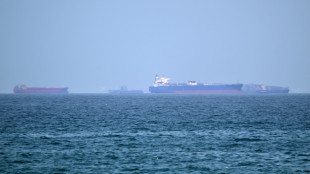 US strikes Iran after Hormuz tanker attacks: military

 Messi 'didn't want to go home' as Argentina comeback stuns Egypt

 Netflix strikes deals in short-form video push

 The height factor: how a small building survived Venezuela's quakes

 Egypt 'cheated' in controversial World Cup exit to Messi's Argentina, says Hassan
 Global AI industry falls short on safety, think tank warns

 'History made': Egyptian pride despite World Cup heartbreak

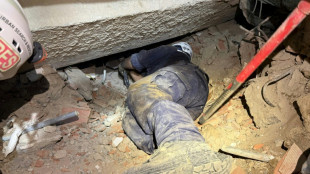 How rescuers carried out 180-hour 'miracle' amid Venezuela's ruins
 Victorious Belgian footballers troll Trump with YMCA dance

A 7.1-magnitude earthquake hit the northern Philippines Wednesday, the US Geological Survey said, shattering windows of buildings at the epicentre and shaking high-rise towers more than 300 kilometres (185 miles) away in the capital Manila.
The shallow but powerful quake struck the mountainous and lightly populated province of Abra on the main island of Luzon at 8:43 am (0043 GMT), the USGS said, after initially measuring the quake at 6.8 magnitude.
Shallow earthquakes tend to cause more damage than deeper ones.
In Dolores, which felt the full force of the quake, terrified people ran outside their buildings and windows of the local market were shattered, Police Major Edwin Sergio told AFP.
"The quake was very strong," Sergio said, adding there were minor cracks in the police station building.
"Vegetables and fruits sold in the market were also disarranged after tables were toppled."
A video posted on Facebook and verified by AFP showed cracks in the asphalt road and ground in the nearby town of Bangued, but there was no visible damage to shops or houses.
A number of people were injured in Bangued and taken to hospital for treatment, police chief Major Nazareno Emia told AFP.
University student Mira Zapata was in her house in San Juan town when she felt "really strong shaking".
"We started shouting and rushed outside," she said, as aftershocks continued.
"Our house is ok but houses down the hill were damaged."
- Ring of Fire -
The Philippines is regularly rocked by quakes due to its location on the Pacific "Ring of Fire", an arc of intense seismic activity that stretches from Japan through Southeast Asia and across the Pacific basin.
Wednesday's quake was the strongest recorded in the Philippines in years.
In October 2013, a magnitude 7.1 earthquake struck Bohol Island in the central Philippines, killing over 200 people and triggering landslides.
Old churches in the birthplace of Catholicism in the Philippines were badly damaged. Nearly 400,000 were displaced and tens of thousands of houses were damaged.
The powerful quake altered the island's landscape and a "ground rupture" pushed up a stretch of ground by up to three meters, creating a wall of rock above the epicentre.
In 1990, a magnitude 7.8 earthquake in the northern Philippines created a ground rupture stretching over a hundred kilometres.
Fatalities were estimated to reach over 1,200 and caused major damage to buildings in Manila.
The nation's volcanology and seismology institute regularly holds quake drills, simulating scenarios in the nation's active fault lines.
During major earthquakes, the agency said people would find it difficult to stand on upper floors, trees could shake strongly, heavy objects and furniture may topple and large church bells may ring.
N.Fournier--BTB