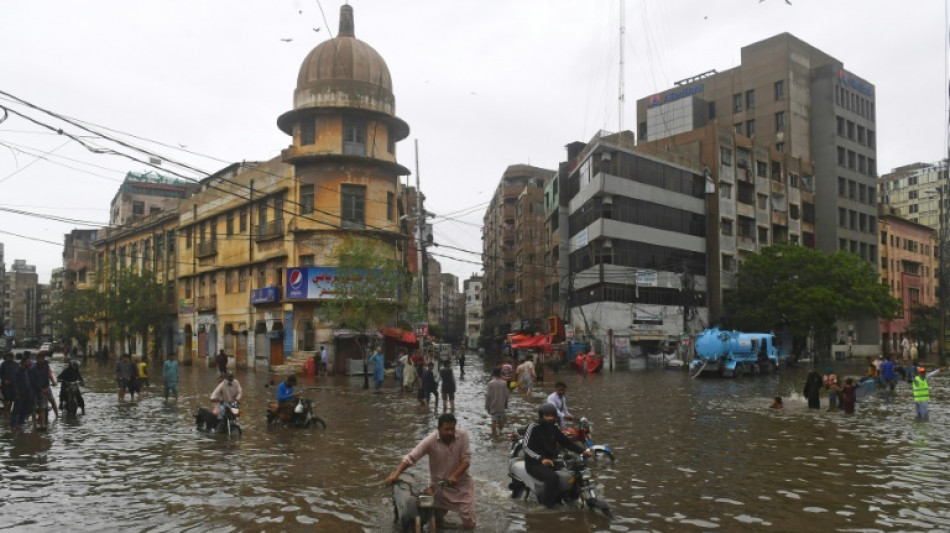
Misery for millions as monsoon pounds Pakistan port city / Photo: © AFP

 Rescuers search for missing in China storms after 100,000 flee

 OpenAI to launch new model after US freeze

 UK museums at 'sharp end' of climate change challenge

 In Mauritania, Imraguen people's desert-ocean paradise under threat

 Iraq's holy cities host funeral processions for Khamenei

 Rescuers search for missing in China storms after 100,000 evacuated

 Ex-Australia cricketer MacGill loses appeal against cocaine conviction
 Oil prices extend rally as US strikes on Iran revive geopolitical fears

 Iraq's holy cities to host funeral processions for Khamenei
 In Venezuela's quake ruins, a baby is born

 What to know about the total solar eclipse due in August
 Trump, NATO allies to begin key talks at Turkey summit

 Former Real Madrid coach Arbeloa named Fulham manager

 Messi inspires Argentina great escape over Egypt, Swiss advance

 US strikes Iran after Hormuz attacks, Tehran threatens response

 Djokovic wins five-hour epic to earn Sinner showdown at Wimbledon

 US strikes Iran after Hormuz tanker attacks: military

 Messi 'didn't want to go home' as Argentina comeback stuns Egypt
 Netflix strikes deals in short-form video push
 The height factor: how a small building survived Venezuela's quakes

 Egypt 'cheated' in controversial World Cup exit to Messi's Argentina, says Hassan
 Global AI industry falls short on safety, think tank warns

 'History made': Egyptian pride despite World Cup heartbreak

 How rescuers carried out 180-hour 'miracle' amid Venezuela's ruins

 Victorious Belgian footballers troll Trump with YMCA dance

Shazad Akbar carried his four-year-old daughter on his shoulders Tuesday as he and his wife waded through knee-high water flooding a street in Surjani, a poor part of Pakistan's port city of Karachi.
His wife fell sick overnight, but Akbar couldn't take her to a doctor as heavy monsoon rains fell until morning, causing misery for the city of 15 million.
"I can only manage to come out now," Shazad told AFP as his burqa-clad wife hid behind him.
The monsoon, which usually lasts from June to September, is essential for irrigating crops and replenishing lakes and dams across the Indian subcontinent, but also brings a wave of destruction each year.
This year's monsoon is being felt hardest in cities, where poor infrastructure and services lead to clogged drains and culverts -- and the collapse of the sewage system.
The result is widespread flooding, particularly in low-lying areas, and usually in poor neighbourhoods.
In Rahim Goth, a slum in the west of the city, locals were attempting to bail water from their shacks and dwellings using buckets, pots and jugs.
But their efforts appeared futile as they tipped the contents into streets already several feet deep.
- Climate change -
Sardar Sarfaraz, director of the Pakistan Meteorological Department, told AFP an "unprecedented" 568 millimetres (22.3 inches) of rain had fallen in the city this month -- nearly triple Karachi's recent averages and more than four times that of two decades ago.
Environmentalist Arif Zubair conceded monsoons can regularly cause natural havoc, but is clear what is to blame for the worsening situation -- climate change.
"(It) has engulfed all of South and Southeast Asia," he told AFP Tuesday.
"The recent (heavy) rains have certainly been an indicator of global climate change."
Pakistan ranks eighth on a list of countries most vulnerable to extreme weather caused by climate change, according to the environment NGO Germwatch.
But the effects of climate change are also exacerbated by the mismanagement and negligence of authorities and policymakers, who critics accuse of being oblivious to the problems ahead.
Coastal Karachi is particularly prone to flooding because the city has expanded with scant planning on a landscape ill-suited to urban development.
"We are sitting on a climate bomb," Arif said.
Over 300 people have died as a result of the heavy monsoon rains this year, which have also washed away more than 600 kilometres (375 miles) of roads and 50 bridges, according to the National Disaster Management Authority (NDMA).
It said more than 10,000 homes had been damaged -- with Baluchistan province the worst hit.
In Rahim Goth, many residents have moved to rooftops to escape the flooding, stretching tarpaulin between poles to give them shelter from the incessant rain.
"People (officials) come every year to inquire about us, but every year we are doomed," Afsari Bano told AFP as she tried to cook a family meal.
She said most of the family's belongings -- furniture, bedding and other possessions -- were destroyed by flooding two years ago, and they were only just recovering.
Now she was surrounded by water in which floated soiled nappies and other garbage.
"Swarms of flies and mosquitos will follow now," the 50-year housewife said.
"If someone dies -- Allah forbid as life and death is in his hand -- it is next to impossible to hold a funeral."
M.Furrer--BTB