Exiled Tibetans choose leaders for lost homeland / Photo: © AFP/File

 Dodgers return to Trump White House despite fan anger

 Lyles, Richardson ease into 100m semis at US athletics championships
 Salman Rushdie testifies at knife attacker's US terror trial

 World Bank confirms plan to phase out China lending by 2031
 US panel backs trendy peptides despite safety concerns

 Justice Dept withdraws NY Times subpoenas over Trump plane report

 Barcelona's De Jong returns from World Cup with torn ligament
 Albania police teargas protesters against Trump-linked resort

 US panel says to loosen restrictions on popular peptide despite safety concerns

 Verstappen swerves around future questions
 EU renews online child sex abuse detection powers

 Airbus, Boeing fly in different directions at Farnborough

 Bab al-Mandeb Strait: another key oil shipping route under threat

 Deadly wildfires in Europe force thousands to flee

 NATO to overhaul European fuel pipeline network

 US trade envoy to make tariff announcement as 10% duty soon expires

 Trump stuns Saudis by pinning nuclear deal to Israel ties

 Tough day for Ubisoft stock topped with weaker revenues

 Swelling jet fuel costs hit American Airlines outlook
 Carapaz climbs unopposed to Tour de France 18th stage win

 Sooryavanshi hits maiden 50 as India thump Zimbabwe in T20

 ECB opens door to September rate-hike as Iran war flares up

 World Bank estimates Venezuela quakes caused $19.6 bn in damage
 Italy's far-right line up to defend jeweller who killed robbers

 AI-led boom in IPOs raises concerns about a bust

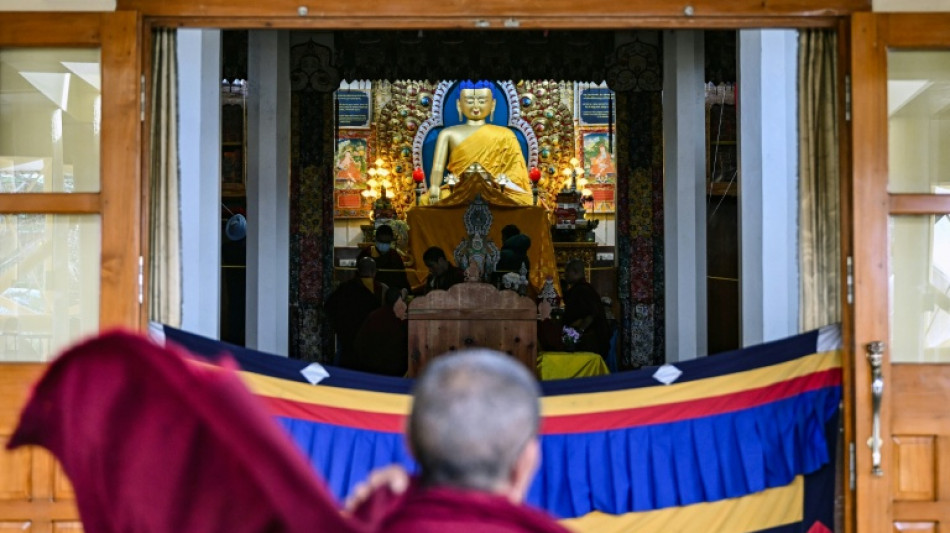
Exiled Tibetans began a unique global election on Sunday for a government representing a homeland many have never seen, as part of a democratic exercise voters say carries great weight.
From red-robed Buddhist monks in the snowy Himalayas, to political exiles in megacities across South Asia, to refugees in Australia, Europe and North America, voting will take place in 27 countries -- but not China.
"Elections... show that the struggle for Tibet's freedom and independence continues from generation to generation," said candidate Gyaltsen Chokye, 33, based in the Indian hill-town of Dharamsala, headquarters of the government-in-exile, the Central Tibetan Administration (CTA).
It is an electoral system unlike any other, a vote for a parliament without a state.
Beijing, which in 1950 sent troops to the vast high-altitude plateau it calls an integral part of China, condemned the elections as a "farce".
"The so-called 'Tibetan government-in-exile' is nothing but a separatist political group," China's foreign ministry said in a written statement to AFP.
"It is an illegal organisation that completely violates the Chinese constitution and laws."
The 91,000 registered voters reject that view.
Many see the vote as the most consequential democratic moment for them since their revered Buddhist spiritual leader, the Dalai Lama -- who celebrated his 90th birthday last year -- fled Chinese rule in 1959.
"These elections show that political agency exists even without a state, especially when democratic participation is denied inside Tibet," said Sonam Palmo, 38, from Switzerland's University of Zurich, who helps run Smartvote Tibet, a website helping the diaspora select candidates.
"They underscore the resilience and shared purpose of the exile community at a decisive moment."
Exiled voters represent only a fraction of ethnic Tibetans -- whom the CTA estimates at six million worldwide, compared with more than seven million China counted in its 2020 census.
- 'Tibetan cause' -
The five-year parliament, which sits twice a year, has 45 members: 30 representing three traditional provinces, 10 representing five religious traditions, and five representing the diaspora.
Sunday's vote will select candidates ahead of a final round on April 26, with results due May 13.
Voters will cast paper ballots, with Election Commission chief Lobsang Yeshi alleging "past attempts by China to interfere with and disrupt Tibetan elections", including "cyber-espionage".
It is a key institution for the exiles, especially after the Dalai Lama handed over political power in 2011.
The Nobel Peace Prize laureate insists he has many more years to live, but Tibetans are preparing for an inevitable future without him. China insists it will have the final say over who succeeds him.
"The advancing age of His Holiness is, without question, a matter of deep concern for all Tibetans," said US-basedTenzin Namgyal Tethong, 78, a former Tibetan government leader.
"The most important thing we can do during this time is to safeguard everything we have achieved under his guidance."
Elections come as the diaspora community grapples with changing identities driven by generational shift and geographic dispersion, as well as geopolitical change.
While punishing US aid cuts in 2025 were partially reversed, concerns about donor dependence persist, including reliance on host India and how this intersects with New Delhi's relationship with China -- once icy, now gradually easing.
"Given the shifting foreign policy priorities of the US administration, and China's expanding influence in global affairs, there is little doubt that we may see major changes", Namgyal told AFP.
"We cannot predict how harmful these shifts may be for the Tibetan cause."
- 'Freedom struggle' -
More than half of voters, about 56,000, live in India, Nepal and Bhutan. The remaining 34,000 are scattered around the world, including roughly 12,000 in North America -- including New York and Toronto -- and 8,000 in Europe, including Paris, Geneva, Zurich and London.
"The stakes are too high to risk choosing ineffective leadership," said Kunga Choekey, 24, a voter based in India's town of Dehradun.
Voters will also elect the government's "sikyong", or leader.
Current sikyong, Penpa Tsering, is seeking a second term. Like many, he does not seek full independence for Tibet, in line with the Dalai Lama's long-standing "Middle Way" policy seeking autonomy.
But Australia-based lawmaker Doring Tenzin Phuntsok, 40, campaigning for reelection, wants the vote to send a message to Beijing.
"The election... forms a major counter to China's autocratic one-party rule," said Phuntsok. "It is part of the continual process of the freedom struggle."
G.Haefliger--VB