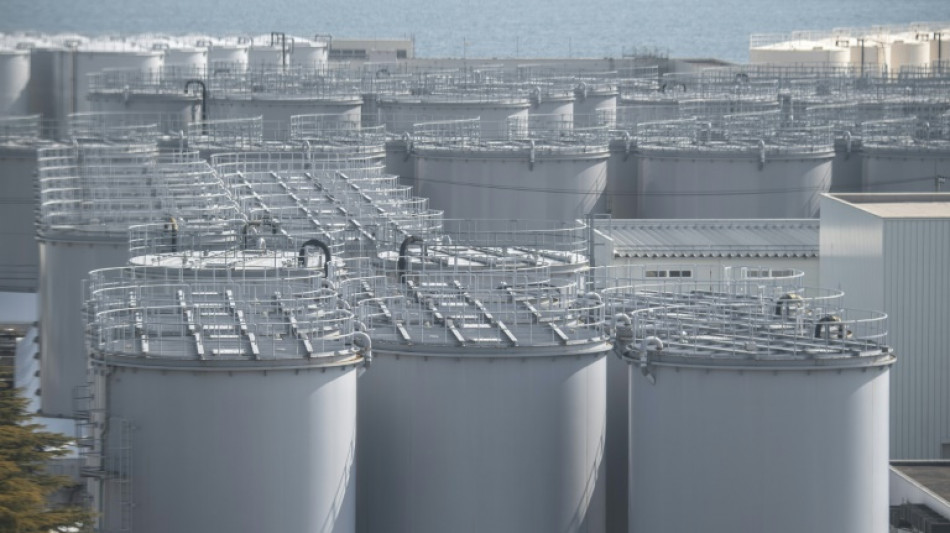
Japan regulator OKs release of treated Fukushima water / Photo: © AFP/File

 Rescuers search for missing in China storms after 100,000 flee

 OpenAI to launch new model after US freeze

 UK museums at 'sharp end' of climate change challenge

 In Mauritania, Imraguen people's desert-ocean paradise under threat

 Iraq's holy cities host funeral processions for Khamenei

 Rescuers search for missing in China storms after 100,000 evacuated

 Ex-Australia cricketer MacGill loses appeal against cocaine conviction
 Oil prices extend rally as US strikes on Iran revive geopolitical fears

 Iraq's holy cities to host funeral processions for Khamenei
 In Venezuela's quake ruins, a baby is born

 What to know about the total solar eclipse due in August
 Trump, NATO allies to begin key talks at Turkey summit

 Former Real Madrid coach Arbeloa named Fulham manager

 Messi inspires Argentina great escape over Egypt, Swiss advance

 US strikes Iran after Hormuz attacks, Tehran threatens response

 Djokovic wins five-hour epic to earn Sinner showdown at Wimbledon

 US strikes Iran after Hormuz tanker attacks: military

 Messi 'didn't want to go home' as Argentina comeback stuns Egypt

 Netflix strikes deals in short-form video push

 The height factor: how a small building survived Venezuela's quakes

 Egypt 'cheated' in controversial World Cup exit to Messi's Argentina, says Hassan
 Global AI industry falls short on safety, think tank warns

 'History made': Egyptian pride despite World Cup heartbreak

 How rescuers carried out 180-hour 'miracle' amid Venezuela's ruins

 Victorious Belgian footballers troll Trump with YMCA dance

Japan's nuclear regulator on Friday formally approved a plan to release more than a million tonnes of treated water from the crippled Fukushima nuclear power plant into the ocean.
The plan has already been adopted by the government and endorsed by the International Atomic Energy Agency (IAEA), but plant operator TEPCO must still win over local communities before going ahead.
The country's Nuclear Regulation Authority approved TEPCO's plan, according to a foreign ministry statement, which said the government would ensure the safety of the treated water as well as the "reliability and transparency of its handling".
Cooling systems at the plant were overwhelmed by a tsunami triggered by a massive undersea quake on March 11, 2011, causing the worst nuclear accident since Chernobyl.
Decommissioning work is under way and expected to take around four decades, with painstaking efforts to remove molten fuel from damaged reactors among the tasks ahead.
Each day, the site produces 140 cubic metres of contaminated water -- a combination of groundwater, seawater and rainwater that seeps into the area, and water used for cooling.
The water is filtered to remove various radionuclides and moved to storage tanks, with 1.29 million tonnes on site already and space expected to run out in around a year.
TEPCO says the treated water meets national standards for radionuclide levels, except for one element, tritium, which experts say is only harmful to humans in large doses.
It plans to dilute the water to reduce tritium levels and release it offshore over several decades via a kilometre-long underwater pipe.
The IAEA says the release, which will take place over many years and is not expected to begin before spring 2023, meets international standards and "will not cause any harm to the environment".
But local fishing communities that suffered in the wake of the nuclear accident fear consumers will once again shun their products if the water is released in the area.
There has also been criticism from regional neighbours including South Korea and China, as well as groups like Greenpeace.
The 2011 disaster in northeast Japan left around 18,500 people dead or missing, with most killed by the tsunami.
Around 12 percent of the Fukushima region was once declared unsafe, but no-go zones now cover around two percent, although populations in many towns remain far lower than before.
L.Janezki--BTB