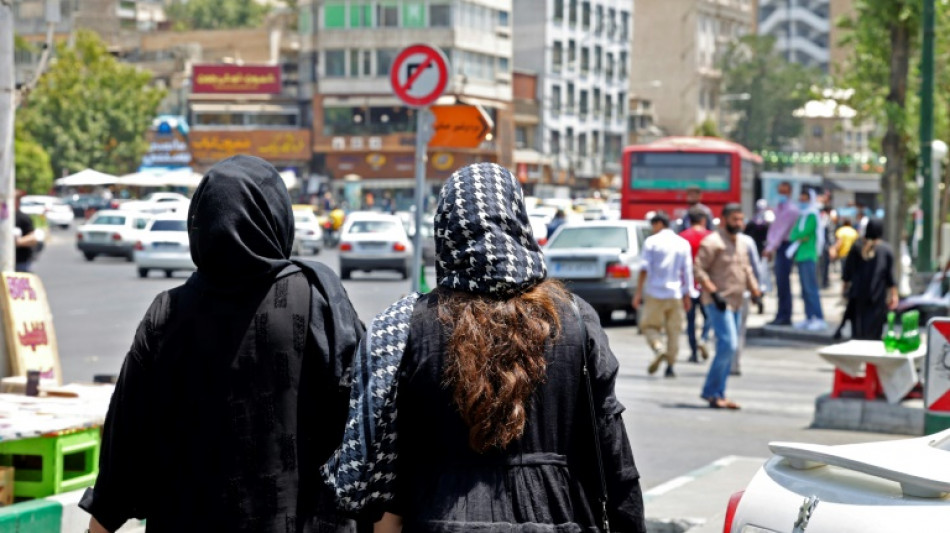
Calls grow for Iran morality police to change course / Photo: © AFP/File

 Rescuers search for missing in China storms after 100,000 flee

 OpenAI to launch new model after US freeze
 UK museums at 'sharp end' of climate change challenge
 In Mauritania, Imraguen people's desert-ocean paradise under threat
 Iraq's holy cities host funeral processions for Khamenei
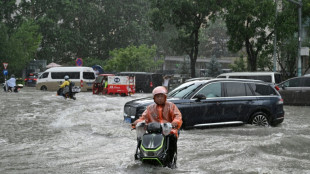 Rescuers search for missing in China storms after 100,000 evacuated
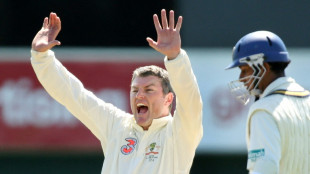 Ex-Australia cricketer MacGill loses appeal against cocaine conviction

 Oil prices extend rally as US strikes on Iran revive geopolitical fears
 Iraq's holy cities to host funeral processions for Khamenei
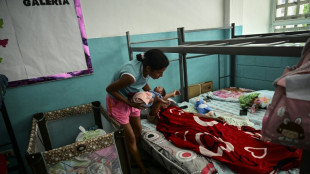 In Venezuela's quake ruins, a baby is born

 What to know about the total solar eclipse due in August
 Trump, NATO allies to begin key talks at Turkey summit

 Former Real Madrid coach Arbeloa named Fulham manager
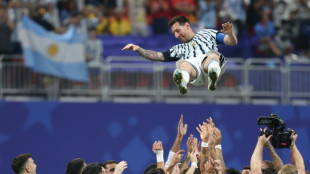 Messi inspires Argentina great escape over Egypt, Swiss advance
 US strikes Iran after Hormuz attacks, Tehran threatens response
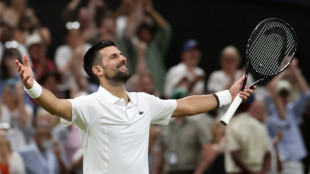
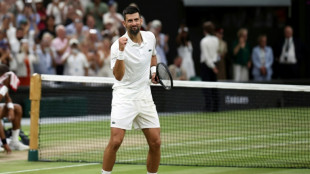
 Djokovic wins five-hour epic to earn Sinner showdown at Wimbledon

 US strikes Iran after Hormuz tanker attacks: military

 Messi 'didn't want to go home' as Argentina comeback stuns Egypt
 Netflix strikes deals in short-form video push
 The height factor: how a small building survived Venezuela's quakes
 Egypt 'cheated' in controversial World Cup exit to Messi's Argentina, says Hassan

 Global AI industry falls short on safety, think tank warns

 'History made': Egyptian pride despite World Cup heartbreak
 How rescuers carried out 180-hour 'miracle' amid Venezuela's ruins
 Victorious Belgian footballers troll Trump with YMCA dance
In a rare move, Iranian newspapers on Thursday criticised the country's morality police, tasked with ensuring respect for Islamic laws, after a viral video of a woman pleading for her daughter to be released.
The criticism emerged as public debate about the hijab, a required female head covering, resurfaced after local media reported measures that may indicate tighter controls.
The morality police patrol the streets with a mandate to enter public areas to check on implementation of the head scarf law and other Islamic requirements.
Morality officers became a much less common sight after moderate president Hassan Rouhani came to power in 2013, but the force has had a renewed presence over the past weeks under his successor, ultraconservative Ebrahim Raisi.
The video, widely shared on social media in Iran, showed a woman standing in front of a green-striped white van of Tehran's morality police -- commonly known as Gasht-e Ershad, or "guidance patrol". She screamed that her daughter, allegedly being carried away in the van, is ill.
The veiled women kept holding on to the vehicle, trying to stop it as it started moving slowly, before eventually being pulled aside. The van sped away.
It was unclear whether the woman's daughter had allegedly violated the hijab law, or other Islamic regulations, but Reformist daily Sazandegi published a drawing of the scene on its front page Thursday, with "Stop the morality police" as its headline.
Similar calls echoed in reformist papers, with Arman-e Melli asking the police to "be kind", and Shargh warning that "urban peace (is) in a tight spot".
The video, which could not independently be verified by AFP, spread widely early this week.
Tehran police said it involved a patrol in the west of the capital.
"Following this incident... the matter was immediately investigated... and disciplinary action was taken against the head of the police patrol for the mismanagement", Tehran's police inspection chief Hamid Khorvash was quoted as saying by state news agency IRNA on Thursday.
"Today, the mother of this citizen was consoled and this citizen also appreciated the quick handling and follow-up of this matter", he added, without further elaborating.
- Political debate -
The debate made its way to the political scene as well.
Hassan Khomeini, a reformist figure and grandchild of Ayatollah Ruhollah Khomeini, the founder of the Islamic republic, posted the scene on Instagram.
"Whatever this is, it is not guidance, it is not Islamic, it is not wise and has no benefit", he wrote on his official page with more than 600,000 followers on Tuesday.
Ahmad Khatami, a conservative member of Iran's Assembly of Experts, tasked with electing the Islamic republic's supreme leader, defended the morality officers.
Khatami said that the law on the hijab "must be implemented".
"Unfortunately, some people do not observe hijab and even remove their coverings in public places, which is against the law", he was quoted as saying by ISNA news agency on Thursday.
Following the 1979 Islamic revolution, the law requires all women, regardless of nationality or religious belief, wear a hijab that covers the head and neck while concealing the hair.
Many have pushed the boundaries over the past two decades by allowing the hijab to slide back and reveal more hair, especially in Tehran and other major cities, and the actions of the morality police have been criticised before.
Rouhani, then-president, warned in 2018 that "promoting virtue will not work through violence," after a video emerged of a violent encounter between a women and morality officers.
Earlier this month, local media reported that women in Iran's second-largest city of Mashhad are banned from taking the metro if they are not wearing a head covering, and three coffee shops were closed in the central city of Qom because customers were not wearing their head scarves.
Raisi, who came to power last year, called this month for hijab laws and rules to be implemented "in full", state media reported.
He stressed that "the enemies of Iran and Islam" are targeting "religious foundations and values of the society", IRNA reported on July 5.
"Necessary and preventive measures should be taken", the president added, asking competent institutions -- which would include the morality police -- "to take systematic and integrated actions in this regard."
K.Brown--BTB