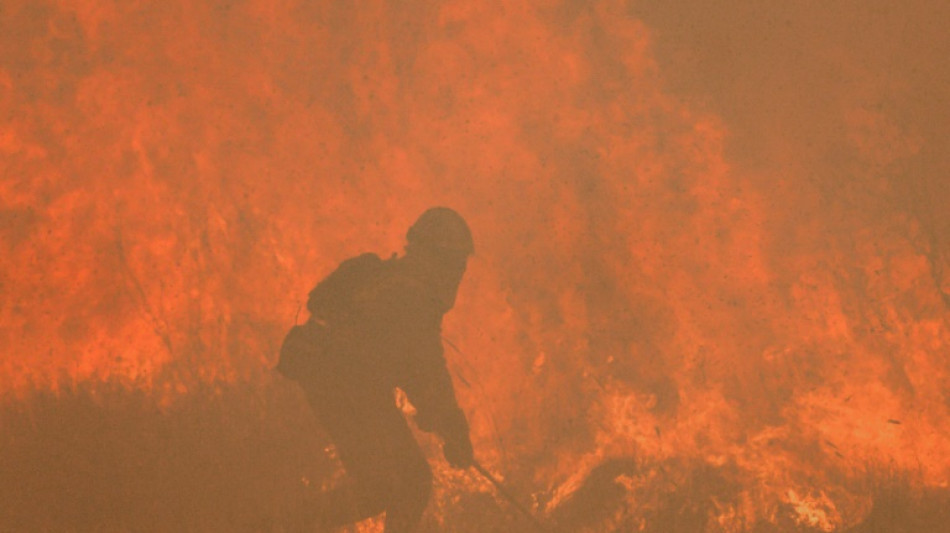
Wildfires ravage Spanish region twice in a month / Photo: © AFP

 Trump says Iran ceasefire 'over' after fighting flares

 Thai beer dynasty mother drops 'ungrateful child' case against son
 France v Morocco rematch as World Cup quarter-finals get under way

 Modi visits Australia for minerals talks and rockstar welcome

 Sensors, early starts: how Spain keeps working when heat hits
 Kenya Rastafarians hope for freedom to smoke

 Pacific nation of Tuvalu condemns Chinese missile launch into Pacific
 How a viral post sparked India's Gen-Z protest

 Cambodia wants to bring tigers back, but should it?

 Chinese repairwomen smash stereotypes with power tools

 Ecuador's Death Canal: watery grave for victims of gang violence

 'Unique event': Solar eclipse fever fills empty Spain

 Venezuela says Caracas airport to reopen to commercial flights 'soon as possible'

 World Cup: Eight teams remain in the hunt for glory

 'A nice surprise': Marathon man Djokovic revels in Wimbledon epic

 Switzerland beat Colombia on penalties to reach World Cup quarter-finals

 Djokovic survives Wimbledon's longest quarter-final to book Sinner blockbuster

 'Flunked': US soccer seeks answers as World Cup dream shattered

 Mbappe revels in captain's role for France at World Cup

 Iyer's India 'atrocious' in record 125-run T20 defeat by England

 Rain hands West Indies series win over Sri Lanka
 World Cup exit puts another nail in America's summer of fun

 US revokes Iran oil waiver after Hormuz tanker attacks

 England quicks star as India suffer record 125-run T20 defeat

 Cardinal tipped to be pope accused of molesting several women
Just a month after a huge wildfire ravaged Spain's northwestern province of Zamora, flames are once again consuming swathes of the region as locals helplessly watch their land being destroyed.
A column of smoke can be seen some 30 kilometres (18 miles) away as it billows into the sky, obscuring the landscape.
Antonio Puga cried as he observed the desolate scene, saying he felt "desperate and helpless" as flames surrounded his village of Pumarejo de Tera.
"We could have avoided all this," said Puga, who is in his sixties.
In front of him fires devour the fields, making them crackle. A relentless wind revives embers and ignites pine trees.
A helicopter ferried water from a nearby river and dumped it on the smouldering fields.
Some 6,000 people from around 30 localities in this rural region have been evacuated from their homes since Sunday.
The wildfires have claimed two lives -- that of a firefighter near the village of Losacio and a shepherd whose body was found in a nearby town.
They are by far the largest of the dozens of blazes raging across Spain amid a scorching heatwave affecting much of Western Europe.
- 'Already too late' -
In June, a wildfire ravaged nearly 30,000 hectares (75,000 acres) in Sierra de la Culebra, a wooded mountain range near the border with Portugal that is known for its population of wolves.
It was the biggest fire in Spain since 2004.
Desperate locals try to help firefighters stamp out the flames by carrying hoses or transporting water with their tractors. But they are furious with the authorities.
"Firefighters arrived late, the helicopters were there this morning, then they left at 3 pm and now we only have one," said Puga.
Alberto Escade, a 48-year-old technician, was upset to see three fire trucks leave the area.
"They keep saying they are overwhelmed," he said.
"They arrive and then they say: It's already too late, it's lost.' They are ordered to take care of inhabited areas," he added.
Local authorities respond to the criticism by saying the priority is saving human lives.
The former mayor of the village, Isabel Blanco, is also upset.
A month ago a wildfire ravaged one side of the road, she said as she pointed to the charred vegetation on the right. And now its ravaged the land on the other side.
Firefighters were "a little late in coming," the 52-year-old said.
- 'Forgotten Spain' -
She sees this as a symptom of the neglect which rural depopulated regions like Zamora -- often referred to as "forgotten Spain" -- suffer, a recurring political theme in the country.
In Zamora, thousands of people spent the night on cots at a reception centre sent up for evacuees.
Many declined to speak to the media, their minds consumed by fear that their homes won't survive the flames.
Daniel Santamaria, 21, said he was on vacation at his grandparents' house when the approaching flames forced him to flee in a hurry with only a backpack.
He recalls how ash-filled raindrops "left black spots as they fell".
Sitting just a few metres (feet) away, Luis Rivero, 76, said he will not forget "the strong wind which carried everything away in its path" and fanned the flames.
Laura Gago, a 36-year-old beekeeper from the village of Escober de Tabara, said between sobs that she has "not yet had the strength" to check on her 700 hives but estimates that "90 percent of her production is burnt".
"We can't do anything against nature, the wind, the temperatures, the drought. Climate change is here. It's not going to go away," she added.
G.Schulte--BTB