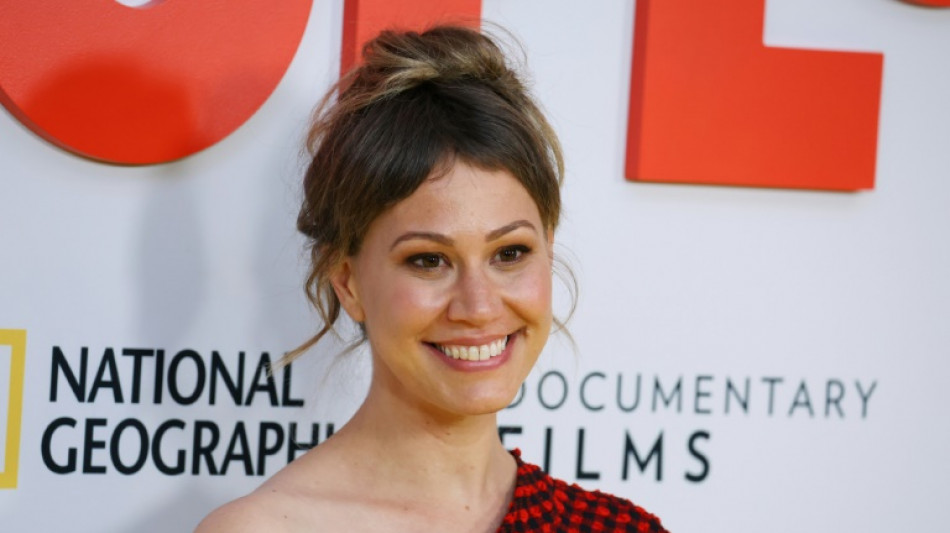
'Fire of Love' charts romance and death of volcano-chasing scientists / Photo: © GETTY IMAGES NORTH AMERICA/AFP/File

 Trump says Iran ceasefire 'over' after fighting flares

 Thai beer dynasty mother drops 'ungrateful child' case against son
 France v Morocco rematch as World Cup quarter-finals get under way

 Modi visits Australia for minerals talks and rockstar welcome
 Sensors, early starts: how Spain keeps working when heat hits
 Kenya Rastafarians hope for freedom to smoke
 Pacific nation of Tuvalu condemns Chinese missile launch into Pacific
 How a viral post sparked India's Gen-Z protest

 Cambodia wants to bring tigers back, but should it?
 Chinese repairwomen smash stereotypes with power tools
 Ecuador's Death Canal: watery grave for victims of gang violence
 'Unique event': Solar eclipse fever fills empty Spain
 Venezuela says Caracas airport to reopen to commercial flights 'soon as possible'
 World Cup: Eight teams remain in the hunt for glory
 'A nice surprise': Marathon man Djokovic revels in Wimbledon epic

 Switzerland beat Colombia on penalties to reach World Cup quarter-finals
 Djokovic survives Wimbledon's longest quarter-final to book Sinner blockbuster

 'Flunked': US soccer seeks answers as World Cup dream shattered
 Mbappe revels in captain's role for France at World Cup

 Iyer's India 'atrocious' in record 125-run T20 defeat by England
 Rain hands West Indies series win over Sri Lanka
 World Cup exit puts another nail in America's summer of fun

 US revokes Iran oil waiver after Hormuz tanker attacks

 England quicks star as India suffer record 125-run T20 defeat

 Cardinal tipped to be pope accused of molesting several women
French scientists Maurice and Katia Krafft were brought together, and eventually killed, by their shared love of volcanoes.
Now the married couple are the subject of "Fire of Love," a new film constructed from hours of dazzling, terrifying and occasionally quirky footage they shot close to -- and even inside -- erupting craters.
Playing in a limited number of US theaters, the documentary from National Geographic and prestigious indie distributor Neon ("Parasite") is earning rave reviews and generating early awards buzz.
Director Sara Dosa first stumbled upon the pair's "spectacular imagery" while researching another documentary about Icelandic volcanoes -- but was drawn more to the "love that just radiates behind the lens, unlike anything else."
For 25 years, the Kraffts had traveled the world together in search of active volcanoes, writing some 20 books and making five feature films, plus countless television programs and lectures.
But they are perhaps best remembered today for their deaths side-by-side on Japan's Mount Unzen volcano, which erupted in 1991 after nearly two centuries dormant, sending a fatal cloud of gas and ash surging down its eastern flank.
"Fire of Love" begins and ends with this tragic information -- yet it spends the bulk of its running time on the "love triangle" between the couple and their lifelong obsession.
"Once we really learned about them as people... and the fact that they were married and also seemed to be in love with volcanoes -- that's when we thought, 'okay, we want to make a film of these people,'" Dosa told AFP.
"We wanted to tell kind of a mythic love story that was told through the language of volcanoes," she added.
"That's what drew them together in the first place, and that was the propulsive material, the fuel of their relationship."
- 'Reckless love' -
While Maurice was the more extroverted and ostensibly thrill-seeking of the pair -- he paddles in an acid lake and plots to kayak down an active lava stream -- Katia was similarly courageous in the face of peril.
Their gung-ho approach drew criticism from some of their scientific peers, but "I don't think that we ever found them reckless, quite honestly," said Dosa.
"They ultimately did lead a deeply meaningful life and die a meaningful death. And so much of that was this pursuit of love," she added.
"I'm sure many people will say perhaps it was a reckless love, but for us, it was the way for them to live."
After witnessing the staggering 1980 eruption of Mount St Helens in the northwestern United States, and the Nevado del Ruiz disaster that killed up to 25,000 Colombians five years later, the pair reoriented their work to lobby governments for better evacuation planning.
"Since they were some of the only people really capturing those images, they were uniquely suited to do that advocacy work," said Dosa.
"And that is literally what they were trying to do as they died on mountains in 1991."
- 'Salve' -
Aside from informing modern audiences about the pair's work, Dosa hopes the film can remind viewers that the planet is not simply "a resource to be capitalized upon."
"These kinds of stories about the aliveness, the sentience of the Earth, are all the more important to counteract the exploitation," she said.
Making the film during the pandemic and "having these guides, Katia and Maurice, teaching you how to navigate the unknown, and who knew how to reconcile fear -- that was such a salve and a refuge for us."
And then there is the aesthetic beauty of the footage itself, full of glowing red lava and alien-looking volcanic landscapes, all captured in a distinctive style with "the hallmarks of the French New Wave."
"For example, in the cinematography, there was a lot of playful snap zooms, which reminded us of films in France from the 60s and 70s," she said.
"And their own writing -- they authored nearly 20 books -- almost recalled the bombastic and playful spirit of narration in Truffaut films."
Dosa herself drew on that style, including the documentary's own, breathy narration.
"One of the great narrative devices of the French New Wave was love triangle stories," said Dosa.
"And for us, that was something that felt appropriate. Katia and Maurice truly did seem to have a third in their relationship -- volcanoes."
O.Krause--BTB