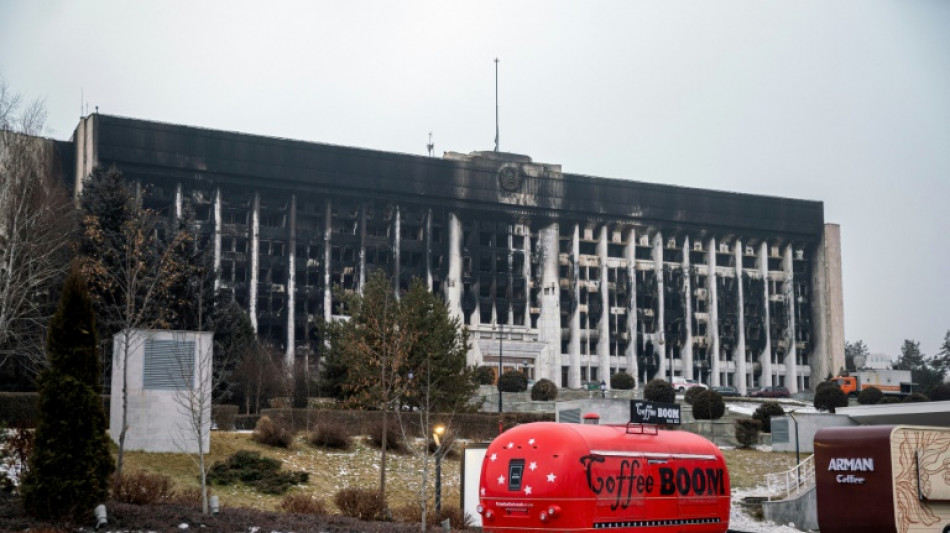
Shadow of 'Bloody January' unrest stalks Kazakhstan / Photo: © AFP

 Trump says Iran ceasefire 'over' after fighting flares
 Thai beer dynasty mother drops 'ungrateful child' case against son
 France v Morocco rematch as World Cup quarter-finals get under way

 Modi visits Australia for minerals talks and rockstar welcome
 Sensors, early starts: how Spain keeps working when heat hits
 Kenya Rastafarians hope for freedom to smoke
 Pacific nation of Tuvalu condemns Chinese missile launch into Pacific
 How a viral post sparked India's Gen-Z protest
 Cambodia wants to bring tigers back, but should it?
 Chinese repairwomen smash stereotypes with power tools
 Ecuador's Death Canal: watery grave for victims of gang violence
 'Unique event': Solar eclipse fever fills empty Spain
 Venezuela says Caracas airport to reopen to commercial flights 'soon as possible'
 World Cup: Eight teams remain in the hunt for glory
 'A nice surprise': Marathon man Djokovic revels in Wimbledon epic
 Switzerland beat Colombia on penalties to reach World Cup quarter-finals
 Djokovic survives Wimbledon's longest quarter-final to book Sinner blockbuster
 'Flunked': US soccer seeks answers as World Cup dream shattered
 Mbappe revels in captain's role for France at World Cup
 Iyer's India 'atrocious' in record 125-run T20 defeat by England
 Rain hands West Indies series win over Sri Lanka
 World Cup exit puts another nail in America's summer of fun
 US revokes Iran oil waiver after Hormuz tanker attacks

 England quicks star as India suffer record 125-run T20 defeat
 Cardinal tipped to be pope accused of molesting several women
Red plastic embellishes the canvas of painter Saule Suleimenova, depicting the starting point of the lethal unrest that shook Kazakhstan at the beginning of the year.
The dark, brooding wall-sized piece shows the main square of the Central Asian country's largest city, Almaty, with its distinctive Soviet-era buildings and independence-era monument celebrating Kazakh statehood.
With her distinctive "cellophane painting" technique, Suleimenova sought to capture a violent moment in Kazakhstan's modern history that remains full of unanswered questions six months on.
The republic's winter of discontent began with peaceful protests over a hike in fuel prices before descending into chaos, leaving 238 people dead and becoming known as "Bloody January".
Government critics say the authorities' handling of the protests was full of abuses.
The state, meanwhile, insists that the country witnessed a terrorist-led coup attempt in January -- a narrative that has been met with widespread scepticism.
Painter Suleimenova has tried to convey the sense of injustice surrounding the events in her work.
She said her motivation to convey a collective mood during January grew stronger after Russia -- which sent troops to Kazakhstan to help bolster a regime in disarray -- invaded Ukraine the following month.
"With the colour (red), I wanted to express the condition we have been living through this year," she told AFP at an exhibition of her work in Almaty.
- Stripped and beaten -
Metal worker Akylzhan Kiysimbayev -- who was wounded during the events in January -- was still on crutches when AFP spoke to him.
He thought little about politics before he found himself on the sidelines of a fierce clash between police and protesters.
Now, he faces up to eight years in prison if convicted in taking part in mass disorder.
Kiysimbayev said he was guarding a property that his company was renovating on January 5 when stray bullets pierced the building's windows.
He was shot in the leg as he attempted to escape. While he was still recovering from an operation in hospital, police arrested him and beat him in the hospital corridors.
Thrown into jail, he was stripped of his clothes and beaten again, he said.
"They hit us in the places where our injuries were," he told AFP.
"They told us: you are terrorists, you are Wahabbists!"
He was forced to appear in front of a judge wearing nothing but his underwear.
Public uproar ensured that some detainees, Kiysimbayev among them, were released from pre-trial detention.
Authorities acknowledge some incidents of torture -- including several leading to death -- but there has been little progress in more than 240 investigations into the abuses.
None of the officers who Kiysimbayev says tortured him have been charged with any offence.
President Kassym-Jomart Tokayev, meanwhile, has tried to move on from the events that shook his rule, pledging a "New Kazakhstan".
Last month, his government passed constitutional changes that appeared to bring to an end the influence of his 82-year-old predecessor Nursultan Nazarbayev, who dominated the country's politics for 30 years -- a key demand in the January protests.
But Moscow's invasion of Ukraine brought newfound uncertainty for Tokayev, whose position was strengthened after the Kremlin agreed to send forces to Kazakhstan to help quell the unrest.
- 'Toxic partner' -
Russian President Vladimir Putin's decision to launch a full-scale assault on Ukraine on February 24 came just over a month after a Moscow-led security bloc intervened in Kazakhstan.
Since then, Kazakhstan's neutral stance on the conflict has angered the Kremlin.
Although Tokayev partly owes his survival to Moscow, the war in Ukraine "changed the format of relations", political analyst Dosym Satpayev told AFP.
The war itself, he said, divided opinion in Kazakhstan -- an ethnically diverse country with a large Slavic minority concentrated near Russia's border.
"Tokayev understands Russia is a toxic partner," he said.
Fresh tensions in the partnership were epitomised by an awkward exchange between Tokayev and Putin in June, in which the Kazakh leader publicly disagreed with the Kremlin chief over Ukraine.
Sitting next to Putin in Saint Petersburg, Tokayev said Kazakhstan would not recognise "quasi-state territories" like eastern Ukraine's rebel republics, as Russia has.
Kazakhstan's foreign ministry even pledged to blacklist Russian public figure Tigran Keosayan, who branded its leadership ungrateful and threatened Kazakhstan with a Ukraine-style invasion.
Ruslan Rafikov, an artist who sported a pro-Ukrainian T-shirt at Suleimenova's exhibition, told AFP that he thought the unrest in January could be repeated if authorities failed to improve living standards and ease political repression.
"The activism of citizens has not gone anywhere," said Rafikov at the event coinciding with former leader Nazarbayev's birthday.
"To the contrary, it is getting stronger."
F.Pavlenko--BTB