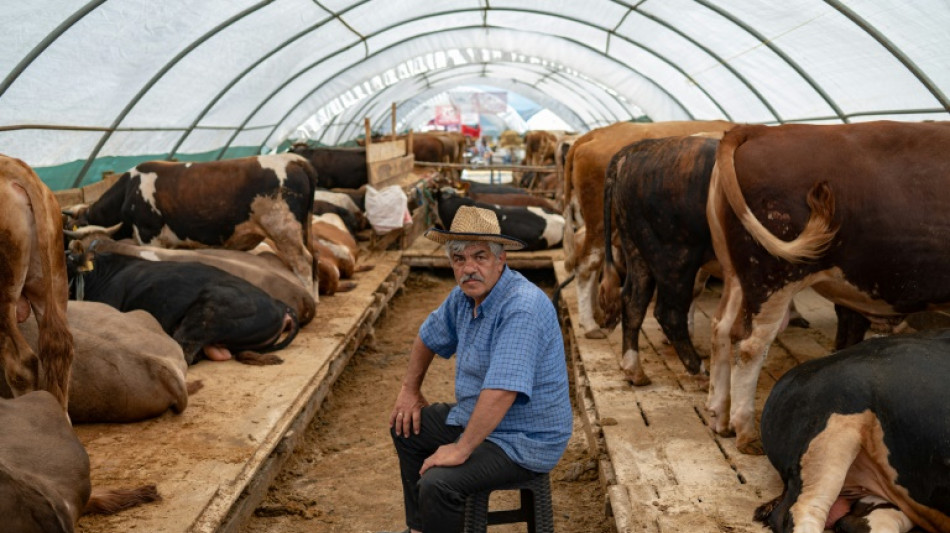
'Sacred duty': Inflation eats into Turkey's Muslim feast / Photo: © AFP

 Bayeux tapestry to arrive in London in secret, high-stakes operation
 Messi World Cup magic masks familiar penalty frailty
 Trump lashes out at allies as key NATO summit begins

 Swiss party into the night after reaching World Cup quarter-finals

 Trump says Iran ceasefire 'over' after fighting flares
 Thai beer dynasty mother drops 'ungrateful child' case against son
 France v Morocco rematch as World Cup quarter-finals get under way

 Modi visits Australia for minerals talks and rockstar welcome
 Sensors, early starts: how Spain keeps working when heat hits
 Kenya Rastafarians hope for freedom to smoke
 Pacific nation of Tuvalu condemns Chinese missile launch into Pacific
 How a viral post sparked India's Gen-Z protest
 Cambodia wants to bring tigers back, but should it?
 Chinese repairwomen smash stereotypes with power tools
 Ecuador's Death Canal: watery grave for victims of gang violence

 'Unique event': Solar eclipse fever fills empty Spain

 Venezuela says Caracas airport to reopen to commercial flights 'soon as possible'
 World Cup: Eight teams remain in the hunt for glory
 'A nice surprise': Marathon man Djokovic revels in Wimbledon epic

 Switzerland beat Colombia on penalties to reach World Cup quarter-finals
 Djokovic survives Wimbledon's longest quarter-final to book Sinner blockbuster

 'Flunked': US soccer seeks answers as World Cup dream shattered
 Mbappe revels in captain's role for France at World Cup

 Iyer's India 'atrocious' in record 125-run T20 defeat by England
 Rain hands West Indies series win over Sri Lanka

With inflation in Turkey galloping, the sheep Gul Er buys every year for the Muslim festival of sacrifice in Istanbul looks agonisingly out of reach.
Prices have doubled or even tripled since President Recep Tayyip Erdogan began an unorthodox economic experiment last year that has seen Turks' living standards suffer.
The young mother hopes to bargain down the price on one of the skimpiest-looking animals at a livestock fair held under white tents in a conservative corner of the city before the Kurban Bayrami (Eid al-Adha in Arabic) holiday.
"It is a sacred duty," she said of buying a sheep, which along with oxen and goats are sacrificed in the name of Allah, with the meat traditionally shared with the poor, friends and neighbours.
"But this year, prices are unaffordable," Er said, the stench of thousands of animals mixing with the sounds of haggling in the heavy summer air, ahead of Saturday's first full day of festivities.
Annual inflation in Turkey has officially reached 78.6 percent, although economists and many ordinary Turks doubt government data.
Even if the official figures are to be believed, that is higher than in any other emerging market and nearly 10 times the record levels rocking the European Union, where the cost of living is unleashing political crises.
An independent survey prepared by the ENAG group -- and believed by most Turks -- puts the annual inflation rate at 175 percent.
Besides clouding Erdogan's chances in next year's election, these figures spell trouble for the merchants at the Istanbul animal fair.
- Snowballing problems -
Turkey's agricultural chambers union chief Semsi Bayraktar expects sales to fall by a quarter this year.
Galip Toklu, a breeder who came to the 40,000-square-metre (10-acre) fair from the Black Sea city of Samsun, listed the ways inflation snowballs into seemingly endless problems.
The cost of animal feed has quadrupled while the amount he pays to drive his livestock to Istanbul has tripled since the last Kurban Bayrami, forcing Toklu to double the price of his meat.
"Last year, I sold 500 kilos (1,100 pounds) of beef for 20,000 liras. This year, I set my prices at 45,000 liras," he said.
Yet few can now afford Toklu's beef, while selling it any cheaper could put him out of business.
"Customers are unavoidably upset," he said, his face sullen under a wide-brimmed hat.
- 'Erdonomics' -
While this year's animal fair looks huge, its 160 tents are a fraction of the 500 erected in past years.
As the fair winds down, breeder Sinas Ates looks despondent, having failed to make a single sale in two days. Livestock farming in Turkey is "finished", he grumbled.
Just like the sacrifice of sheep, Erdogan's economic experiment -- dubbed "Erdonomics" by sceptical global markets -- is also linked to his faith.
Erdogan cites Islamic proscriptions on usury to justify his refusal to raise interest rates to fight inflation.
High interest rates cause prices to rise, according to Erdogan's logic, which contradicts accepted economic orthodoxy.
So Erdogan has pushed the central bank to set interest rates even lower. Analysts at Capital Economics in London see the possibility of a crash of the lira as "a major risk".
- 'Allah's orders' -
At the market, Salih Yeter has responded to the crisis by coming out to look for the perfect sheep with seven friends, who will all contribute to the purchase.
"People usually can't afford to eat meat," the 57-year-old said, adding that giving away meat to the poor is particularly important in times of trouble.
The price of food has soared by 93 percent in the past year, according to official data, with meat prices pushing even higher.
This is especially painful for Er, whose daughter has a metabolic condition that restricts her to a meat diet.
"I can't even respect my daughter's diet," the mother whispered.
But respect for the holy holiday's traditions is binding, said Selahattin Kose, a "hajji" (one who has made the pilgrimage to Mecca), from the eastern city of Erzurum.
"Prices have doubled, but we have to deal with it," Kose said. "It's Allah's orders."
R.Adler--BTB