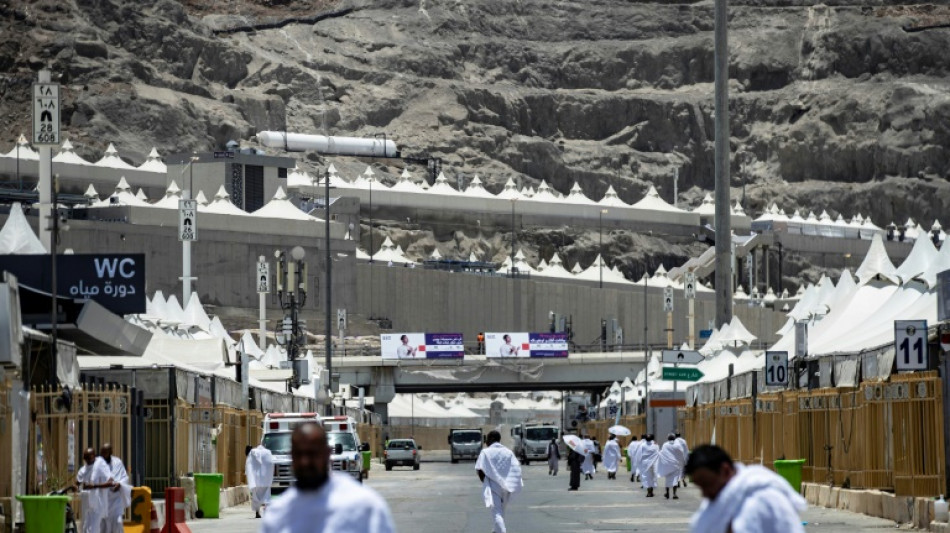
Pilgrims scale Mount Arafat for climax of biggest Covid-era hajj / Photo: © AFP

 Bayeux tapestry to arrive in London in secret, high-stakes operation
 Messi World Cup magic masks familiar penalty frailty
 Trump lashes out at allies as key NATO summit begins

 Swiss party into the night after reaching World Cup quarter-finals

 Trump says Iran ceasefire 'over' after fighting flares

 Thai beer dynasty mother drops 'ungrateful child' case against son
 France v Morocco rematch as World Cup quarter-finals get under way

 Modi visits Australia for minerals talks and rockstar welcome

 Sensors, early starts: how Spain keeps working when heat hits
 Kenya Rastafarians hope for freedom to smoke
 Pacific nation of Tuvalu condemns Chinese missile launch into Pacific
 How a viral post sparked India's Gen-Z protest
 Cambodia wants to bring tigers back, but should it?
 Chinese repairwomen smash stereotypes with power tools
 Ecuador's Death Canal: watery grave for victims of gang violence
 'Unique event': Solar eclipse fever fills empty Spain

 Venezuela says Caracas airport to reopen to commercial flights 'soon as possible'

 World Cup: Eight teams remain in the hunt for glory
 'A nice surprise': Marathon man Djokovic revels in Wimbledon epic

 Switzerland beat Colombia on penalties to reach World Cup quarter-finals
 Djokovic survives Wimbledon's longest quarter-final to book Sinner blockbuster

 'Flunked': US soccer seeks answers as World Cup dream shattered
 Mbappe revels in captain's role for France at World Cup

 Iyer's India 'atrocious' in record 125-run T20 defeat by England
 Rain hands West Indies series win over Sri Lanka
Huge crowds of Muslim pilgrims started praying on Saudi Arabia's Mount Arafat early Friday, the high point of the biggest hajj pilgrimage since the pandemic forced drastic cuts in numbers for two years in a row.
The worshippers, capped at one million including 850,000 from abroad chosen by lottery, spent the night at camps in the valley of Mina, seven kilometres (four miles) from Mecca's Grand Mosque, Islam's holiest site.
In the early hours of Friday, they converged on Mount Arafat, where the Prophet Mohammed is believed to have delivered his final sermon, for the most important of the hajj rituals.
They will stay all day at the site, praying and reciting the Koran, the Muslim holy book.
After sunset they will head to Muzdalifah, half-way between Arafat and Mina, where they will sleep under the stars before performing the symbolic "stoning of the devil" ceremony on Saturday.
This year's hajj is taking place against the backdrop of a resurgence of Covid-19 in the region, with some Gulf countries tightening restrictions to keep outbreaks in check.
All participants were required to submit proof of full vaccination and negative PCR tests. Upon reaching Mina on Thursday, they were handed small bags containing masks and sanitiser.
The hajj, usually one of the world's largest annual religious gatherings, is among the five pillars of Islam and must be undertaken by all Muslims with the means at least once in their lives.
In 2019, some 2.5 million Muslims from around the world took part, as in previous years.
But the coronavirus outbreak has since forced Saudi authorities to dramatically downsize the hajj. Just 60,000 fully vaccinated citizens and residents of the kingdom participated in 2021, up from a few thousand in 2020.
- Sun and tears -
The pilgrimage can be physically draining even in ideal conditions, but worshippers this year have faced an added challenge: scorching sun and temperatures rising to 42 degrees Celsius (108 degrees Fahrenheit).
Islam forbids men from wearing hats once the rites start, and many have been seen shielding themselves with umbrellas, prayer mats and even, in one case, a small bucket filled with water.
Women, meanwhile, are obliged to cover their heads with scarves.
On the mountain Friday morning, many of the worshippers wept as they prayed, and carried umbrellas in preparation for the high temperatures later in the day.
- Extreme conditions -
"We can tolerate (the heat). We are here for the hajj. The more we tolerate, the more our pilgrimage is accepted," Laila, a 64-year-old Iraqi pilgrim who gave only her first name, told AFP in Mecca before reaching the mount.
Saudi officials have touted their preparations for the extreme conditions, highlighting the hundreds of hospital beds allocated for heat stroke patients and the "large number of misting fans" they have provided.
A truck has also been allocated to distribute umbrellas, water bottles and small fans.
Nevertheless, the National Centre for Meteorology, which has set up an office in Mina, is sending warnings to pilgrims on their mobile phones, urging them to avoid outdoor rituals at certain times of the day, especially at noon.
On Saturday, Muslim pilgrims will take part in the "stoning", the last major ritual of this year's hajj.
This ritual has in past years led to deadly stampedes, as hundreds of thousands of participants converge on a small space.
After the stoning ritual, pilgrims return to the Grand Mosque in Mecca to perform a final "tawaf" or circling of the Kaaba, the cubic structure draped in a gold-embroidered black cloth that is the focal point of Islam.
Eid al-Adha, feast of the sacrifice, marks the end of hajj.
O.Krause--BTB