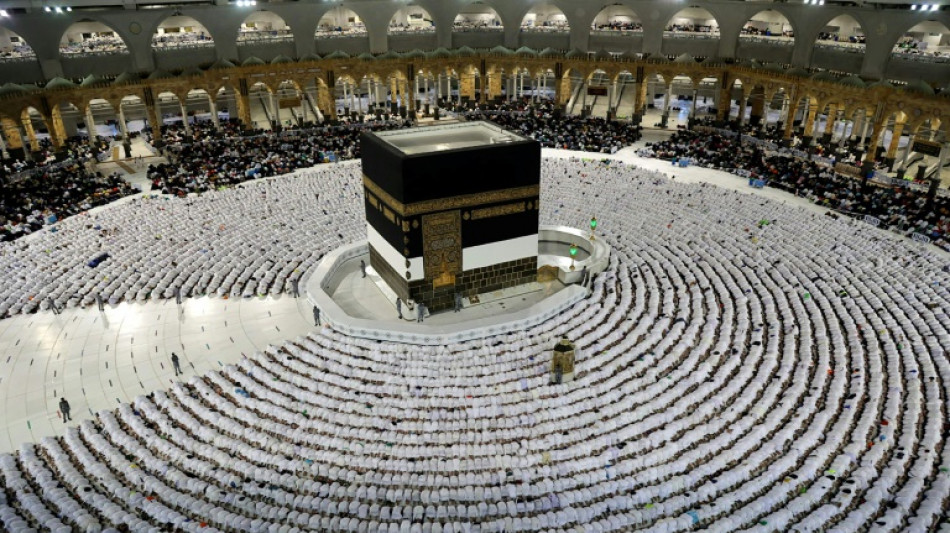
Maskless pilgrims launch largest hajj of Covid era / Photo: © AFP

 Bayeux tapestry to arrive in London in secret, high-stakes operation
 Messi World Cup magic masks familiar penalty frailty
 Trump lashes out at allies as key NATO summit begins

 Swiss party into the night after reaching World Cup quarter-finals
 Trump says Iran ceasefire 'over' after fighting flares

 Thai beer dynasty mother drops 'ungrateful child' case against son
 France v Morocco rematch as World Cup quarter-finals get under way

 Modi visits Australia for minerals talks and rockstar welcome
 Sensors, early starts: how Spain keeps working when heat hits
 Kenya Rastafarians hope for freedom to smoke
 Pacific nation of Tuvalu condemns Chinese missile launch into Pacific
 How a viral post sparked India's Gen-Z protest
 Cambodia wants to bring tigers back, but should it?
 Chinese repairwomen smash stereotypes with power tools
 Ecuador's Death Canal: watery grave for victims of gang violence
 'Unique event': Solar eclipse fever fills empty Spain
 Venezuela says Caracas airport to reopen to commercial flights 'soon as possible'
 World Cup: Eight teams remain in the hunt for glory
 'A nice surprise': Marathon man Djokovic revels in Wimbledon epic

 Switzerland beat Colombia on penalties to reach World Cup quarter-finals
 Djokovic survives Wimbledon's longest quarter-final to book Sinner blockbuster
 'Flunked': US soccer seeks answers as World Cup dream shattered
 Mbappe revels in captain's role for France at World Cup

 Iyer's India 'atrocious' in record 125-run T20 defeat by England
 Rain hands West Indies series win over Sri Lanka
The biggest hajj pilgrimage since the coronavirus pandemic began kicks off Wednesday, with hundreds of thousands of mostly maskless worshippers expected to circle Islam's holiest site in Saudi Arabia's Mecca.
One million fully vaccinated Muslims, including 850,000 from abroad, are allowed at this year's hajj, a major break from two years of drastically curtailed numbers due to the pandemic.
At Mecca's Grand Mosque, pilgrims will perform the "tawaf", the circumambulation of the Kaaba, the large cubic structure draped in golden-embroidered black cloth that Muslims around the world turn towards to pray.
Many have chosen to perform the ritual ahead of Wednesday's official hajj start date.
On Tuesday afternoon, white-robed male worshippers and women in colourful abayas walked side by side on the white floors near the Kaaba, the majority without a mask even though authorities said last month that masks would be mandatory at the site.
"I just prayed for you," one pilgrim, wearing a green robe, said during a video call with relatives.
"I love you mother, I love you all," she added, waving into her mobile phone screen as she continued walking around the Kaaba.
- Five days of rituals -
This year's hajj is larger than the pared-down versions staged in 2020 and 2021 but still smaller than in normal times.
In 2019, some 2.5 million Muslims from around the world participated in the annual event -- a key pillar of Islam that able-bodied Muslims must undertake at least once in their lives.
But after that, the coronavirus outbreak forced a dramatic downsizing. Just 60,000 fully vaccinated citizens and residents of the kingdom took part in 2021, up from a few thousand in 2020.
The pilgrimage consists of a series of religious rites which are completed over five days in Islam's holiest city and its surroundings in western Saudi Arabia.
On Thursday, the pilgrims will move to Mina, around five kilometres (three miles) away from the Grand Mosque, ahead of the main rite at Mount Arafat, where it is believed the Prophet Mohammed delivered his final sermon.
This year's hajj is restricted to vaccinated Muslims under the age of 65 chosen from millions of applicants through an online lottery system.
Those coming from outside Saudi Arabia were required to submit a negative Covid-19 PCR result from a test taken within 72 hours of travel.
Since the start of the pandemic, Saudi Arabia has registered more than 795,000 coronavirus cases, more than 9,000 of them fatal.
- 'Too hot' -
Those attempting to perform the hajj without a permit face fines of 10,000 Saudi riyals (around $2,600).
Policemen in the mountainous city have set up checkpoints and conducted foot patrols while holding green umbrellas to shield themselves from the scorching sun.
Temperatures in Mecca topped 40 degrees Celsius (104 degrees Fahrenheit) on Tuesday.
Inside the Grand Mosque, female medics were on standby in different locations, and volunteers with wheelchairs were waiting in a long queue to help those needing assistance.
Authorities have set up multiple health facilities, mobile clinics and ambulances to cater to pilgrims.
Some pilgrims donned clothing featuring the names and flags of their countries. "Hajj 2020 -- Chad" was written on the back of the white robes of one group.
Hosting the hajj is a matter of prestige and a powerful source of political legitimacy for Saudi Arabia's rulers.
Costing at least $5,000 per person, it is also a money-spinner for the world's biggest oil exporter, which is trying to diversify its economy.
In normal years, the pilgrimage brings in billions of dollars.
These days it represents a chance to showcase the kingdom's ongoing social transformation, despite persistent complaints about human rights abuses and limits on personal freedoms.
Saudi Arabia now allows women to attend the hajj unaccompanied by male relatives, a requirement that was dropped last year.
"Being here is the best thing that has ever happened to me. I can't wait for the rest," said 42-year-old Egyptian pilgrim Naima Mohsen, who came to the Grand Mosque by herself Tuesday.
"My only problem is the weather. It's just too hot."
F.Pavlenko--BTB