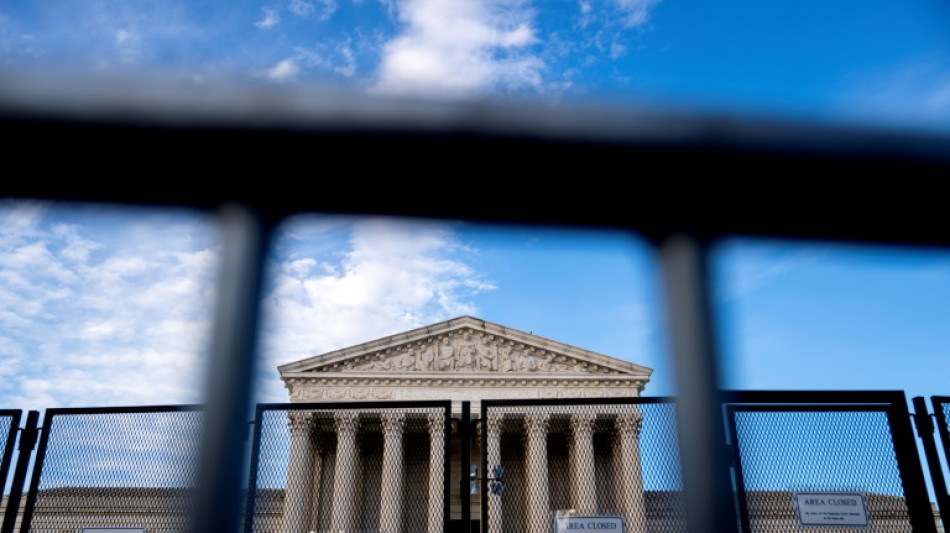
Like none other: profound impact of conservative US Supreme Court / Photo: © AFP/File

 Bayeux tapestry to arrive in London in secret, high-stakes operation

 Messi World Cup magic masks familiar penalty frailty

 Trump lashes out at allies as key NATO summit begins

 Swiss party into the night after reaching World Cup quarter-finals

 Trump says Iran ceasefire 'over' after fighting flares

 Thai beer dynasty mother drops 'ungrateful child' case against son

 France v Morocco rematch as World Cup quarter-finals get under way

 Modi visits Australia for minerals talks and rockstar welcome

 Sensors, early starts: how Spain keeps working when heat hits

 Kenya Rastafarians hope for freedom to smoke

 Pacific nation of Tuvalu condemns Chinese missile launch into Pacific

 How a viral post sparked India's Gen-Z protest

 Cambodia wants to bring tigers back, but should it?

 Chinese repairwomen smash stereotypes with power tools

 Ecuador's Death Canal: watery grave for victims of gang violence

 'Unique event': Solar eclipse fever fills empty Spain

 Venezuela says Caracas airport to reopen to commercial flights 'soon as possible'

 World Cup: Eight teams remain in the hunt for glory

 'A nice surprise': Marathon man Djokovic revels in Wimbledon epic

 Switzerland beat Colombia on penalties to reach World Cup quarter-finals

 Djokovic survives Wimbledon's longest quarter-final to book Sinner blockbuster

 'Flunked': US soccer seeks answers as World Cup dream shattered

 Mbappe revels in captain's role for France at World Cup

 Iyer's India 'atrocious' in record 125-run T20 defeat by England

 Rain hands West Indies series win over Sri Lanka

Two years after President Donald Trump filled its ranks with conservatives, the US Supreme Court has engineered a sharp turn in US constitutional law that could have a profound effect on American life for decades.
Key decisions that rescinded abortion rights, permit Americans to tote their guns freely in public, expand religion in schools, remove voting rights protections, and impede the government's ability to set controls on greenhouse gases, have turned long-accepted rules of justice on their heads.
With a 6-3 majority on the bench, the conservatives led by Chief Justice John Roberts represent a mighty swing of the judicial pendulum from decades of a modestly progressive course.
Politically, the Roberts court is effectively payback by the Republican right, which has since the 1970s endeavored to claim control of the high court to reverse key decisions they view as excessive.
But analysts say the just-closed annual court season has revealed a set of judges more hard-line than anyone anticipated.
They have brashly tossed out the decisions of their respected predecessors, including, as with abortion, rights that previous courts said were guaranteed by the constitution.
"It's not unusual to see the pendulum swinging, and to have what might be considered course-corrections," said American University constitutional law professor Stephen Wermiel.
But in the term just ended, he said, the court took "a dramatic and sudden shift in a far more conservative direction."
"Two generations of Americans, maybe more, have grown up knowing certain sets of rights," Wermiel said.
"This is the rare instance in which the Supreme Court has dramatically taken back constitutional rights," he said.
- Political alignment -
"The last time there was an ideologically cohesive court was the Warren court, and that court pursued liberal objectives" said Neal Devins, a Supreme Court expert at the William & Mary University law school.
Led by Chief Justice Earl Warren, over 16 years from 1953 to 1969 that court made transformative decisions that expanded civil rights and civil liberties.
It effectively ended segregation of whites and Blacks, increased the power of the federal government, curtailed official Christian prayer sessions in public schools, and laid the ground for the 1973 decision that made abortion a constitutional right.
Warren's team overturned plenty of precedents, and was viewed with as much outrage by conservatives as liberals see the Roberts court.
But Devins points to stark differences. Four of the Warren court's conservative members were appointed by a Democratic president, and two liberal justices were chosen by a Republican.
On many crucial decisions, justices from both sides were in the majority and the dissenting minority. Their decisions did not cleanly align with the political divide between Republicans and Democrats.
Indeed, five of the seven justices who backed the 1973 abortion decision were appointed by Republicans.
In the current court, the conservatives were all appointed by Republican presidents -- three by Trump -- and there is far less crossover between the two sides, said Devins.
While the justices might not be consciously thinking in terms of Republican or Democratic politics, "This court is divided not just along ideological but along political party lines," said Devins.
Moreover, the decisions of the conservative six hew farther to the right than many Republicans appear to support.
"This court is willing to go further doctrinally than other courts," Devins said.
- Not our job -
Noteworthy about the Roberts court is its deep belief that the Supreme Courts of the past, like Warren's, took on issues that they had no business deciding.
For example, they said abortion is not a right in the constitution but a moral issue to be decided by the voters of each state.
And only Congress, not an independent government agency, has the broad power to establish things like regulatory caps for greenhouse gases, they said.
The current way government functions, Justice Neil Gorsuch wrote critically, reflects "the explosive growth of the administrative state since 1970."
However, critics say that ignores the reality that the states themselves are deeply divided over abortion, creating a deeply unequal environment for women.
And they say that government cannot function if regulatory agencies cannot implement policy.
"The court knows that Congress is effectively dysfunctional," said Harvard University law professor Richard Lazarus.
Yet it "threatens to upend the national government’s ability to safeguard the public health and welfare at the very moment when the United States, and all nations, are facing our greatest environmental challenge of all."
- Just getting going -
There is little sign that the conservative bloc will slow down. They have accepted more potentially landmark cases for the next term beginning in September, on affirmative action, election laws, and more on regulation of business.
"This court is just getting going. What they accomplish remains to be seen," said Devins.
Conservatives "now have an opportunity for the direction, after 50 years, to dramatically change," noted Wermiel. "And their view is they're not going to blow that opportunity."
J.Fankhauser--BTB