
'The power of cannabis': Japan embraces CBD despite drug taboo / Photo: © AFP

 Hong Kong's Robert Wun: the bold Millennial conquering Haute Couture
 IMF cuts 2026 world growth forecast, flags risks from new Mideast fighting

 Kostyuk sets up Wimbledon semi-final against Noskova
 Noskova reaches first Wimbledon semi-final

 Air Canada taps new CEO to replace chief who couldn't speak French
 Istanbul mayor ejected from court in corruption case
 Landslide kills eight at refugee school in Bangladesh
 Cleary leads NSW past Queensland to regain State of Origin crown
 MEXC Adds Nine Ondo Tokenized Stock and ETF Trading Pairs Tied to AI Infrastructure Demand

 Oil prices surge, stocks slide as Trump says Iran ceasefire over
 Sunken wrecks, hot seas threaten fishermen on Italian isle

 Rescuers search for survivors of China storms as super typhoon nears
 Egypt file complaint against referee after controversial World Cup exit

 Apple loses challenge against EU digital competition rules

 Trump says Iran ceasefire 'is over'
 Rescuers search for missing in China storms after 100,000 flee

 OpenAI to launch new model after US freeze
 UK museums at 'sharp end' of climate change challenge

 In Mauritania, Imraguen people's desert-ocean paradise under threat
 Iraq's holy cities host funeral processions for Khamenei
 Rescuers search for missing in China storms after 100,000 evacuated
 Ex-Australia cricketer MacGill loses appeal against cocaine conviction
 Oil prices extend rally as US strikes on Iran revive geopolitical fears
 Iraq's holy cities to host funeral processions for Khamenei
 In Venezuela's quake ruins, a baby is born
With its zero-tolerance cannabis laws, deep social stigma against the drug and moves to tighten rules on consumption, Japan is no stoner's paradise.
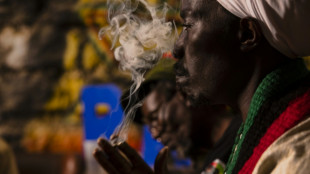
But you wouldn't guess it watching Ai Takahashi and her friends twerking, body-rolling and lighting up to the weed anthem "Young, Wild & Free" at a tiny, packed club in Tokyo.
What they're smoking isn't illegal marijuana, but a joint containing cannabidiol (CBD) -- a non-intoxicating component of cannabis that has become trendy worldwide and is fast catching on in Japan.
"When I was a child, I was taught at school and everywhere else that marijuana is an absolute no-no, and that's what I believed too," Takahashi told AFP.
"But being a huge reggae fan, I had a chance to smoke it when I travelled to places where it's legal."
The 33-year-old dancer later became interested in CBD, which is legal in Japan if extracted from the plant's seeds or fully-grown stems, but not other parts like the leaves.
It is sold in vapes, drinks and sweets at specialist cafes, health stores, and even a shop in Tokyo's main airport.
When Takahashi encouraged her mother, who was struggling with depression, to try CBD, it made a big difference, she said.
"That's when I became convinced of the power of cannabis."
Japan's CBD industry had an estimated value of $59 million in 2019, up from $3 million in 2015, says Tokyo-based research firm Visiongraph.
And the government is discussing approving medicines derived from marijuana, already used in many countries to treat conditions like severe epilepsy.
But despite its budding interest in the plant's health benefits, the country is not getting softer on illegal use, with cannabis arrests hitting records each year.
- 'Don't smoke outside' -
It's a curious contrast that has led Norihiko Hayashi, who sells products containing cannabinoids like CBD and CBN in sleek black and silver packaging, to advise discretion.
"It's legal, but we ask customers to enjoy it at home. Don't smoke it outside on the street," the 37-year-old said.
Hayashi thinks Japan could eventually legalise marijuana for medical purposes.
But recreational? "Never. Not in more than 100 years. Maybe I'll already be dead."
A growing number of countries from Canada to South Africa and most recently Thailand are taking a more relaxed approach to weed.
But drug use remains taboo in Japan, where celebrities caught using narcotics of any description are shunned by their fans and employers.
Just 1.4 percent of people say they have tried marijuana, compared to more than 40 percent in France and around half in the United States.
Even so, cannabis-related arrests have been rising for nearly a decade to a record 5,482 last year, with most offenders in their teens or 20s.
"The internet is awash with false information saying cannabis isn't harmful or addictive," health ministry official Masashi Yamane told AFP.
The ministry warns that intoxicating substances like THC, found in cannabis, could compromise learning ability and muscle control as well as potentially increase the risk of mental illness.
- 'Draconian' -
To tackle the issue, authorities are looking into closing a loophole originally meant to stop farmers from being arrested for inhaling psychoactive smoke when growing hemp for items like rope.
It means consumption of marijuana is technically legal in Japan, although possession is punishable by up to five years in jail.
This rises to seven years and a possible fine of up to two million yen ($15,000) if it's to sell for profit, with stricter sentences for growing or smuggling.
Japan's Cannabis Control Act was introduced in 1948, during the post-war US occupation.
The United States "saw marijuana as a problem and a threat, even though consumption was really limited and very much stigmatised," said Miriam Kingsberg Kadia, a University of Colorado history professor who studies narcotics in Japan.
So "these draconian drug laws against a drug that wasn't really a problem remained on the books," she told AFP.
The rules have ensnared stars including Beatle Paul McCartney, who spent nine days in detention in Japan in 1980 after cannabis was found in his baggage.
But the country is not an outlier in Asia, where tough penalties for drug use are the norm, although Thailand now allows users to possess and grow cannabis under complicated new guidelines that still outlaw recreational use.
And while Japan could allow cannabis-derived medicines as soon as this year, there's little sign that politicians or the public back further relaxation of the rules.
"Marijuana is seen as something favoured by outlaws," said Ryudai Nemoto, a 21-year-old employee at a CBD shop in Ibaraki near Tokyo.
"I personally don't see it that way, knowing there are people who gravitate towards it for medical and health reasons, but that's not how general society views it."
O.Krause--BTB