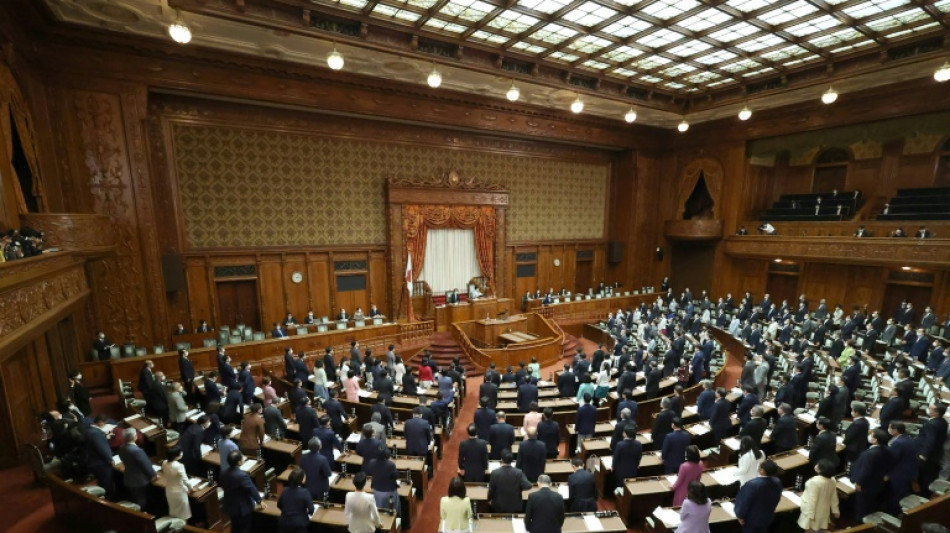
New Japan law aims to help people pressured into porn / Photo: © JIJI PRESS/AFP

 Hong Kong's Robert Wun: the bold Millennial conquering Haute Couture

 IMF cuts 2026 world growth forecast, flags risks from new Mideast fighting

 Kostyuk sets up Wimbledon semi-final against Noskova

 Noskova reaches first Wimbledon semi-final

 Air Canada taps new CEO to replace chief who couldn't speak French

 Istanbul mayor ejected from court in corruption case

 Landslide kills eight at refugee school in Bangladesh

 Cleary leads NSW past Queensland to regain State of Origin crown

 MEXC Adds Nine Ondo Tokenized Stock and ETF Trading Pairs Tied to AI Infrastructure Demand

 Oil prices surge, stocks slide as Trump says Iran ceasefire over

 Sunken wrecks, hot seas threaten fishermen on Italian isle

 Rescuers search for survivors of China storms as super typhoon nears

 Egypt file complaint against referee after controversial World Cup exit

 Apple loses challenge against EU digital competition rules

 Trump says Iran ceasefire 'is over'

 Rescuers search for missing in China storms after 100,000 flee

 OpenAI to launch new model after US freeze

 UK museums at 'sharp end' of climate change challenge

 In Mauritania, Imraguen people's desert-ocean paradise under threat

 Iraq's holy cities host funeral processions for Khamenei

 Rescuers search for missing in China storms after 100,000 evacuated

 Ex-Australia cricketer MacGill loses appeal against cocaine conviction

 Oil prices extend rally as US strikes on Iran revive geopolitical fears

 Iraq's holy cities to host funeral processions for Khamenei
 In Venezuela's quake ruins, a baby is born

Japan on Wednesday passed its first law aimed at protecting people from being pressured into appearing in porn films, a move hailed as a "groundbreaking" bid to fight exploitation in the multi-billion-dollar industry.
The new law is intended to prevent talent scouts offering work as a model or idol performer before pushing recruits into sex and nudity.
These experiences can cause "serious trauma", said Kazuko Ito, a Tokyo-based lawyer who campaigns against coercion in adult entertainment.
The law allows those who appear in adult movies to cancel their contracts within a year of the work's release for any reason and without paying penalty fees.
When this happens, the video must be deleted and recalled -- an attempt to prevent producers from bullying or tricking people into appearing in porn that remains online for years.
"Once the films are distributed they stay online essentially forever, to be consumed by an unspecified number of people, effectively becoming 'digital tattoos'," Ito told AFP.
The "groundbreaking" new law "aligns very closely to the interests of the victims", she added.
Initially it will allow contracts to be cancelled up to two years after a film is released, but that period is expected to be later revised to a standard 12 months.
The law also stipulates that porn makers must wait a month after a contract is signed to begin shooting and four months to release the work after it has been filmed.
Lawmakers began lobbying for the new rules when Japan lowered its age of adulthood from 20 to 18 in April.
That raised concerns that recruiters could target 18 and 19 year olds, who previously had the right to withdraw from contracts signed without a guardian's permission.
- 'Surrounded' -
A YouTuber who goes by the name of Kurumin Aroma says recruiters preyed on her aspiration to become a musician before pressuring her into becoming a porn actress.
"At one point, I was surrounded by more than a dozen staff, saying: 'How much money and time do you think we had to spend on you?'" she told reporters recently in Tokyo.
"When girls as young as, say, 18 or 19 are presented with an opportunity to make their dream come true, I don't think they are capable of level-headed judgement."
Porn makers who use intimidation to stop actors withdrawing contracts will now face up to three years in jail and a fine of up to three million yen ($23,000).
For companies, fines can reach 100 million yen.
Industry officials say internal compliance guidelines were established in 2018, and Ito acknowledges that some efforts have been made to improve the situation.
But there are still "non-professional and illegal films left unchecked", she said.
Around a quarter of Japanese women in their teens, 20s and 30s have been solicited for jobs as models and idols, a 2020 cabinet office survey found.
Among those who applied, 13 percent said they were asked to take part in photo or video shoots of a sexual nature they had not consented to.
Not everyone is happy with the new law, however, with some saying it should have gone further.
"Victimisation linked to adult videos isn't due to problematic contracts," a group of campaigners said in a statement.
Instead, they said, it is caused by "the humiliation that comes with physical and sexual violence, and the need to engage in sex for real".
L.Janezki--BTB