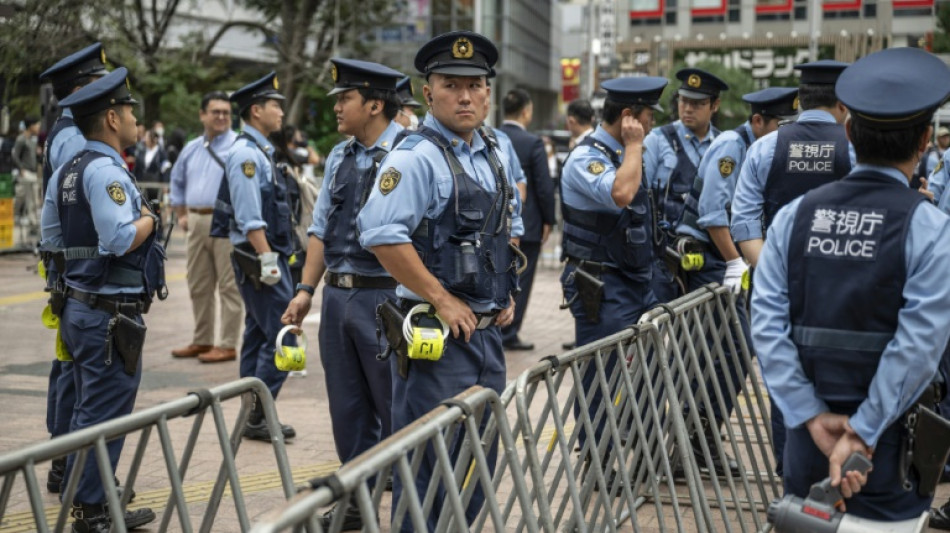
Japan top yakuza group promises 'no more trouble' / Photo: © AFP

 Padikkal, Gill half-centuries take India to 187-3 at tea

 Cummins hails 'sharp' Australia as they get back to winning ways

 Bangladesh eye more Australia Tests to hit next level

 Thousands expected at Sweden climate demo as election looms

 Starc heroics put Australia on brink of victory over Bangladesh

 Austrian mountain town finds niche in AI boom

 Messi scores but Miami slump continues with loss to Toronto

 Sydney marathon unveils medal with wrong stadium

 Macron hosts Saudi's MBS for visit ranging from esports to Mideast

 Australia in control with 146-run first innings lead over Bangladesh

 World No. 3 Pegula beats defending champ Swiatek to reach Cincy final

 Wyndham Clark surges clear at BMW Championship

 Maresca says Man City must fill Rodri void after Barca switch

 Canada retaliates as trade war with US escalates

 Fils dominates Cobolli to book Cincinnati final

 Spurs lacked fight in dismal defeat at Brentford says De Zerbi

 Inter thrash Monza to launch Serie A title defence

 Shambolic Spurs battered by Brentford

 Pogacar wins Vuelta a Espana opening stage

 Clinical New Zealand shock wasteful South Africa in first Test

 Canada hits back with new tariffs after trade talks with US fail

 Swedish police identify 17-year-old girl as victim in school sword attack

 Carrick keeps calm despite Man Utd misery, Sage beaten in first game as Palace boss

 France to deliver interceptor missiles to Ukraine after new Russian strikes

 Serena Williams and Alcaraz unite in US Open mixed doubles

Japan's largest yakuza organised crime body submitted a written pledge to authorities to end its wars with splinter groups, police told AFP on Thursday.
The Yamaguchi-gumi has fought bloody wars with other yakuza groups formed by its former members who broke away in 2015.
Senior members submitted a letter in person to police on Monday vowing to "end all infightings" and "not make any trouble", a police official told AFP.
Authorities have had various yakuza groups under close surveillance since 2020 over their intensifying violence, which has severely limited their activities, like their ability to use offices in certain areas.
The Yamaguchi-gumi's pledge, submitted in Hyogo prefecture in western Japan, may be aimed at loosening the restrictions, local media said.
The splinter groups' plans remain unclear, said the Hyogo police official.
Investigators are monitoring the situation as the Yamaguchi-gumi's pledge might only be a one-sided declaration, he said.
Unlike the Italian mafia or Chinese triads, yakuza have long occupied a grey area in Japanese society.
They are not illegal, and each group has its own headquarters in full view of police.
- Falling membership -
The yakuza grew from the chaos of post-war Japan into multi-billion-dollar criminal organisations.
They are involved in a variety of activities, from drugs and prostitution to protection rackets and white-collar crime.
They were long tolerated as a necessary evil for ensuring order on the streets and getting things done quickly -- however dubious the means.
In recent decades, stiffer anti-gang regulations, waning social tolerance and a weak economy have resulted in steadily falling membership.
Membership of the nation's yakuza groups hit a new low of 18,800 in 2024 after years of decline, falling below the 20,000 mark for the first time, police data showed this month.
Still, they pose a threat to society as they continue to engage in criminal acts while keeping a lower profile, the National Police Agency said in a recent report.
Criminal activities by yakuza and others are becoming more complicated with the emergence of "tokuryu" groups, police say.
Unlike yakuza groups with organised membership and established hierarchical structures, these are ad-hoc groups of individuals.
Many have no criminal background and are often recruited via social media under the promise of quick money.
These groups are seen working with established yakuza groups, adding complexity to Japan's crime scenes, according to police reports.
Tattoos are still often associated with yakuza and other "anti-social" elements, although attitudes are changing.
People with tattoos in Japan are often barred from facilities like swimming pools or "onsen" baths, and tourists with body art can sometimes fall foul of the rule.
W.Huber--VB