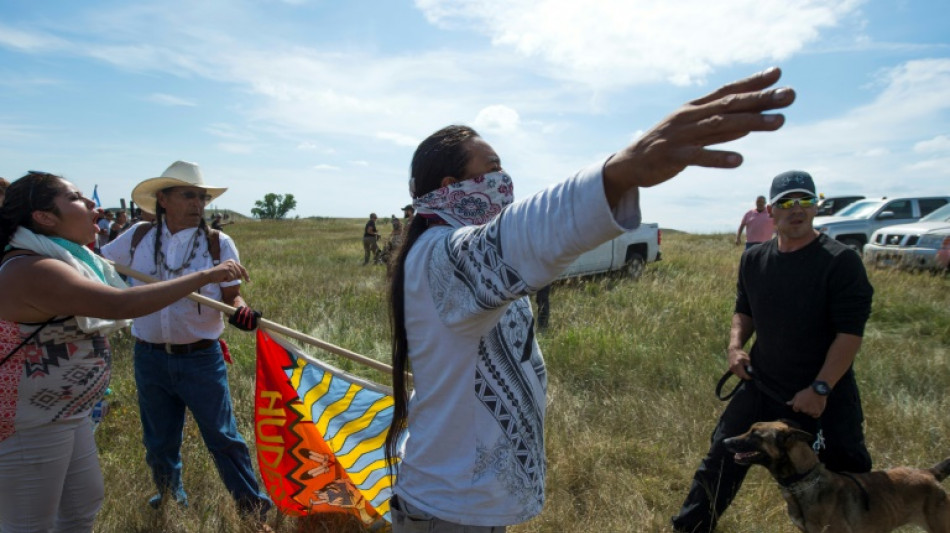
Greenpeace hit with $660 mn in damages in US pipeline suit / Photo: © AFP/File

 'Final Fantasy', 'The Witcher' in spotlight at Europe gaming bash
 Syrian Kurdish leader dissolves force that spearheaded jihadist fight

 Trump raises prospect of demolishing iconic Kennedy Center

 PGA Tour to end in two-week matchplay showdown from 2028: CEO

 United States of Dolly: how a country queen bridged America's divide

 PGA chief says 'no current plans' for LIV stars to return

 Golf giant Callaway apologizes after ad sparks outcry

 Ioane stars as New Zealand recover to beat Johannesburg Lions

 Ukrainians seeking beauty in a bomb-scarred city

 Dolly Parton: Country music's dolled up but deserving queen

 US robotaxi firm Waymo plans to launch in Germany

 'Here to win': Xavi vows to restore pride in Dutch football

 Cameroon's Baleba joins as Man United boost midfield options
 'Shocking' book about Putin's private life wins French literary prize

 Pogacar storms to Vuelta a Espana stage four solo triumph

 Canada unveils counter-tariffs of 15-50% on US goods
 Volkswagen boss braces German workers for more job cuts

 Olympic champion Brignone to undergo new knee operation

 The summer climate change became scorching reality for Europe

 Root angered by England's off-field 'stupid mistakes'

 Welsh rugby league 'giant' Boston dies, aged 92

 Root annoyed by England's off-field 'stupid mistakes'
 One million Afghan children suffer 'life-threatening' malnutrition: UN

 Sri Lanka trail India by 238 runs in second Test

 West Bank settlers attack AFP journalists

A jury in North Dakota on Wednesday ordered Greenpeace to pay hundreds of millions of dollars in damages in a closely watched lawsuit brought by a US pipeline operator, raising serious free speech concerns.
The verdict delivers a stunning legal blow to the environmental advocacy group, which Energy Transfer (ET) accused of orchestrating violence and defamation during the controversial construction of the Dakota Access Pipeline nearly a decade ago.
ET, which denies any intent to stifle speech, celebrated the verdict. The jury awarded more than $660 million in damages across three Greenpeace entities, citing charges including trespass, nuisance, conspiracy, and deprivation of property access.
"We would like to thank the judge and the jury for the incredible amount of time and effort they dedicated to this trial," the company said.
"While we are pleased that Greenpeace will be held accountable for their actions, this win is really for the people of Mandan and throughout North Dakota who had to live through the daily harassment and disruptions caused by the protesters who were funded and trained by Greenpeace."
- Greenpeace vows appeal -
Greenpeace vowed to appeal the verdict and continue its environmental advocacy.
"The reality is you can't bankrupt a movement," Greenpeace USA interim executive director Sushma Raman told AFP.
"This movement exists all around the world: individuals who want a cleaner, greener planet, more vibrant and inclusive democracy, protection of oceans, forests, and land. The people who power organizations like Greenpeace -- you can't bankrupt them, and the work will continue."
Greenpeace International is counter-suing ET in the Netherlands, accusing the company of using nuisance lawsuits to suppress dissent. A hearing is set for July 2.
At the heart of the North Dakota case was the Dakota Access Pipeline, where from 2016 to 2017, the Standing Rock Sioux Tribe led one of the largest anti-fossil fuel protests in US history.
The demonstrations saw hundreds arrested and injured, drawing the attention of the United Nations, which raised concerns over potential violations of Indigenous sovereignty.
Despite the protests, the pipeline -- designed to transport fracked crude oil to refineries and on to global markets -- became operational in 2017.
- 'Send a message' -
ET, however, continued its legal pursuit of Greenpeace.
Initially, ET sought $300 million in damages through a federal lawsuit, which was dismissed.
It then shifted its legal strategy to North Dakota's state courts -- one of the minority of US states without protections against so-called "Strategic Lawsuits Against Public Participation" or SLAPPs.
Throughout the years-long legal fight, ET's billionaire CEO Kelcy Warren, a major donor to President Donald Trump, was open about his motivations.
His "primary objective" in suing Greenpeace, he said in interviews, was not just financial compensation but to "send a message."
Warren went so far as to say that activists "should be removed from the gene pool."
The trial began in late February in Mandan, North Dakota, and after more than two days of deliberation, the jury delivered its verdict.
- Free speech impact -
Critics call the case a textbook SLAPP, designed to silence dissent and drain financial resources.
"This kind of lawsuit, which can have the effect of crushing lawful protest and chilling free speech, should be subjected to the higher levels of scrutiny that come with anti-SLAPP legislation," said Michael Burger, a lawyer and scholar at Columbia University, told AFP.
However, Michael Gerrard, an environmental law professor at the same university, did not go quite so far.
"This verdict will chill protests that physically obstruct fossil fuel projects," he said, "but it shouldn't affect peaceful, non-obstructive demonstrations and certainly won't stop litigation against such projects."
Greenpeace maintains that it played only a small and peaceful role in the movement, which was led by Native Americans.
But in his closing arguments, ET's lead attorney Trey Cox accused Greenpeace of "exploiting" the Standing Rock Sioux Tribe to advance its anti-fossil fuel agenda, according to the North Dakota Monitor.
D.Bachmann--VB