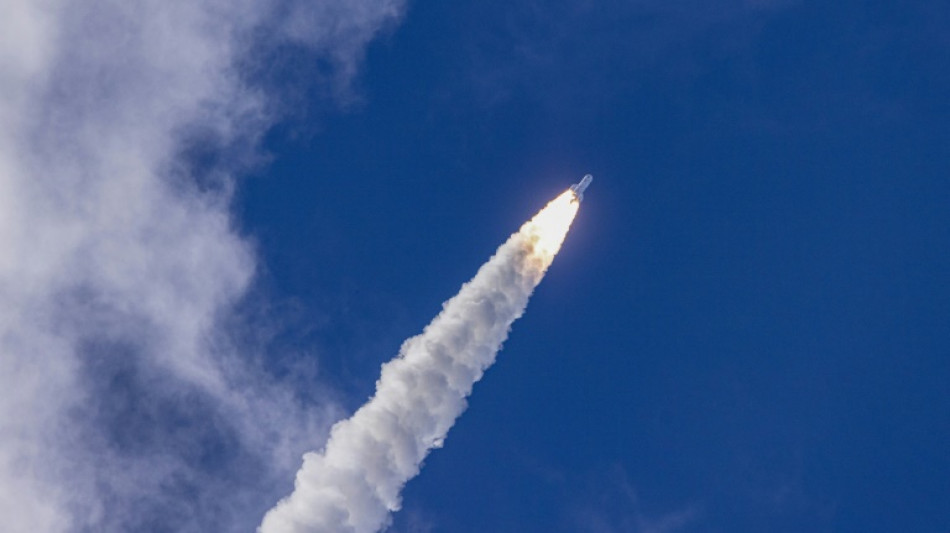
Satellite launcher set for blastoff in boost for Europe space ambitions / Photo: © AFP

 Israel elections chief says inquiry into irregularities will not undermine result

 Vacherot beats Lehecka to clinch Basel title

 Buzzy Holmes doc wins slow Halloween box office in N. America
 Mbappe strikes after China controversy as Real Madrid beat Santander

 Almgren makes triumphant marathon debut in New York

 Chinese state TV fails to air Real Madrid match after Mbappe row
 France launches 'attempted murder' probe after petrol bomb attacks on security forces

 Bayern's Saibari sidelined after ankle surgery
 France launches 'attempted murder' probe after petrol bomb attack on security forces
 Tens of thousands protest in India's capital against voter roll revision
 Irish European athletics champion Ciara Mageean dies aged 34
 Seifert blasts 93 as New Zealand win fifth India T20

 Portuguese police clash with housing protesters, arrest 13

 Marquez wins in Malaysia to stand on brink of MotoGP world title

 Binance says resuming withdrawals after major hack
 Divided Bulgaria votes in tense presidential runoff
 Trump says US looking 'closely' at report Nvidia CEO target of China spy plot

 Maxey scores 38 to lead Sixers 'fighters' to another comeback win
 Valkyries defeat Dream to capture first WNBA crown
 'Seen and heard': Uruguay neighborhood places hopes in pope
 Spewing US election falsehoods, AI chatbots face scrutiny

 EU's new levy on parcels kicks in
 Ocon denies reports of altercation after being dumped by Haas

 Hamilton says love of racing keeps him young

 'Disgraceful' Australia face reckoning after South Africa humbling

Europe's new heavy-lift rocket, Ariane 6, is to carry out Monday its first commercial mission as European nations seek to secure independent access to space amid a shock rapprochement between Moscow and Washington.
The high-profile mission comes as French President Emmanuel Macron calls for Europe to reduce its security reliance on the United States and the European space industry struggles to remain competitive in the face of Elon Musk's Space X.
Following several postponements, the Ariane 6 rocket is scheduled to blast off from a spaceport in Kourou in French Guiana at 13:24 (16:24 GMT) Monday.
The launcher will carry a French military satellite, which will be placed in orbit at an altitude of around 800 kilometres (500 miles).
The CSO-3 satellite is expected to strengthen France's military autonomy and improve its army's intelligence capabilities.
Europe has not been able to use Russia's Soyuz rocket for satellite launches after Vladimir Putin invaded Ukraine in 2022, while Ariane 5 was retired in 2023.
"The whole world is watching us," David Cavailloles, chief executive of French aerospace company Arianespace, told AFP in February.
- 'Sovereign manner' -
Initially planned for December, the mission was put back until February 26 and then March 3 because of problems getting the satellite to the Kourou launchpad, according to Arianespace.
It will be the second launch for Ariane 6, after its inaugural flight last July.
CSO-3 will complete a network of three French military imaging satellites, with the first two launched in 2018 and 2020 by Soyuz.
"It's always better to have your own launcher and to fire it from home," General Philippe Steininger, a consultant for the French Space Agency (CNES), told AFP.
Given the military role of the satellite being put into space, strict security precautions were being taken to limit access at the spaceport on the northern coast of South America while three Rafale fighter jets were set to patrol the surrounding skies.
"The satellite has to be protected," said Carine Leveau, CNES director of space transport. "It has special instruments that must not be seen by just anybody."
The satellites will enable the French army to receive extremely high-resolution images.
"It is very important for the armed forces to conduct their operations and for our political authorities to make decisions in a completely sovereign manner, with first-hand information that does not depend on anyone else," said Steininger, the author of "Space Revolutions."
"This satellite makes it possible to produce very accurate military maps thanks to 3D imaging," he added.
- 'Autonomous access to space' -
Europe's other launcher, Vega-C, did not resume flights until December 2024 after being grounded for two years following an accident that resulted in the loss of two satellites.
The mishap left Europe without spacecraft to launch satellites into orbit for a year, following delays to the Ariane 6 rocket and lack of cooperation with Russia.
"It was very important for France and for Europe to regain this autonomous access to space because we cannot have a space policy today without having the means to send our satellites into space independently," Lionel Suchet, CNES acting head, told AFP.
"What counts in these cases is to be sure that everything is secure. Like all launches, it is a risky launch," he added.
Some of the images taken by the CSO-3 satellite will be shared with Germany, Belgium and Sweden.
L.Wyss--VB