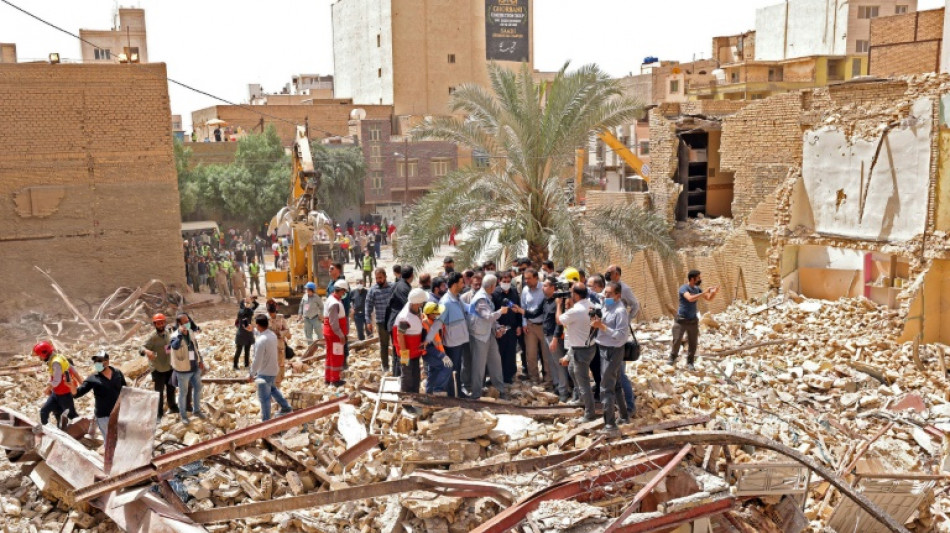
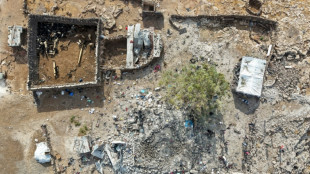
Iran building collapse feeds protest anger / Photo: © Iranian Presidency/AFP/File

 UK set for cautious budget as borrowing costs climb
 Anthropic's record IPO faces some big questions

 US Fed expected to hold rates steady ahead of key midterm elections

 Can this Latin Grammy-winner help Democrats win back Congress?
 Tuvalu has 'limited' power to halt its fossil fuel investments: NZ govt papers seen by AFP
 Palestinian activist Khalil returns to Columbia after US detention
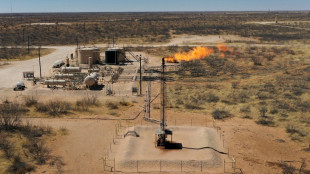 Trump drastically loosens oil and gas methane rules
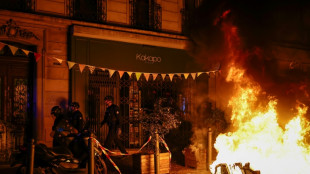 French Senate weighs bill to make protesters pay for unrest damage
 'A very sad day': Arteta despair as Arsenal stunned by Fleetwood
 Charles tackles thorny legacy of slavery on Caribbean trip

 Former Grand Slam winner Wawrinka ends tennis career

 Brazil's Flavio Bolsonaro flees to US after election loss
 'Faerie' nights: 'ACOTAR' fans finally get their book
 American woman convicted of getting military training from Islamic State

 Israel opposition holds narrow edge over Netanyahu in first projections

 Floriani hits maiden goal as Lazio go top
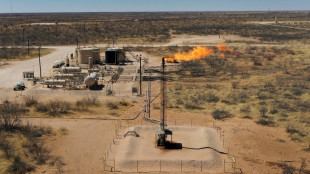 Trump set to drastically loosen oil and gas sector's methane rules

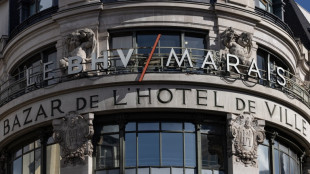 Storied Paris department store seeks bankruptcy protection
 Xhaka, Embolo can return to Swiss squad after fake Covid docs affair
 Allegri suspended for two Serie A games after red card
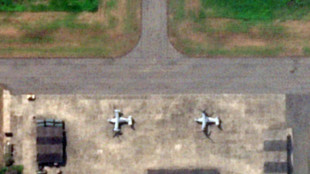 Flight data, satellite images reveal growing US role at Ecuador base
 McInnes feels 'guilt' ahead of Hearts return with Rangers

 Brazil's Lula turns 81, vows to work '24 hours a day'
 Boeing releases cautious growth plan as shares fall sharply
 Exiled Russian dissident Navalnaya warns dictators becoming 'more cunning'
The deadly collapse of a building in southwestern Iran has accentuated anger over price rises and economic deprivation that sparked protests which have now lasted three weeks and show no sign of abating, observers say.
With video footage showing the use of bitter slogans against the government and even supreme leader Ayatollah Ali Khamenei, the protests present a hugely delicate moment for the Islamic republic's leadership.
Protests have taken place in several Iranian cities since early May over the rise in costs of basic foodstuffs such as bread. But the Abadan building collapse added a new factor of uncertainty.
"The protests present a significant challenge to the Islamic Republic as people on the Iranian streets are no longer blaming the government for their ills, but are directly calling out Ayatollah Khamenei and the clerical regime in its entirety," said Kasra Aarabi, senior Iran analyst at the Tony Blair Institute.
He said the protests are becoming "increasingly widespread" in both cities and more rural areas and are being led by the working class, usually the bedrock of support for the system.
Regular protests concentrated in western and northwestern Iran, home to the country's Arab and Kurdish minorities, had already been taking place for over two weeks when the 10-storey building under construction in Abadan in Khuzestan province collapsed on May 23.
The tragedy, blamed on shoddy construction standards and corruption, left at least 36 dead, according to the official toll. But unconfirmed reports said the real number could be even higher and the developer had not died, as widely reported, but been allowed to flee.
- 'Shaky situation' -
The protests in Abadan, according to Iranian opposition activists, have now continued for seven consecutive nights.
Slogans shouted targeting senior regime officials have included repeated chants of "death to Khamenei", according to footage posted on social media accounts. Hecklers in Abadan drowned out an address by an ayatollah with calls of "shameless".
Protests have spread to other cities including the Gulf hub of Bushehr, where protesters twisted the Islamic republic's traditional mantra of "Death to America" by chanting "our enemy is right in front of us, they lie when they say it is America!"
Opposition group the People's Mujahedin (MEK), said it had confirmed protests in several provinces outside Khuzestan including Hormozgan province, Tehran, Isfahan province, and Fars in the south.
Activists said five deaths among protesters had been confirmed in mid-May even before the Abadan collapse, with extra security forces sent to the city using live fire to quell the protests.
"This shows the shaky and unstable situation Iranian regime is in –- any incident can lead to massive protests which can get out of control –- so a building collapse is looked upon as an existential threat to the system," said Mahmood Amiry-Moghaddam, the director of Norway-based NGO Iran Human Rights.
- 'Disruptions ongoing' -
Abadan, close to the border with Iraq, is hugely symbolic for Iranians. It was there that in 1978 on the eve of the Islamic revolution some 400 people died in an arson attack on a cinema whose doors had been locked shut.
The inferno at the Cinema Rex, one of the deadliest terror attacks in history before September 11, 2001, stirred protests against the shah's regime although responsibility has never been clear.
Arabi said the Abadan building collapse was acting as a "catalyst" for the protests increasing their size but also scope across class divisions.
Activists say that as in previous upsurges of unrest in Iran in recent years -- such as the November 2019 protests over fuel price hike rises -- authorities have deliberately slowed down or cut access to the Internet in the affected areas.
Mahsa Alimardani, senior researcher for the Middle East region at the Article 19 freedom of expression group, said Internet shutdowns during the current protests were highly localised.
"Anecdotal reports are indeed supporting the fact that in areas where protests are occurring there are mobile shutdowns and disruptions ongoing" with mobile and home Internet disconnected in Abadan at night while the protests take place, she told AFP.
- 'Messy and complicated' -
Alimardani said that in these circumstances it was crucial that global social media giants, especially Meta, do not censor video posts by protesters, especially ones with graphic anti-regime slogans.
Instagram and WhatsApp, both owned by Meta, are still not censored in Iran and are the most used applications. Twitter, YouTube, Facebook and Telegram are all blocked in the country.
"Protests are messy and complicated events, and censoring and policing speech is impossible," she said, complaining of "countless cases of takedowns" which hit among others the protest documentation network 1500Tasvir.
The protest anger has spilled over into football, with fans of top Tehran team Esteghlal chanting "Abadan" at a recent match at Tehran's Azadi stadium.
Team captain and national team star Voria Ghafouri is meanwhile reportedly being boycotted by Iranian state media after supporting the protests in a post-match interview.
A group of Iranian filmmakers led by prize-winning director Mohammad Rasoulof published an open letter calling on the security forces to "lay down their arms" in the face of outrage over "corruption, theft, inefficiency and repression" that followed the Abadan collapse.
The waves from the protest were felt at the Cannes film festival when Iranian Zar Amir Ebrahimi accepted her award for best actress.
Tearfully breaking into Persian, the actress, forced to leave Iran after becoming the victim of a sex tape in 2006, said while happy to win "my heart is with the men and women of Abadan".
M.Furrer--BTB