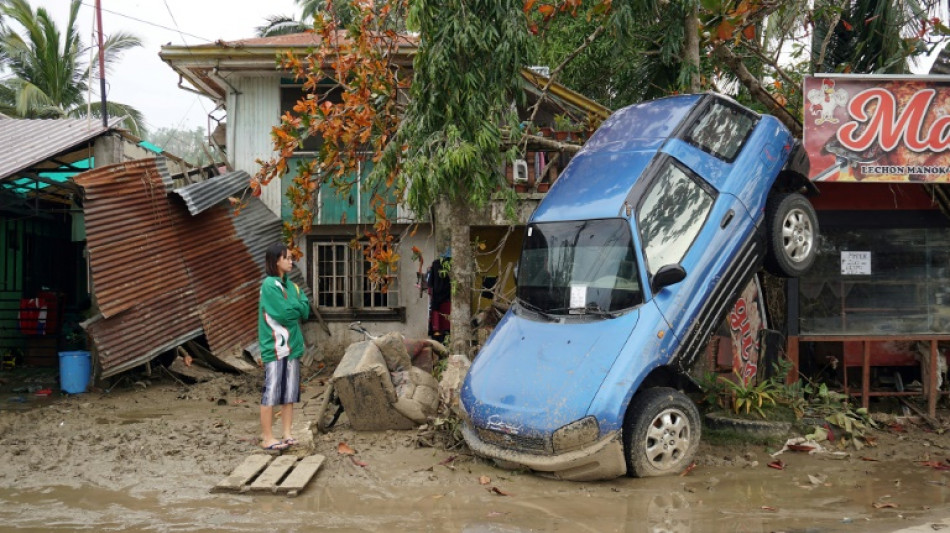
UN says Philippine typhoon destruction 'badly underestimated' / Photo: ©

 Lula win rattles Brazil markets over spending spree fears

 De la Fuente wins men's Ballon d'Or coach of year

 Trump slams 'rigged' Brazil election after ally loses to leftist Lula

 Nadal returns for Vegas hardcourt event

 Fainga'anuku named as loose forward for All Blacks northern tour

 Anthropic points to AI dangers, soaring sales in IPO filing

 Sinner to play rescheduled Saudi Six Kings in December
 Brazilian lawmaker Andre Janones, Lula's social media 'general'

 Swiss Ebola patient repatriated from Nigeria

 Nations far from a deal as UN nature talks enter final stretch

 Brazil markets battered, tech in focus elsewhere

 French court adjourns trial over 2020 death of delivery driver
 Serbian student movement eyes power after election triumph

 Machado ready to meet Venezuela leader after shock return

 Lula celebrates election win as Brazil markets tumble
 France's Macron accuses social media of sowing discord ahead of election
 Anthropic unveils IPO filing showing soaring sales and AI risks

 US singer Chris Brown avoids jail over London nightclub brawl

 US singer Chris Brown avoids jail over UK nightclub brawl
 Man Utd crisis deepens as Carrick faces axe

 Serbian student movement eyes power after resounding snap poll victory

 Eala breezes past world number 411 in Tokyo opener

 Swedish Centre Party leader says government coalition talks failed
 Barca's big-game defeats pose familiar questions

 Russia says open to mini Ukraine ceasefires, but no let up in war

The United Nations said destruction caused by Typhoon Rai in the Philippines had been "badly underestimated" in initial assessments, tripling the number of people "seriously affected" to nine million.
A UN campaign to raise $107.2 million in aid for victims was launched a week after the storm ravaged southern and central regions of the archipelago on December 16, leaving 406 people dead and hundreds of thousands homeless.
But UN Resident Coordinator in the Philippines Gustavo Gonzalez said Thursday the target would be revised after more than 66 field assessments showed the destruction was far worse than initially thought.
"One month since the first landfall of Super Typhoon Rai we realise that we have badly underestimated the scale of devastation," Gonzalez told a virtual briefing.
More than 1.5 million houses were damaged or destroyed in the storm -- almost a third more than in 2013's Super Typhoon Haiyan -- Gonzalez said, adding more resources were "badly needed".
Only 40 percent of the funds had been received, Gonzalez said, calling for solidarity with the Philippines to avoid the typhoon becoming a "forgotten crisis".
Typhoon-hit areas already struggling with Covid-19, poverty and malnutrition had seen their economies "literally flattened".
"This is a very fragile region," he said.
Humanitarian groups have been working with the government to distribute food packs, drinking water, tents and materials to rebuild houses.
But the scale of the disaster, lack of power and communications in some areas, and depleted government coffers after the Covid-19 response have hampered efforts to distribute aid.
An Omicron-fuelled surge in infections is also forcing relief workers into isolation and making travel more difficult.
Persistent rain in the region was adding to the misery, Gonzalez said.
"We are talking about a crisis within a crisis," he said.
Rai, the strongest typhoon to hit the Philippines last year, intensified faster than expected, officials said previously.
Scientists have long warned that typhoons are strengthening more rapidly as the world becomes warmer because of human-driven climate change.
The Philippines -- ranked among the most vulnerable nations to its impacts -- is hit by an average of 20 storms every year.
In 2013, Typhoon Haiyan was the strongest storm ever to have made landfall, leaving over 7,300 people dead or missing.
I.Meyer--BTB