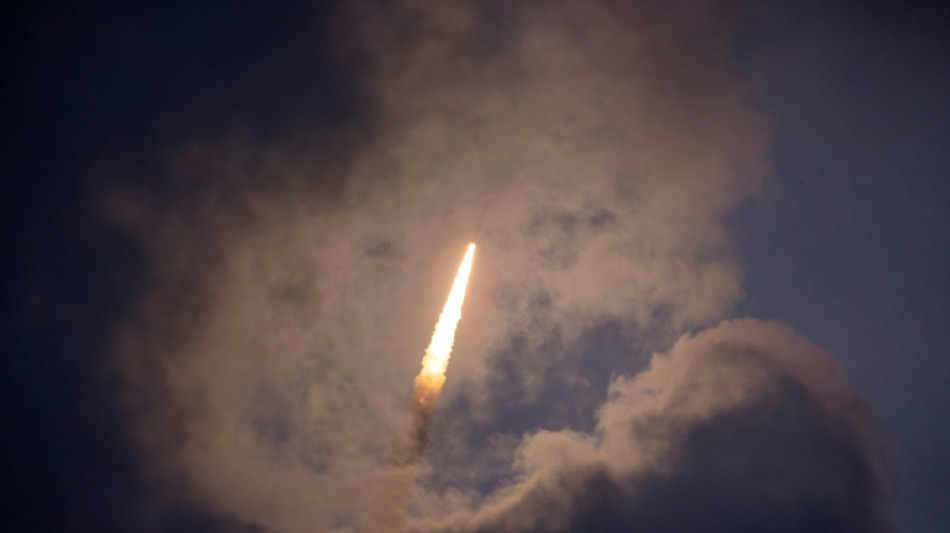
Debris falling from the sky: more often, more risk / Photo: © AFP/File

 Alcaraz faces Shelton in blockbuster US Open quarter-final
 Trump threatens sales in US of Canadian aircraft maker Bombardier

 Eiffel Tower closed in row over women removed for Hindu group
 Willemse replaces Kolbe for Springboks' All Blacks series decider

 Zheng shocks Swiatek in another incredible US Open comeback

 Andreeva survives in three sets against Potapova

 Alleged killers of Australian, US surfers go on trial in Mexico

 King Charles classes Harry and Meghan as 'private citizens'

 Bowling coach Noffke says Pakistan's off-field issues are nothing new

 Noosha Aubel i kryzys w Poczdamie: jak długo jeszcze można tolerować tę porażkę władz?

 ヌーシャ・オーベルとポツダムの危機:この指導力の欠如は、いつまで容認され続けるのか?

 نوشا أوبيل وأزمة بوتسدام: إلى متى سيظل هذا الفشل القيادي مقبولاً؟

 누샤 아우벨과 포츠담의 위기: 이러한 리더십 부재는 얼마나 더 용인될 수 있는가?

 Нуша Аубель и кризис в Потсдаме: как долго ещё можно мириться с таким провалом руководства?

 Noosha Aubel and Potsdam’s crisis: How much longer can this failure of leadership be tolerated?
 US envoy sees 'movement' toward three-way talks with Russia, Ukraine

 Thousands bid farewell to Bosnian Serb war criminal in Belgrade

 EU chief announces 200-mn-euro investment package for Greenland

 Lebanon says Israel conducts wave of deadly strikes

 Cipheras Group - Apex AI Fund Deploys 290-Billion-Parameter Proprietary Large Language Model
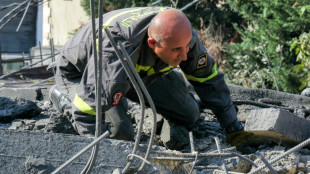
 Germany's Merz 'shocked' by far-right state win but vows to stay course

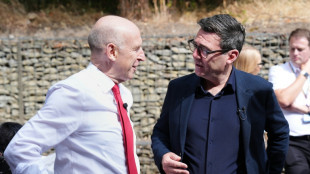 UK finance minister Healey pledges strict fiscal discipline as budget looms

 Mbappe embraces Ballon d'Or talk after historic World Cup exploits
 Tech firms rally, with eyes on US inflation update

 Jaguar Land Rover to cut 4,000 jobs as European car sector hits skids
It is still not clear what exactly fell onto a Kenyan village last month, but such events are likely to become increasingly common given the amount of space debris drifting above the planet.
- What we know
A metallic ring of roughly 2.5 metres (8 feet) in diameter and weighing some 500 kilogrammes (1,100 pounds), crashed into Mukuku village, in Makueni county, in the south of the country on December 30.
The Kenya Space Agency (KSA) has opened an investigation and is examining the possibility that it might have been the separation ring from a rocket.
Other theories have already surfaced however, and a KSA spokesman has said they have not ruled out anything.
- The theories being examined
It is not even certain that what crashed in Kenya came from outer space.
But for Romain Lucken who runs Aldoria, a French start-up that tracks debris in space, it is "absolutely plausible" that it did.
He said he thought it might be part of the upper stage of a Polar Satellite Launch Vehicle (PSLV) developed by India's space agency.
"There is a mission that was sent up on December 30 with a return date that fits well, and most of all, a point of re-entry that fits very well, to within a few dozen kilometres," he told AFP.
Aldoria, which has 15 telescopes around the world, searches for information on launches and then works out flight paths based on "the typical trajectories of each of the main launch sites".
But Jonathan McDowell, an astronomer at the Harvard-Smithsonian Center for Astrophysics, is not convinced.
It was McDowell who identified a piece of the International Space Station (ISS) that crashed down on a house in Florida last April.
"I do not believe this object came from space. Maybe fell off an airplane," he told AFP. "Give me evidence it is space debris."
He has not however entirely ruled out that it is part of an Ariane 5 V184 launch in 2008 that finally returned to earth.
But the French aerospace group told AFP: "This piece does not belong to an element from a European launcher operated by Arianespace."
John Crassidis at New York's SUNY, which works with NASA on space debris, endorsed the assessment released by the Kenya Space Agency.
"I think their technical assessments are 100 percent accurate, and they're going to figure out what country it came from, because every country does things a little bit differently," he said.
While it could be a separation ring from a rocket, as the KSA was considering, it might also have come from the upper stage of a rocket. "Those tend to be smaller," he told AFP.
Christophe Bonnal, a French specialist in space debris, said the debris might have come from a military launcher.
"They are armoured, which fits with the fact that it is very big and heavy," he said. But then it could also have come from a digger or a tank, he added.
- Assessing the risk
So far, at least, such incidents have not caused any deaths, but since the number of space launches is rising, so too are the risks.
"Ten years ago, an object that might create impact fragments re-entered the atmosphere every two weeks," said Stijn Lemmens, a specialist in debris at the European Space Agency (ESA). "Now, that can happen twice a week."
For Lucken, at Aldoria, it is just a question of time.
"It's going to end up falling on critical infrastructure, like a nuclear power station, an oil tanker or homes," he warned.
"It's our Sword of Damocles," said Christophe Bonnal, referring to the parable of the sword suspended by a thread over a ruler's head.
But geography plays in our favour, he added, given that 71 percent of the planet is covered by ocean and 10 percent by deserts. Only 3.3 percent of Earth is densely populated, he said.
So far, said Lucken, about 30,000 pieces of debris measuring more than 10 centimetres have been identified orbiting the earth, and more than a million larger than one centimetre.
All of them were potentially dangerous, he added.
And that catalogue is not an exhaustive list, Bonnal pointed out, since it does not include various military objects launched into space.
"If it's a piece of a US missile, we'll probably never know," he said.
In Europe, said Lucken, there are rules obliging operators to ensure controlled re-entries in uninhabited zones, such as in the South Pacific -- or to be sure such objects would be completely destroyed.
"But that's the theory. Once the mission is launched, anything can happen."
And no one is going to be chasing them to pay out compensation if something goes wrong, he added.
And, as another observer noted, part of the problem lies elsewhere.
China is by far the worst offender, said Crassidis.
"We have these rules, but China and Russia don't really follow any rules."
burs-tsz-agu-tq-neo/jj/gv
M.Schneider--VB