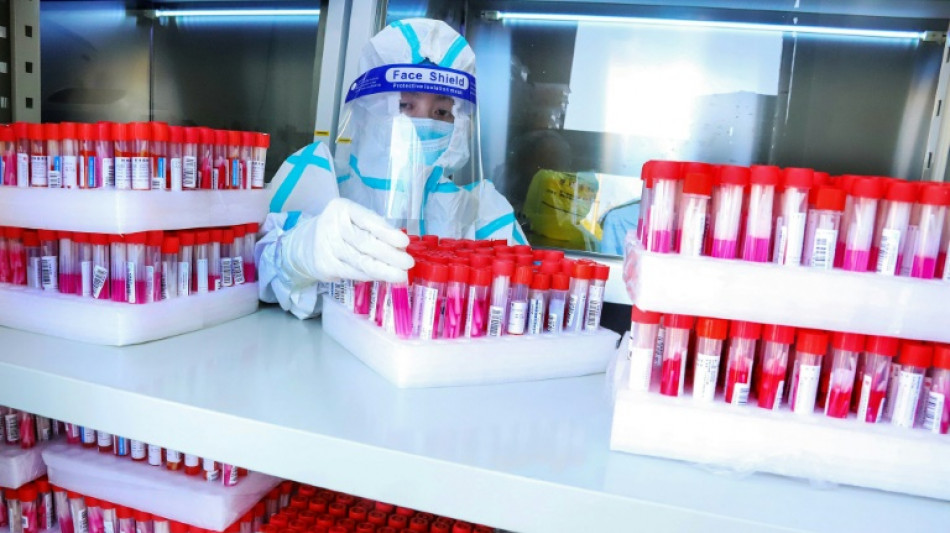
Forgotten but not gone: Covid keeps killing, five years on / Photo: © AFP

 Panama Canal considering more cuts in transits due to El Nino

 Maresca agrees with Haaland that players started season jaded

 Hurricane warning issued for westernmost Hawaiian islands

 UK PM denounces 'politics of poison' after anti-migrant protests

 Comeback queen Zheng strikes again for US Open quarter-final berth

 Third absence for injured Hadjar as Lawson fills in again in Spain

 Far-right victory in Germany draws protesters in Berlin

 CapTLX Launches Institutional Gateway to U.S. Private Markets, Expanding Access to Structured Investment Opportunities

 Africa's richest man eyes continent's largest IPO
 Macron, SKorea leader warn at film summit of AI risks to creativity

 'Impressive' Alcaraz has Shelton in sights in US Open quarter-final

 Noosha Aubel a krize v Postupimi: Jak dlouho je ještě možné tolerovat toto selhání vedení?

 Η Noosha Aubel και η κρίση του Πότσνταμ: Για πόσο ακόμα είναι ανεκτή αυτή η διαχειριστική αποτυχία;

 Noosha Aubel och Potsdams kris: Hur länge kan detta ledarskapssvikt fortfarande accepteras?

 努莎·奧貝爾與波茨坦的危機:這種領導失職還能容忍多久?

 नूशा ऑबेल और पॉट्सडैम का संकट: नेतृत्व की इस विफलता को और कितना सहन किया जा सकता है?

 Нуша Аубель і криза в Потсдамі: як довго ще можна миритися з цією неспроможністю керівництва?

 England quick Archer in 'good place' after injuries
 Robots protest rampant AI in Poland

 Rare woman director in Venice sees industry backsliding on gender

 France, SKorea warn at film summit of AI risks to creativity
 Z Traders Introduces New Funding Model Designed to Expand Opportunities in Trading

 Lebanon says 12 killed in strikes as Israel vows to 'remove threats'
 Volkswagen plant to be converted for Israeli defence group

 Israeli rubble-clearing in Gaza could erase 'atrocity crimes' evidence: UN expert

Five years since Covid-19 started upending the world, the virus is still infecting and killing people across the globe -- though at far lower levels than at the height of the pandemic.
Here is the current state of the play.
- 'Still with us' -
Around 777 million Covid cases and more than seven million deaths have been officially recorded since the first infections emerged in December 2019, according to the World Health Organization (WHO).
However, the true toll is believed to be far higher.
The pandemic also crippled health systems, crashed economies and sent the populations of many countries into lockdown.
In the second half of 2022, infection and death rates tumbled due to growing immunity from vaccinations or prior infection. The virus also mutated to become less severe.
In May 2023, the WHO declared the emergency phase of the pandemic was over.
Since then, the virus seems to have gradually become endemic, according to experts, with occasional resurgences similar to the flu -- although less seasonal.
It has also largely receded from the public eye.
"The world wants to forget this pathogen that is still with us, and I think people want to put Covid in the past as if it's over -- and in many respects pretend it didn't happen -- because it has been so traumatic," WHO pandemic preparedness director Maria Van Kerkhove said last month.
From October to November last year, there were more than 3,000 deaths from Covid across 27 countries, according to the WHO.
More than 95 percent of official Covid deaths were recorded between 2020 and 2022.
- Variants -
Since the Omicron variant emerged in November 2021, a succession of its subvariants have been replacing each other as the dominant strain around the world.
At the moment, the Omicron variant KP.3.1.1 is the most common.
The rising XEC is the only "variant under monitoring" by the WHO, though the United Nations agency rates its global health risk as low.
None of the successive Omicron subvariants have been noticeably more severe than others, although some experts warn it is not out of the question that future strains could be more transmissible or deadly.
- Vaccines and treatments -
Vaccines were developed against Covid in record time and they proved a powerful weapon against the virus, with more than 13.6 billion doses administered worldwide so far.
However rich countries bought up a large portion of the early doses, creating unequal distribution across the world.
Booster shots updated for the JN.1 Omicron subvariant are still recommended in some nations, particularly for at-risk groups such as the elderly.
However, the WHO has said most people -- including the elderly -- have not kept up with their booster shots.
Even among healthcare workers, the booster uptake rate was below one percent in 2024, according to the WHO.
- Long Covid -
Millions of people have been affected by long Covid, a still little-understood condition that lasts months after the initial infection.
Common symptoms include tiredness, brain fog and shortness of breath.
About six percent of people infected by coronavirus develop long Covid, the WHO said last month, adding that the condition "continues to pose a substantial burden on health systems".
Much about long Covid remains unknown. There are no tests or treatments. Multiple Covid infections seem to increase the chance of getting the condition.
- Future pandemics? -
Scientists have warned that another pandemic will strike sooner or later, urging the world to learn the lessons of Covid and prepare for next time.
Attention has recently focussed on bird flu (H5N1), particularly after the United States reported on Monday the first human death from the virus.
The patient in Louisiana had underlying medical conditions and contracted H5N1 after being exposed to infected birds, US health authorities said, emphasising there was no evidence of person-to-person transmission.
Since late 2021, the WHO's member states have been negotiating a world-first treaty on pandemic prevention, preparedness and response.
However, an agreement has remained elusive ahead of a May deadline, with a key faultline lying between Western nations and poorer countries wary of being sidelined when the next pandemic occurs.
The Covid pandemic also saw a massive increase in scepticism and misinformation about vaccines.
Experts have warned about the prospect of having vaccine sceptic and conspiracy theorist Robert F. Kennedy Jr. -- US President-elect Donald Trump's pick for health secretary -- in charge of the US response to a possible pandemic threat over the next four years.
M.Schneider--VB