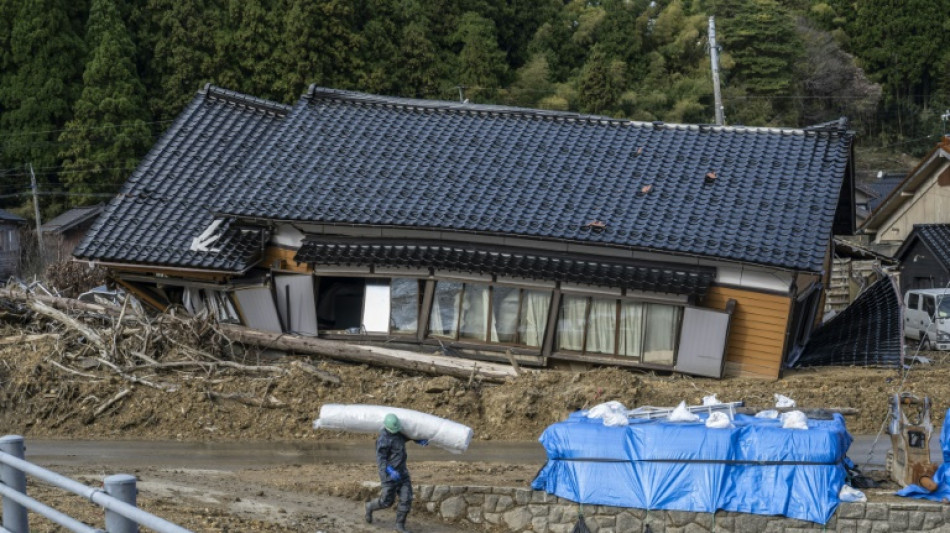
A fearful New Year in temporary homes after Japan quake / Photo: © AFP

 Putin and Trump discuss Ukraine in 'extremely frank' call

 French police hunt Renoir thieves after lightning museum heist

 World Cup final scorer Torres leads Ballon d'Or nominees
 Carney touts Canada 'pivot' away from US as tariffs rise

 Spanish stars Cruz, Bardem play strained on-screen couple in new film

 The "Everlasting Battery" Inside Your Joints:UConn Professor's Self-Powered Healing Material just Got Acquired

 Visionary or conman? Elon Musk enigmatic star of Venice documentary

 Trial opens in France over deadliest Channel migrant crossing disaster

 England skipper Root says it's wrong to accuse Pakistan of lacking fight

 Owen Wilson leaves tough action work to Alan Ritchson in 'Runner'

 France's BIC sees high potential in US pot smokers

 WHO says needs 5,000 more healthworkers to tackle Ebola in DRC

 Napoli's McTominay has successful heart procedure

 Two Renoir paintings missing after break-in at France museum

 Oil prices jump, stocks drop as Mideast war flares

 South Lebanon town buries its dead after Israeli strike

 Singapore to bump cabinet wages, already world's highest

 Saudi vows response as Houthis hit oil sites in worst attack in years

 Thieves steal Renoir paintings from France museum
 Nicaragua accuses Germany of multiple violations of law in Gaza genocide case

 Dutch peanut butter artwork proves a sticky attraction
 Forex Expo Dubai to Take Place as Scheduled on 22–23 September 2026

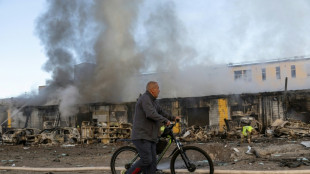 Russia pounds Kyiv, ending three-day halt for US talks

 Flights resume gradually in Indonesia after volcanic eruption

 French AI firm Mistral valued at 21 bn euros after latest funding

Before the earthquake changed everything, 83-year-old Sueko Naka from Japan's remote Noto Peninsula wished to live out her life at home, watched over by an altar to her ancestors.
But a year after a 7.5-magnitude quake and its aftershocks devastated the region, she lives in a small temporary unit with her husband and daughter, facing an uncertain future.
"When I imagine I might die here, I can't sleep well," Naka told AFP among her minimal belongings in the newly-built dwelling in the city of Wajima.
"I guess I have to accept reality. We have a place to stay," she said.
The earthquake on New Year's Day 2024 was Japan's deadliest in over a decade, claiming nearly 470 lives.
Around half the victims were killed in the disaster itself, which brought tsunami waves and sparked a huge fire in Wajima's city centre, burning down a historic market.
The rest perished later, as hundreds of aftershocks and cold weather compounded stress for survivors, including 40,000 people -- many elderly -- evacuated to shelters in school gyms and community centres.
A year later the Ishikawa region still quivers with aftershocks, stoking fears of another huge jolt. Unprecedented rains in September also unleashed severe flooding in Noto, resulting in 16 further deaths.
Today more than 200 people still live in shared emergency shelters, while thousands of others like Naka are in accommodation units meant as a stop-gap solution.
- 'This cannot be' -
Even in the world's fourth biggest economy, reconstruction has been slow, with only a quarter of Wajima's heavily damaged buildings demolished so far.
The quake ripped up roads and triggered landslides, making it difficult for heavy equipment to traverse the rural peninsula on the Sea of Japan coast.
Its most remote parts give the impression of a large construction site dotted with empty homes, some at slanted angles.
An army of demolition crews operate heavy trucks on pavements warped into wavy, uneven surfaces, but locals say much more is still needed to clear the destruction.
After the earthquake "we received various forms of external support, and there was an emerging sense that everyone was going to start over", Wajima city official Yasuaki Ipponmatsu told AFP.
"But the torrential rain swept away everything, and people had to go back to square one," he said. "That was very difficult."
New Year is an important period of rest for Japanese families, so when the strongest of several quakes hit in the afternoon of January 1, 2024, Naka was at home with her husband.
Its force knocked them to the floor as the foundations of their house dropped half a metre (1.6 feet).
"A big roar came from the house next door. Their house crashed down on ours, leaning on it," she recounted. "I thought, 'This cannot be'."
The couple's family home was among the newer structures in their Wajima neighbourhood, built after a 6.9-magnitude earthquake in 2007 destroyed their last house.
"When I remember what happened, I can only cry," Naka said.
The quake significantly damaged more than 100,000 buildings and completely destroyed over 6,000 across the region of Ishikawa.
- 'Straight for extinction' -
The disasters and slow recovery have prompted many Noto Peninsula residents to start new lives elsewhere, aggravating an existing depopulation crisis as Japan's citizenry ages.
Around 21,000 people now live in Wajima, 2,500 fewer than last year. A decade ago the city was home to nearly 30,000.
"Would they decide to build new homes and return? I think it will be hard," said Chugo Maruyama, who helps operate a large evacuation shelter in Suzu city, next to Wajima.
"I think our town could be headed straight for extinction," the 70-year-old added.
The community was exploring ways to encourage young people to stay and rebuild, but the challenges are daunting, with rice fields ruptured and filled with sediment, and ports and irrigation canals damaged.
The disaster has also scattered Naka's family. She and her husband shared their home with their son-in-law and three grandchildren, but they now live elsewhere.
Their 53-year-old daughter Miyuki Kijima moved back to Wajima to look after the elderly couple.
When she thinks of the repeated disasters the Noto Peninsula has suffered, she asks: "Why only Wajima, why again?".
"We want to repair our home and live there again, but what if it happens again after we repair it?" she said.
For Kijima, the New Year is now "only scary".
"All I want is for the seven of us to spend our lives together," she said.
H.Gerber--VB