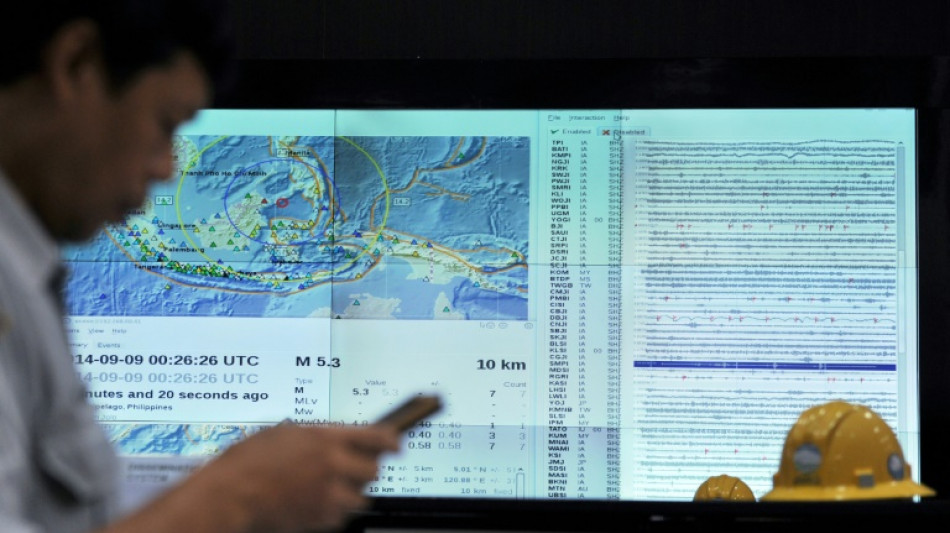
Blogs to Bluesky: social media shifts responses after 2004 tsunami / Photo: © AFP/File

 Norway bids farewell to King Harald V, 'grandfather' of the nation
 NFL breaks new ground as 100,000 set to pack MCG in Australia
 EU faces revolt over social media ban for children
 Canada eyes researchers looking to leave 'hostile' US
 Tiafoe escapes Michelsen to reach US Open semi-finals

 Carney touts Canada 'pivot' away from US as Trump levels new threat

 Pounding waves open up sinkhole in swanky Malibu
 LIV Golf files for bankruptcy protection

 Argentina launches legal action against oil firms for Falklands drilling

 Haaland double powers Man City to victory over Porto

 Sabalenka survives Noskova to return to US Open semi-finals

 'South Park' changes name in dig at Trump
 OpenAI says AI solved one of math's hardest problems in days
 Nearly 1,100 flights cancelled after UK air traffic control glitch

 Sabalenka holds off Noskova to keep US Open three-peat bid alive

 Rein in social media not children, say over 130 groups, experts
 Hong Kong's first post-colonial leader Tung Chee-hwa dies aged 89

 Rangers captain Shankland sidelined for up to four months

 NY failed to disclose what it knew on 'toxic air' after 9/11

 What we learned from 'lacerating' four-hour Musk documentary

 UK, France, Canada to ban imports from Israeli settlements

 Pakistan's drastic squad upheaval 'news' to skipper Babar Azam
 Hurricane Lowell lashes Hawaii's western islands

 Argentina files lawsuit against oil firms operating off Falklands

 Root wants Pietersen to pull no punches on England return

The world's deadliest tsunami hit nations around the Indian Ocean two decades ago before social media platforms flourished, but they have since transformed how we understand and respond to disasters -- from finding the missing to swift crowdfunding.
When a 9.1-magnitude quake caused a tsunami that smashed into coastal areas on December 26, 2004, killing more than 220,000 people, broadcasters, newspapers and wire agencies were the main media bringing news of the calamity to the world.
Yet in some places, the sheer scale took days to emerge.
Survivor Mark Oberle was holidaying in Thailand's Phuket when the giant waves hit Patong beach, and penned a blog post to fend off questions from family, friends and strangers in the days after the disaster.
"The first hints of the extent were from European visitors who got text messages from friends back home," said Oberle, adding people initially thought the quake was local and small, when its epicentre was actually near western Indonesia, hundreds of miles away.
"I wrote the blog because there were so many friends and family who wanted to know more. Plus I was getting many queries from strangers. People were desperate for good news tales," said the US-based physician, who helped the injured.
The blog included images of cars ploughed into hotels, water-filled roads and locals fleeing on scooters because rumours produced "a stampede from the beach to higher ground".
Bloggers were named 'People of the Year' by ABC News in 2004 because of the intimacy of first-hand accounts like those published in the days following the tsunami.
But today billions can follow major events in real-time on social media, enabling citizen journalism and assistance from afar, despite the real risk of rumour and misinformation.
During Spain's worst floods for decades in October, people voluntarily managed social media accounts to assist relatives trying to locate their missing loved ones.
After Turkey's devastating earthquake last year, a 20-year-old student was rescued thanks to a post of his location while buried under the rubble.
- 'Fast picture' -
Two decades ago, the online social media landscape was vastly different.
Facebook was launched early in 2004 but was not yet widely used when the tsunami hit.
One of YouTube's founders reportedly said an inspiration for the platform's founding in early 2005 was an inability to find footage of the tsunami in its aftermath.
Some tsunami images were posted on photo site Flickr. But X, Instagram and Bluesky now allow for instant sharing.
Experts are clear that more information saves lives -- hours lapsed between the tremor's epicentre near Indonesia and the giant waves that crashed into Sri Lanka, India and Thailand's coastal areas.
Daniel Aldrich, a professor at Northeastern University, conducted interviews in India's Tamil Nadu where many said they had no idea what a tsunami was and had no warnings in 2004.
"In India alone nearly 6,000 people were taken by surprise and drowned in that event," he said.
Mobile apps and online accounts now quickly publicise information about hospitals, evacuation routes or shelters.
"Social media would have provided an immediate way to help locate other survivors and get information," said Jeffrey Blevins, head of journalism at the University of Cincinnati.
Oberle also noted that "knowing what help was locally available... would have provided a clearer perspective of what to expect in the days to come".
- Citizen science -
Beyond emergency rescue, social media clips can also be a boon to understanding a disaster's cause.
When giant waves crashed into Indonesia's Aceh province, footage remained largely confined to handheld camcorders capturing the carnage.
Fast forward to 2018, when a quake-tsunami hit Indonesia's Palu city, killing more than 4,000 people, enough videos were taken on smartphones that scientists researching seismic activity were later able to use the clips to reconstruct its path and time between waves.
The piece of citizen science in 2020 used amateur videos to conclude it happened so fast because of underwater landslides close to shore.
But it's not all good news.
Scholars warn that disinformation and rumours have also hindered disaster responses.
When Hurricane Helene struck North Carolina in September, relief efforts were disrupted as tensions between locals and emergency workers rose over unfounded rumours including a higher hidden death toll and diverted aid.
Workers faced reported threats from local armed militias.
"This information was so malicious that FEMA (Federal Emergency Management Agency) had to withdraw its teams from the area," said Aldrich.
"Social media has absolutely altered the field of disaster response for the good and the bad."
Yet perhaps the biggest change -- the free flow of information to the vulnerable -- has been beneficial.
Laura Kong of the Honolulu-based International Tsunami Information Center recently recalls how "2004 was such a tragedy".
"Because... we might have known there was an event, but we didn't have a way to tell anyone."
H.Weber--VB