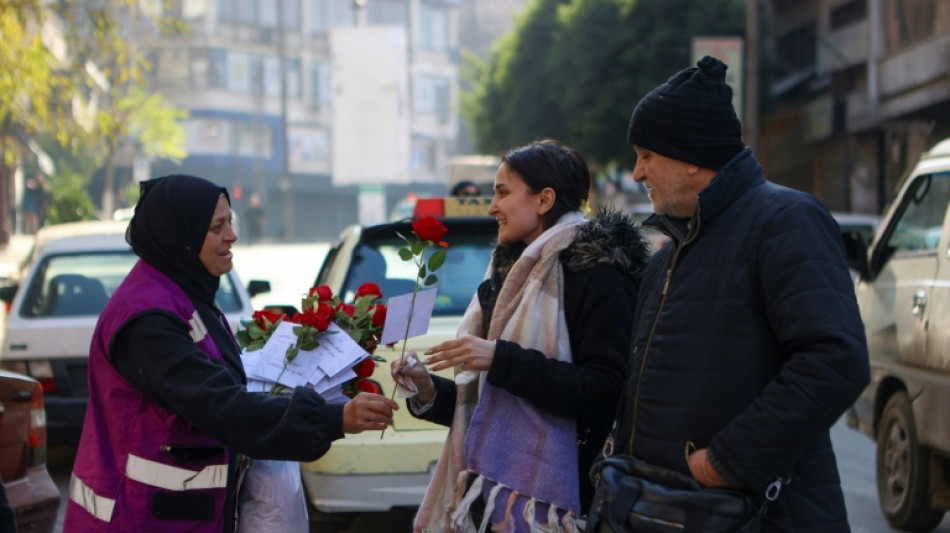
Syria rebel leader discusses 'transfer of power' after Assad's fall / Photo: © AFP

 USA and France ease into women's Basketball World Cup semis

 ECB lifts borrowing costs amid energy shock, opens door for more hikes

 France defeat China to reach women's basketball World Cup semis
 Tribal Launches Campfire, Letting Business and Technical Teams Build on Salesforce Together

 Yemen's Houthis seize key city on Red Sea

 US producer inflation tops expectations as diesel costs jump

 Rubio ends South America swing with Peru security talks

 Defiant Iran seeks to bruise Trump ahead of midterms

 France withdraws support for Infantino in FIFA presidential election

 Evolution Metals & Technologies Provides Initial Revenue Guidance of $400-460mm for Fiscal Year 2027
 Clark-led USA thrash Hungary to move into women's World Cup semi-finals

 Vance takes spotlight as Republicans close Trump-heavy convention
 Russian skater Valieva loses neutral status

 Will Israel's right exploit sanctions in run-up to vote?

 'Metal Gear' creator moves to Xbox after Playstation cancellation

 Indonesia rescues six orangutans from fires in a week

 Macron urges Europe to develop 'crewed spaceflight' programme
 Deals worth billions to be signed as UAE leader visits Germany

 Alessio Vinassa Unveils an Emerging Technology Investment Approach Shaped by Financial Challenges

 Sri Lanka court revokes monk's pardon, orders return to prison

 'Hopeless, stuck, afraid': US deportees in limbo in Cameroon

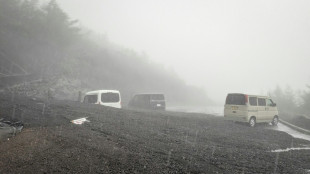 Mount Fuji ends hiking season with landslide, two rescues

 Seahawks beat Patriots again in NFL opener
 Asian Games begin with Qatar basketball win, nine days before opening ceremony

 Stocks sink as oil rally fans inflation and rate hike fears

Syria's Islamist rebel leader on Monday began discussions on transferring power, a day after rebels dramatically unseated president Bashar al-Assad following decades of brutal rule.
Assad fled Syria as Islamist-led rebels swept into the capital, bringing a spectacular end on Sunday to five decades of brutal rule by his clan.
He oversaw a crackdown on a democracy movement that erupted in 2011, sparking a war that killed 500,000 people and forced half the country to flee their homes, millions of them finding refuge abroad.
Rebel leader Abu Mohammed al-Jolani, now using his real name Ahmed al-Sharaa, met with Prime Minister Mohammed al-Jalali "to coordinate a transfer of power that guarantees the provision of services" to Syria's people, said a statement posted on the rebels' Telegram channels.
At the core of the system of rule that Assad inherited from his father Hafez was a brutal complex of prisons and detention centres used to eliminate dissent by jailing those suspected of stepping out of the ruling Baath party's line.
Thousands of Syrians gathered on Monday outside a jail synonymous with the worst atrocities of Assad's rule to search for relatives, many of whom have spent years in the Saydnaya facility outside Damascus, AFP correspondents said.
Rescuers from the Syrian White Helmets group had earlier said they were looking for potential secret doors or basements in Saydnaya.
"We are working with all our energy to reach a new hope, and we must be prepared for the worst," the organisation said in a statement, urging families of the missing to have "patience".
Aida Taha, 65, said she had been "roaming the streets like a madwoman" in search of her brother, who was arrested in 2012.
"We've been oppressed long enough. We want our children back," she said.
While Syria has been at war for over 13 years, the government's collapse came in a matter of days, with a lightning offensive led by the Islamist Hayat Tahrir al-Sham (HTS).
Rooted in Syria's branch of Al-Qaeda, HTS is proscribed by Western governments as a terrorist group but has sought to soften its image in recent years.
- 'Nightmare' -
In central Damascus on Monday, despite all the uncertainty over the future, the joy was palpable.
"It's indescribable. We never thought this nightmare would end. We are reborn," Rim Ramadan, 49, a civil servant at the finance ministry, told AFP.
"We were afraid for 55 years of speaking, even at home. We used to say the walls had ears," Ramadan said, as people honked car horns and rebels fired their guns into the air.
"We feel like we're living a dream," she added.
Syria's parliament, formerly pro-Assad like the prime minister, said it supports "the will of the people to build a new Syria towards a better future governed by law and justice".
Social media groups were alight with Syrians sharing images of detainees reportedly brought out from the dungeons, in a collective effort to reunite families with their newly released loved ones.
Others, like Fadwa Mahmoud, whose husband and son are missing, posted calls for help.
"Where are you, Maher and Abdel Aziz? it's time for me to hear your news. Oh God, please come back. Let my joy become complete," wrote Mahmoud, herself a former detainee.
US President Joe Biden was among leaders cautioning that hardline Islamist groups within the victorious rebel alliance would face scrutiny.
"Some of the rebel groups that took down Assad have their own grim record of terrorism and human right abuses," Biden said.
"We will assess not just their words, but their actions," Biden said.
UK Prime Minister Keir Starmer, in Saudi Arabia on Monday, said HTS must reject "terrorism and violence" before Britain can engage with the group designated "terrorist" by Britain.
- Israeli, Turkish strikes -
The United Nations said that whoever ends up in power in Syria must hold the Assad regime to account. But how Assad might face justice remains unclear, especially after the Kremlin refused on Monday to confirm reports by Russian news agencies that he had fled to Moscow.
Kremlin spokesman Dmitry Peskov however said that if Russia granted asylum to Assad and his family, this would be a decision taken by President Vladimir Putin.
The Syrian embassy in Moscow raised the flag of the opposition, and the Kremlin said it would discuss the status of its bases in Syria with the new authorities.
Russia played an instrumental role in keeping Assad in power, directly intervening in the war starting in 2015 and providing air cover to the army during the rebellion.
Iran, another key ally of Assad, said it expected its "friendly" ties with Syria to continue, with its foreign minister saying the ousted president "never asked" for Tehran's help against the rebel offensive.
Turkey, historically a backer of the opposition, called for an "inclusive" new government in Syria, as the sheer unpredictability of the situation began to settle in.
Israel, which borders Syria, sent troops into a buffer zone on the east of the Israeli-annexed Golan Heights after Assad's fall, in what Foreign Minister Gideon Saar described as a "limited and temporary step" for "security reasons".
Saar also said his country had struck "chemical weapons" in Syria, "in order that they will not fall in the hands of extremists".
The Syrian Observatory for Human Rights war monitor also said Israeli strikes targeted military sites of the deposed government's army, "including weapons depots housing anti-tank missiles and anti-aircraft weapons" in areas including Damascus, the south and the coast.
In northern Syria, a Turkish drone strike on a Kurdish-held area killed 11 civilians, six of them children, according to the Britain-based Observatory.
T.Ziegler--VB