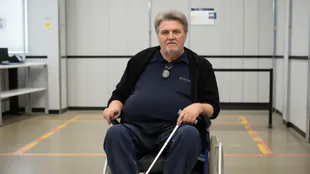
French court acquits man who killed incurably ill wife / Photo: © AFP

 Hong Kong court set to sentence activist Joshua Wong in security case

 Australia raises benchmark rate to highest level in 18 years

 'The Remarried Empress' Cast Discusses Bringing Fantasy Royal Drama to Life

 Asian stocks retreat as AI worries outweigh steep oil-price drop

 Hamad International Airport stages emergency drills during WATAN 2026

 Global failure to punish attacks leaves journalists at continuing risk
 Researchers Warn 'Bookkeeping Trick' Masks Beef Industry's Methane Emissions

 Climate Change Intensified Atlantic Hurricanes, Study Finds

 Qatar solar expansion opens scope for technical performance gains

A French court on Wednesday found a 78-year-old man not guilty of murdering his incurably ill wife after he said that he had assisted her to die at her request.
The prosecution had requested eight years in prison for Bernard Pallot, a retired engineering teacher with no previous convictions, after he tried to kill his wife by injecting cyanide into her thigh in October 2021, then strangled her to death with an electric cable after that did not work.
Although France's parliament has this year debated a controversial right-to-die bill, euthanasia -- whereby someone helps a critically ill patient die -- is illegal in France.
"This trial shows that the current law is insufficient. The law absolutely needs to change," the defendant said after the verdict in the French town of Troyes.
Prosecutor Mickael Le Nouy earlier argued that Suzanne Pallot suffered from "an incurable illness and multiple fractures", but that doctors had said her condition was not "life-threatening".
He said that the defendant might have presented what he did as an "act of love", but stressed that euthanasia was illegal and her death had been "brutal".
Pallot told investigators that he had killed his wife to "avoid her suffering".
"It may seem a bit savage as a method," he said of his use of the electric cable when the cyanide did not work. "But I had no choice."
Near his wife's body, police found a note reading: "I, Suzanne Pallot, still sound of mind, ask my husband Bernard Pallot to definitively relieve me of the incurable suffering that I am enduring."
President Emmanuel Macron said in March that France needed an end-of-life law because "there are situations you cannot humanely accept".
Parliament began debating a bill to legalise assisted dying earlier this year, but Macron then dissolved parliament in June before months of political deadlock over the summer.
Several other European countries have legalised euthanasia since the Netherlands first did so in 2002. They include Belgium, Luxembourg, Spain and Portugal.
Switzerland, which prohibits euthanasia, has for decades allowed assisted suicide.
L.Meier--VB