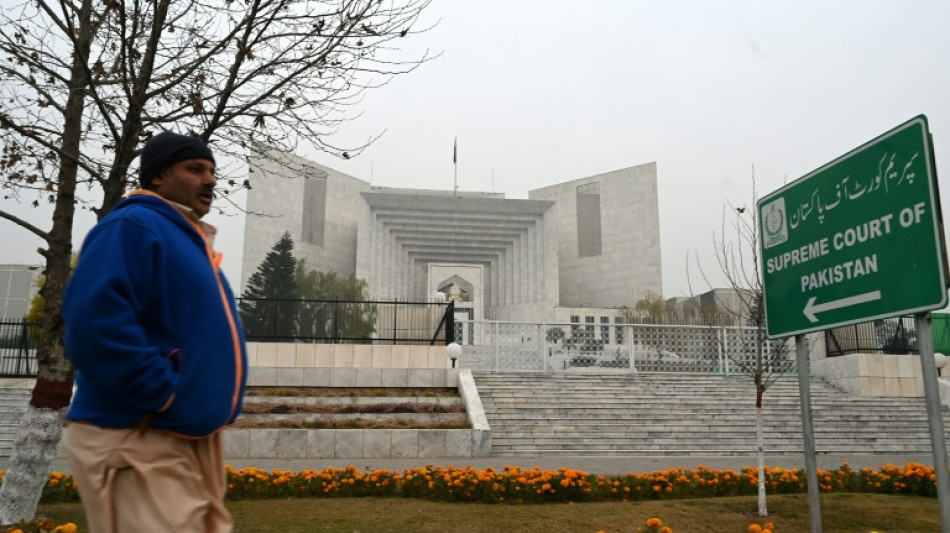
Pakistan passes constitutional amendments aimed at courts / Photo: © AFP/File

 Beyond Investment Returns: Families Are Measuring Wealth by Freedom, Continuity, and Legacy, According to Nour Private Wealth
 King Charles disputes claims in book by Princess Diana's brother

 Real Madrid fan group wants Mbappe apology over Ceuta shirt snub

 Nepal floods among 'most challenging' disasters: WFP

 Doubts as Italy eyes electric future for steel plant

 'One of the kindest people': Taraneh, 21, facing execution in Iran

 Japan eyes changing prostitution law to punish sex buyers

 After record rain, typhoon threatens new challenge to Asian Games

 Kids and social media: what would change under new EU law

 Modi pitches India as global chipmaking hub

 Ukraine plans record defence spending in 2027

 Klopp calls up 44 players in huge first Germany squad

 STARPRIME Responds to Diverging Gold Market Demand with AM/PM Fixing and XAU24/7

 Ukrainian fashion designer debuts art between air raids

 Gambian businesses struggle under prolonged blackouts

 Fiji declares national HIV crisis

 Australia to cut migration to fix housing crisis: minister

 NASA scan discovers new, 'once in a century' Moon crater
 Most stocks rise as Fed hikes and indicates drive to curb inflation

 US again denies Palestinian leader Abbas visa to attend UN assembly

 Lula says he will go to UN to tell Trump to 'stay out' of Brazil's elections

 Messi heads Inter Miami to Campeones Cup triumph

 AI looms large ahead of Xi, Trump summit

 Smith still haunted by 'Sandpapergate' as he prepares for South Africa Tests

 UK-Sudanese author pens book to give children 'African history of Africa'

Pakistan's government on Monday narrowly passed a package of constitutional amendments it said would stop the country's courts from issuing rulings that "interfere in parliament".
Tensions between the state and the country's top courts have deepened since February's national election, which was marred by allegations of rigging as the country's most popular politician, Imran Khan, languished in jail.
Under the judicial reforms passed during a late night session of parliament, the chief justice of Pakistan will now be selected by a parliamentary committee and have a fixed term of three years.
A new constitutional bench will be also formed.
"The goal of the amendments is to block the judicial verdicts that interfere in parliament," Defence Minister Asif Khawaja said on Saturday as the government courted support from smaller religious groups.
"Everybody agrees that we will not compromise on the supremacy of the parliament."
Prime Minister Shehbaz Sharif's Pakistan Muslim League-Nawaz party scraped together a two-thirds majority with the backing of its long-time rival turned supply and demand partner Pakistan People's Party, and a religious party considered an ally of Khan.
The government clinched 225 votes of the required 224 with the crucial support of a handful of rebel MPs from Khan's Pakistan Tehreek-e-Insaf (PTI) party, state media broadcasting the session showed.
PTI, the largest bloc in parliament, had refused to back the package despite offers to water down the amendments and settle a consensus deal, analysts said.
"These amendments are akin to suffocating a free judiciary. They do not represent the people of Pakistan," said PTI’s Omar Ayub Khan, the leader of the opposition in the National Assembly, during the session.
"A government formed through rigging cannot amend the constitution."
The amendments come just days before the chief justice of the Supreme Court, Qazi Faez Isa, is due to retire.
Under the previous law, he would have been automatically replaced by the most senior judge behind him -- currently, Mansoor Ali Shah, who has consistently issued verdicts deemed favourable to Khan and his party.
Analyst Bilal Gilani, who heads Pakistan’s leading polling agency, said the amendments have some "wins" – including bringing balance to the activism of the judiciary.
"A more sinister side of this amendment creates a judiciary that is more pliant with the concerns of the government," he added.
- Wins and losses -
Sharif heads a shaky coalition government that has the backing of the powerful military -- despite Khan's MPs winning the most seats in February's election.
In July, the Supreme Court ruled that the Election Commission of Pakistan was wrong to have sidelined Khan's party in the election campaign by forcing its MPs to stand as independents over a technical violation.
It also awarded Khan's party a handful of non-elected seats reserved for women and religious minorities, which would give Khan's party a majority in parliament.
Earlier this year, six Pakistan high court judges accused the nation's intelligence agency of intimidating and coercing them over "politically consequential" cases.
Khan remains wildly popular and continues to challenge the establishment with frequent protests, despite languishing in jail on charges he says are politically motivated.
He was ousted from power in a no confidence vote in 2022 after analysts say he fell out of favour with the generals.
He waged a defiant campaign against the military -- a major redline in a country that has seen decades of army rule -- which was met with a severe crackdown against his leadership and supporters.
L.Maurer--VB