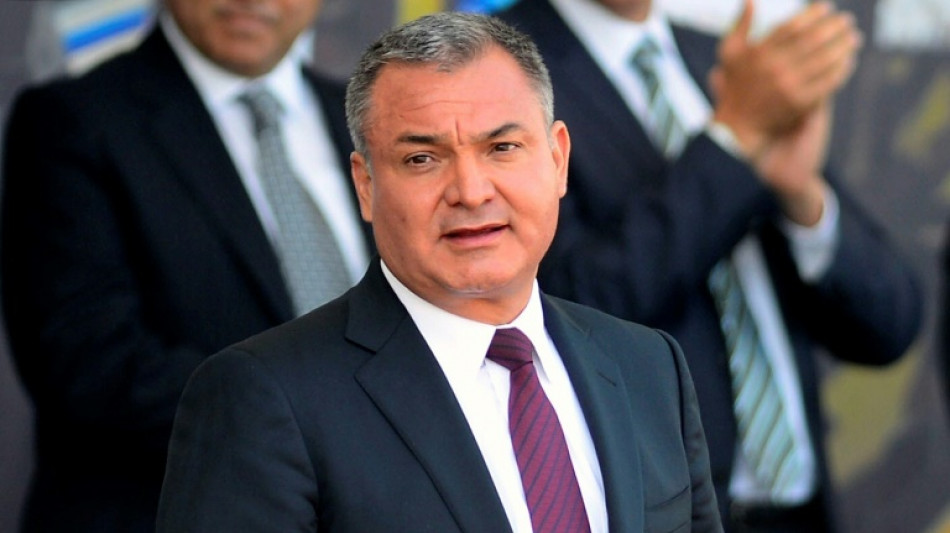
Mexico's ex-security chief sentenced to over 38 years in US prison / Photo: © AFP/File

 Petrol and diesel prices remain broadly steady across major Indian cities

 Reliance shares remain in focus after near-12% surge

 2026 Arizona Midterms: Key Races, Ballot Measures, and Voter Deadlines
 Coal India prepares possible $1 billion Mahanadi Coalfields listing

 Julia Stiles and Ezra Sosa Share Emotional Farewell After 'DWTS' Elimination

 US Buildings Threatened by Wildfires Could Triple by 2060

 Why Pregnancy Cost Estimates Fail: A Family’s $9,000 Surprise

 US Strikes Iranian Targets in Strait of Hormuz Ahead of Midterms

 Brodeur’s Overtime Goal Secures Bethlehem’s Second Consecutive Sectional Title

 Rare 1970 Plymouth ‘Cuda 426 Hemi Listed for $400,000

 The Digital Burden: Why Instant Messaging Feels Like a Full-Time Job

 Alberta Tabled Controversial Riding Boundary Maps Amid Gerrymandering Accusations

 Hong Kong court set to sentence activist Joshua Wong in security case
 Australia raises benchmark rate to highest level in 18 years

 'The Remarried Empress' Cast Discusses Bringing Fantasy Royal Drama to Life

 Asian stocks retreat as AI worries outweigh steep oil-price drop

 Hamad International Airport stages emergency drills during WATAN 2026

 Global failure to punish attacks leaves journalists at continuing risk

 Researchers Warn 'Bookkeeping Trick' Masks Beef Industry's Methane Emissions

 Climate Change Intensified Atlantic Hurricanes, Study Finds

 Qatar solar expansion opens scope for technical performance gains

 OMP Extends UnisonIQ with Agent Library and Agent Studio: AI Agents that Produce Executable Supply Chain Plans
Mexico's former top security official Genaro Garcia Luna was sentenced to more than 38 years in a US prison on Wednesday for aiding the very drug cartels he was tasked with dismantling.
Garcia Luna, 56, was convicted at a high-profile trial in New York last year of taking millions of dollars in bribes to allow the Sinaloa Cartel to smuggle tons of cocaine.
District Judge Brian Cogan sentenced Garcia Luna, who served as secretary of public security under president Felipe Calderon from 2006 to 2012, to 460 months in prison and a $2 million fine at a hearing in federal court in Brooklyn.
Prosecutors had sought a life sentence.
"Today's sentencing of Genaro Garcia Luna is a critical step in upholding justice and the rule of law," US Attorney Breon Peace said in a statement.
"His betrayal of the public trust and the people he was sworn to protect resulted in more than one million kilograms of lethal narcotics imported into our communities and unleashed untold violence here and in Mexico," Peace said.
Garcia Luna's month-long trial shone a spotlight on the corruption of the highest-ranking Mexican government figure ever to face trial in the United States.
It also opened a window on the vast resources of the Sinaloa Cartel under Joaquin "El Chapo" Guzman, who is now serving a life sentence in a US penitentiary.
At his trial, prosecutors said Garcia Luna, who held high-ranking security positions in Mexico from 2001 until 2012, was the cartel's "partner in crime."
That included his time as the architect of then-president Calderon's crackdown on Mexico's drug gangs between 2006 and 2012.
But instead of stopping the smuggling, Garcia Luna took millions of dollars in bribes from the Sinaloa Cartel to allow safe passage of narcotics shipments.
According to prosecutors, Garcia Luna tipped off drug traffickers about law enforcement operations, targeted rival cartel members for arrest and placed other corrupt officials in positions of power.
Garcia Luna served as chief of the Mexican equivalent of the FBI from 2001 until 2006, when he was elevated to secretary of public security, essentially running the federal police force and most counter-drug operations.
- 'Supercop' -
Nine of the 26 witnesses who testified against Garcia Luna, known as a "super cop," were accused drug traffickers extradited from Mexico and collaborating with US prosecutors in exchange for possible leniency in their own trials.
They included high-level cartel bosses Jesus "Rey" Zambada, Sergio Villarreal Barragan and Oscar "Lobo" Valencia.
They claimed to have paid millions of dollars to Garcia Luna collectively, and through Arturo Beltran Leyva, who ran his own drug cartel and served as a go-between with Garcia Luna in exchange for protection.
Garcia Luna, a mechanical engineer by trade, moved to the United States in 2012 and was detained in Texas in December 2019.
He was convicted of multiple charges including engaging in a criminal enterprise that included conspiracy to import and distribute cocaine.
The world's biggest narcotics organization at one time, the Sinaloa Cartel moved multi-ton loads of cocaine each month from producing countries in the Andean region up through Mexico and on to streets in Europe and North America.
R.Buehler--VB