Falling sales cause sour grapes for iconic Portugal wine / Photo: © AFP

 South Korea makes Asian Games complaint over Japan warlord ceremony

 US aid cuts are killing Kenyan sex workers

 October 7 survivors, families take centre stage in Israel vote
 Captain Mat Ryan axed from Socceroos squad for Brazil games

 US approves sale of 48 F-35 jets to Saudi Arabia

 Juventus, Palace cruise to Europa League wins, Bournemouth beat Sociedad

 Stocks climb as oil retreats, Fed calms inflation fears

 Russians begin voting in controlled election as war drags

 Hispanics feel 'betrayed' on immigration, Republican warns Trump

 High-scoring Bears face Vikings in battle of NFL unbeatens

 'In our lane': Fed's Warsh defies Trump but still fighting for credibility

 Trump admin makes major cut to endangered species protections

 Princess Diana's brother makes new explosive claims against Charles

 Ovechkin on Russian political video: 'I support my country'

 Can we shut down AI?

 Teenager Sullivan named in new-look US squad
 Travis Scott and Keith Richards feature on GTA VI soundtrack

 AFP photo shows Trump examining image of apparent Kennedy Center razing

 Pochettino rings changes for USA friendlies

 Alonso says Chelsea ambition 'very clear' after end of Boehly era

 Mbappe draws political fire over Ceuta t-shirt controversy

 Third malaria death in Germany from outbreak tied to Frankfurt airport
 AtlasClear Holdings Reports Preliminary Fiscal 2026 Revenue of Approximately $20.1 Million, Up 85%; Revenue Plus Interest Income of Approximately $21.9 Million

 Alonso says Chelsea ambition clear after end of Boehly era

 Micron's Taiwan workers say 68 months' bonus not enough

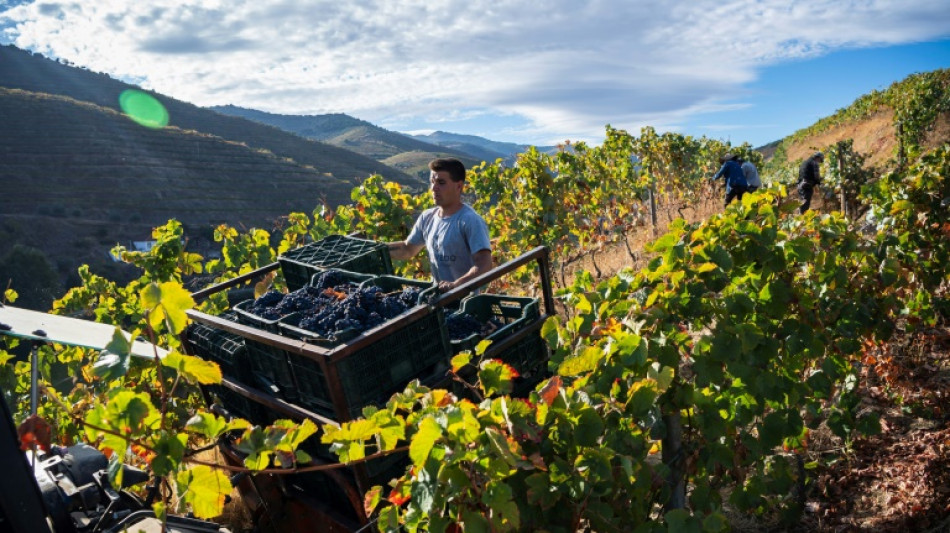
Jose Manuel Ferreira should have already started harvesting grapes on his century-old vineyard in northern Portugal -- instead he is still looking for a buyer for his crop.
"I used to sell my grapes to a cooperative, but this year they refused me," the 74-year-old told AFP in Sao Joao da Pesqueira, in the heart of the Douro wine region.
"We feel abandoned. It's revolting," he said.
His plight is repeated across the Douro Valley, known for its endless swathes of vineyards cascading down lush green hills on tiered terraces carved over the centuries.
The cause: sluggish sales of the region's famous sweet port wine and overproduction.
Roughly 20,000 winegrowers operate along the banks of the River Douro, which winds its way across northern Portugal before spilling out into the Atlantic at Porto, the country's second-largest city, where major wineries are based.
Most vineyards in the region belong to several owners, who cultivate small plots averaging just two hectares (five acres) and generally sell their output to groups operating large estates known as "quintas".
Port wine, which is made by adding brandy during fermentation, was invented by the British in the 18th century and went on to become one of Portugal's most famous exports.
- 'Can't compensate' -
The Upper Douro region, which in 2001 was added to the United Nations' cultural heritage list, produces port wine and table wine, with both enjoying a protected designation of origin status.
This means they can be made only in the region according to a set of production specifications.
While sales of Douro table wines are rising, those of port wines -- which are more profitable -- have fallen steadily in recent years because of changing consumer habits.
Wine consumption has decreased globally, and especially so for products like port wine that are traditionally drunk before meals to stimulate the appetite.
The volume of port wine sold annually has fallen over the last 15 years by a quarter to nearly 65 million litres in 2023.
"Douro table wines can't compensate for the fall in port wine sales," said the head of Portuguese wine promotion body ViniPortugal, Frederico Falcao.
"The grapes still to be harvested in the Douro region are being sold at very low prices, often not even enough to cover the cost of picking," he added.
"Unfortunately, this means there is likely to be quite a lot of grapes left uncollected in the vineyards."
- Production cut -
To tackle the problem of oversupply, the Port and Douro Wines Institute regulatory body has slashed the port wine production quota this year to 90,000 barrels from 104,000 in 2023. Each barrel contains 550 litres (145 gallons).
But industry representatives argue this level of production remains too high given the amount of stocks that have built up in recent years.
These reserves enable major port wine brands, which control almost 90 percent of the market, to limit their losses.
It is small growers like Ferreira, whose modest plot is expected to produce around a tonne of grapes this year, that are being hit hardest.
"The region, which has a unique, world-famous product, generates wealth, but it is not well redistributed," Manuel Cordeiro, the mayor of Sao Joao da Pesqueira, told AFP.
Some are calling for a steeper cut to production that would involve pulling up vines, as is currently being done in the Bordeaux region in southwestern France.
"If we don't create scarcity, we'll never manage to keep prices under control," said Oscar Quevedo, a 41-year-old winemaker who has taken over the family business of around 100 hectares.
Producing wine in the Douro, with its steep slopes and arid climate, "is very expensive" so moving upmarket is necessary to survive and "market a wine that is profitable", he added.
H.Gerber--VB