Supercharged hurricanes trigger 'perfect storm' for disinformation / Photo: © AFP/File

 Alexander-Arnold and Palmer return to England squad for Nations League

 Russians vote as Ukraine war drags on for fifth year

 Backpackers fret over Australian visa crackdown
 Most Asian stocks track Wall St rally, yen drops after BoJ rate hike

 Russians begin voting in controlled election as war drags on

 Trump 'clearly' wants dialogue with Pyongyang: South Korean President

 Bank of Japan hikes rates to 31-year high to battle inflation

 Thailand's Muslim separatists vow to fight to the end

 Mideast turmoil, AI set to dominate UN gathering of world leaders

 Australia to detain tourists who overstay visa, minister says

 Championship rivals brace for renewal of bitter feuds

 In Brazil's Amazon, the hunt for oil fuels hopes and fears
 Australian athlete who soiled herself apologises for continuing Hyrox race

 Baby orangutans in India expose 'frightening' scale of trafficking

 Doom Loop? Ed Sheeran struggles against Gaza tide
 Sudanese women hold fast to threatened henna body art

 Man Utd misery puts Carrick under pressure, Spurs feeling the heat

 Prized Mexican relic returns on loan, two centuries on

 Venezuela unblocks some censored news sites
 Samba stars on debut in Man City rout of Norwich

 Oversight Board blasts 'inadequate' Meta safeguards for AI deepfakes

 The Easter Island origins of buzzy Malkovich drama 'Wild Horse Nine'

 Third body recovered after Grand Canyon flash flood
 Harry makes first public appearance since return to UK
 Abhishek hits record T20 ton as India sweep series 3-0

Monster hurricanes slamming the United States in recent weeks have triggered a torrent of misinformation, with politicians and social media users reviving conspiracy theories about weather manipulation ahead of the November 5 presidential election.
False accusations of the government waging "weather warfare" spread online with social media posts claiming the storms were "deliberately deployed against red states" likely to vote for Republican Donald Trump.
"We are in a geoengineering 'meltdown' perpetrated by Globalists who want to 'control' the whole of humanity," said one post on X.
Rumors also focused on the Alaska-based High-frequency Active Auroral Research Program (HAARP), which was formerly run by the US military, and cloud seeding, despite a lack of evidence linking the technologies to the formation of large storms.
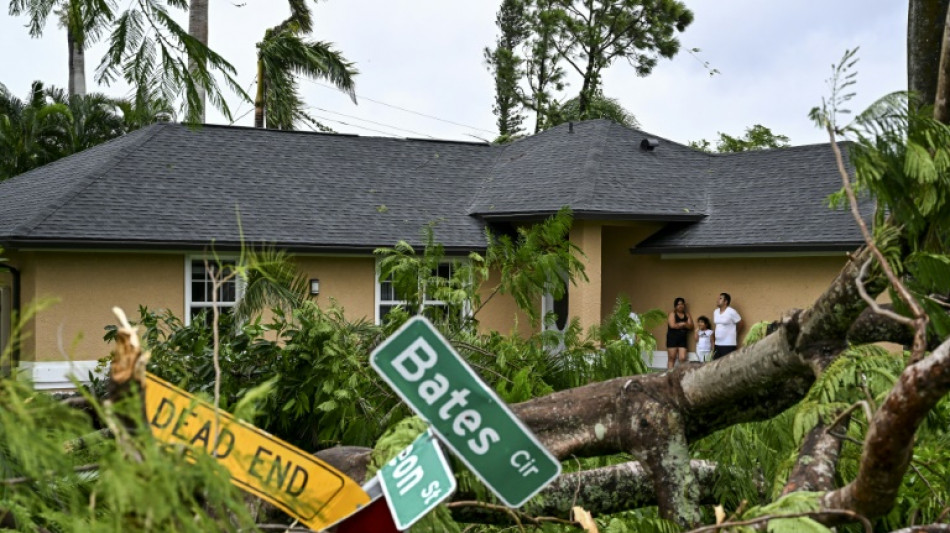
The wave of falsehoods emerged after Helene became the deadliest hurricane to hit the US mainland since 2005's Katrina, and Milton quickly followed, making landfall in Florida on October 9.
Both storms ravaged entire neighborhoods, forcing widespread evacuations and causing massive power outages.
Ethan Porter, a professor and researcher at The George Washington University Misinformation/Disinformation Lab, said some people are using misinformation "as a convenient way to express their political beliefs."
He said the focus is less on the details, but rather the underlying message -- "that neither science nor government should be trusted, that climate change isn't real, and that somehow, Democrats are responsible for the unfolding catastrophe."
Pro-Trump Republican Congresswoman Marjorie Taylor Greene has repeatedly told her followers that the US National Oceanic and Atmospheric Administration authorizes programs that "control the weather."
Methods such as cloud seeding can help increase rain and snow in localized areas, but they cannot create storms like Helene.
Experts told AFP it is concerning that politicians are engaging with such narratives.
"This is coming at a time of real political tension," said Callum Hood, head of research at the Center for Countering Digital Hate.
"The social media landscape is a friendlier place for hate and disinformation than it has been in a long time, particularly on X."
University of Miami professor Joseph Uscinski, who researches why people believe in conspiracy theories, agreed: "We have members of Congress who are pushing ideas that this is real, when, in fact, it's not."
- 'Scary world' -
The situation highlighted the sharp divide over climate change, as scientists warned that supercharged storms were the result of warmer ocean temperatures.
Storms, also amplified by warmer air, show a potential to impact inland areas as well as coastal regions that have historically been in the path of destruction.
"Hurricane Helene showed us that it is not (only) the coast we have to worry about. A hurricane with a lot of moisture passing through a mountainous area -- such as Asheville -- is a bad combination," Jayantha Obeysekera, director of the Sea Level Solutions Center at Florida International University, told AFP.
Nature Conservancy chief scientist Katharine Hayhoe said weather control narratives help defer the responsibility of curbing emissions.
She worries such logic brings a false sense of security and comfort for people trying "to make sense of what is rapidly becoming a very scary world."
These conditions create "a 'perfect storm'" for disinformation, Hayhoe said, highlighting how disbelief can further delay action on the ground or prevent proper resilience and mitigation plans against a warming climate.
"It moves us in exactly the opposite direction from where we need to be going," she said.
C.Stoecklin--VB