
Mohamed bin Zayed, from power behind throne to UAE ruler / Photo: © Saudi Royal Palace/AFP/File

 Former Grand Slam winner Wawrinka ends tennis career

 Brazil's Flavio Bolsonaro flees to US after election loss
 'Faerie' nights: 'ACOTAR' fans finally get their book
 American woman convicted of getting military training from Islamic State
 Israel opposition holds narrow edge over Netanyahu in first projections

 Floriani hits maiden goal as Lazio go top
 Trump set to drastically loosen oil and gas sector's methane rules
 Storied Paris department store seeks bankruptcy protection
 Xhaka, Embolo can return to Swiss squad after fake Covid docs affair
 Allegri suspended for two Serie A games after red card
 Flight data, satellite images reveal growing US role at Ecuador base
 McInnes feels 'guilt' ahead of Hearts return with Rangers

 Brazil's Lula turns 81, vows to work '24 hours a day'
 Boeing releases cautious growth plan as shares fall sharply
 Exiled Russian dissident Navalnaya warns dictators becoming 'more cunning'
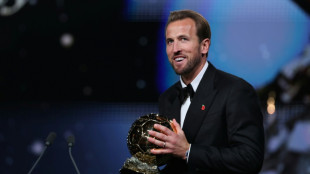
 Bayern 'risk' reaps huge reward for Ballon d'Or winner Kane
 Record turnout as Israeli voters deliver verdict on Netanyahu
 Iraola says Isak 'feels the trust' after Liverpool scoring streak

 French media protest manhandling of journalists at far-right party rally
 EU seeks deportation powers for beefed up border agency
 Two charged with UK security offences over airbase plot: police
 Maresca defends Donnarumma, Guehi after Man City defeat
 Nordic leaders call Putin as local truce begins in Ukraine
 Osaka unveils crane outfit in Tokyo before win over Paolini

 Ronaldo in line for Portugal return after fallout with coach
Sheikh Mohamed bin Zayed Al Nahyan, who was elected as UAE president on Saturday, has long been seen as a strongman who has driven the Gulf country's rise to greater prominence.
A trained soldier and football fan, Sheikh Mohamed has for years been the quiet power behind the throne of Abu Dhabi, the capital of the United Arab Emirates.
The 61-year-old took office, as was widely expected, after the death on Friday of his half-brother Sheikh Khalifa bin Zayed Al Nahyan, who had led the country since 2004.
Sheikh Mohamed was unanimously elected by the Federal Supreme Council, made up of rulers of the UAE's seven emirates. He has also been named as ruler of Abu Dhabi, which controls most of the country's oil wealth.
He has long wielded power, however. In a 2009 note to then US president Barack Obama leaked by WikiLeaks, former American ambassador Richard Olson said he was "the man who runs the United Arab Emirates".
Despite his low profile, and apparent reluctance to speak in public, his ambition has been on display in recent years as the UAE built its profile as a regional player.
He was first Gulf leader to strike a deal normalising relations with Israel, breaking with the decades-old Arab League consensus to isolate Israel until it agrees to the establishment of Palestinian state.
The UAE -- a collection of emirates better known for its skyscrapers, palm-shaped islands and opulent mega attractions -- has in short order built a nuclear power programme and sent a man to space.
And in July 2020 it joined another elite club by sending a probe to Mars, to mark the 50th anniversary of its unification.
Sheikh Mohamed, who was named crown prince of Abu Dhabi in November 2004, is the third son of Sheikh Zayed bin Sultan Al Nahyan -- the founder of the UAE.
He has been serving as deputy commander of the armed forces and chairman of the Executive Council of Abu Dhabi, which controls the emirate's substantial finances.
- Military muscle -
Born in the capital on March 11, 1961, Sheikh Mohamed was sent to military school in Britain, where he graduated from the famed Royal Military Academy Sandhurst in 1979.
He rapidly rose through the ranks to become air force commander, deputy chief of staff and finally chief of staff in January 1993, and a year later was promoted to the rank of general.
Described by diplomats as Abu Dhabi's strongman, Sheikh Mohamed has forged links in world capitals, particularly in the West.
He is believed to have taken the decision to deploy troops in Yemen in 2015 as part of a Saudi-led military campaign against Iran-backed Huthi rebels.
The Yemen war marked the first protracted military campaign abroad for the UAE and the first time it had to contend with military casualties, with dozens of Emirati soldiers killed.
The coalition has been denounced for air strikes, including on markets and hospitals, that have caused heavy civilian casualties in Yemen.
The UAE, which largely exited the conflict in 2019, was also accused of running secret prisons across southern Yemen. It denied the accusations.
- Tight grip -
Although Sheikh Mohamed does not often speak in public -- he left the November 2017 inaugural speech of the Louvre Abu Dhabi to Dubai ruler Mohammed bin Rashid -- his reach cannot be underestimated.
Under his leadership, Abu Dhabi has fostered trade and political ties across the region -- including, to a limited extent, with Shiite Iran -- but has sided with the US against Tehran's nuclear programme and with Saudi Arabia on its role in the mainly Sunni Arab world.
Sheikh Mohamed also took the lead on a staunch no-mercy domestic security policy.
Observers believe it was he who masterminded an unprecedented clampdown on Islamists in the UAE, with dozens handed lengthy jail terms over charges of ties to extremists.
At the same time, he crafted for the UAE a reputation of tolerance that contrasts with its conservative neighbours.
In 2017, he announced that Abu Dhabi's Grand Mosque, also known as Sheikh Zayed Mosque after his father, would be renamed the Mariam Umm Issa (Mary, Mother of Jesus) mosque as a means to "consolidate bonds of humanity between followers of different religions".
An avid football fan, Sheikh Mohamed is president of the local club in the oasis of Al-Ain, his father's hometown and the second largest city in Abu Dhabi.
He has also been spotted cycling through the capital in shorts and a helmet.
A keen hunter and a poetry enthusiast, he is married to fellow royal Sheikha Salama bint Hamdan Al Nahyan. The couple has four sons and five daughters.
F.Müller--BTB