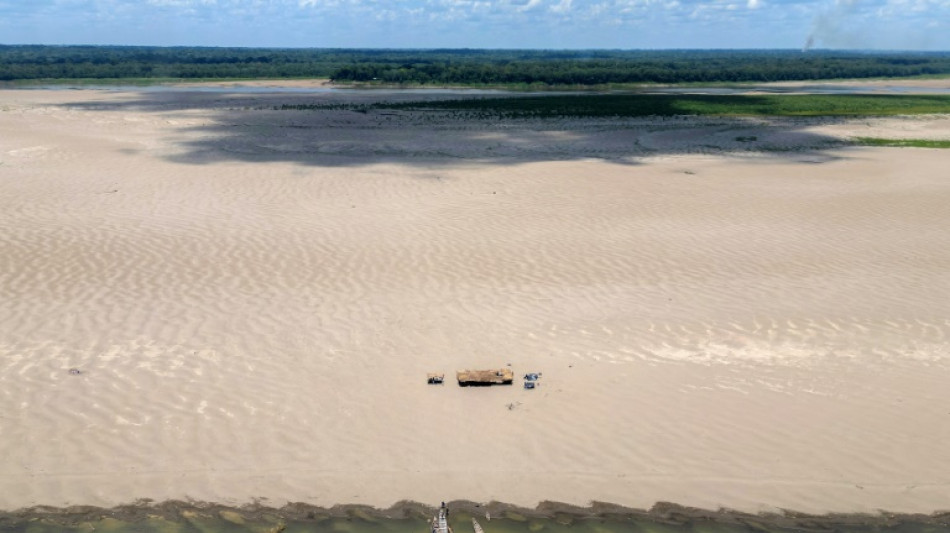
The long walk for water in the parched Colombian Amazon / Photo: © AFP

 Stock markets retreat after central bank rate hikes

 Russia labels director of Cannes Grand Prix winner a 'foreign agent'

 Macron warns of Russian 'hybrid' threat after meeting presidential hopefuls

 UN holds third informal poll for new chief

 Kulusevski return can spark Spurs: De Zerbi

 Shakira to cap off world tour with Madrid 12-gig run

 Isolated Syrian-Druze city blames Damascus for shortages

 Isolated Syrian-Druze city shortages

 Dutch drop Depay for Germany match in Xavi's first pick

 Ronaldo named in Portugal squad for Nations League

 Stock markets diverge after central bank rate hikes

 Anti-Assad music star makes triumphant return to Syria

 In-form Fernandez included in Spain Nations League squad

 Arteta buries hatchet with Hurzeler ahead of Brighton clash

 Alexander-Arnold and Palmer return to England squad for Nations League

 Russians vote as Ukraine war drags on for fifth year

 Backpackers fret over Australian visa crackdown
 Most Asian stocks track Wall St rally, yen drops after BoJ rate hike
 Russians begin voting in controlled election as war drags on
 Trump 'clearly' wants dialogue with Pyongyang: South Korean President

 Bank of Japan hikes rates to 31-year high to battle inflation
 Thailand's Muslim separatists vow to fight to the end

 Mideast turmoil, AI set to dominate UN gathering of world leaders

 Australia to detain tourists who overstay visa, minister says

 Championship rivals brace for renewal of bitter feuds
Bearing six-liter bottles of water on their shoulders, members of Colombia's Indigenous Yagua community tramp along the dried-up riverbed of a branch of the mighty Amazon.
In the Three Frontiers region, where Colombia borders Brazil and Peru, the flow in some spots of the world's biggest river by volume has shrunk by 90 percent, leaving a desert of brown sand etched with ripples.
Near the Colombian border town of Leticia, the 600 inhabitants of a Yagua village have found themselves staring out over a kilometer-wide (.6-mile) pop-up beach.
Before the smaller of two branches of the Amazon that flow past Leticia started to dry up three months ago, it took the villagers only around 15 minutes to reach the shores of the river.
Now they have to walk for two hours under the baking sun to reach the docking point for boats that bring food, fuel and drinking water on the only route in and out of the jungle.
"This is a really difficult time," Victor Facelino, a 52-year-old Yagua man told AFP as he lugged home a water canister donated by the state to help quench the thirst of people living in the world's biggest rainforest.
"Sometimes we get bogged down in the sand," he said, panting.
Colombia's National Unit for Disaster Risk Management (UNGRD) blames the Amazon's worst drought in nearly 20 years for the dramatic shrinkage of the river in the Three Frontiers region.
"For many of these communities, the only means of transport is the river, and with the drying up of the tributaries, they are completely cut off," UNGRD director Carlos Carrillo said.
- 'Like before' -
The governor of the Colombian department of Amazonas, a 109,000-square-kilometer chunk of forest, said the drought was the "worst climate crisis" ever seen in the area.
It coincides with the worst wildfire season in the Amazon in nearly 20 years, according to Europe's Copernicus climate observatory.
On the Peruvian side of the border, several towns have reported food shortages.
On the Brazilian side, which is choking under fumes from fires, authorities have declared a "critical situation," with the low levels of water at a hydropower station that generates 11 percent of the country's electricity causing particular concern.
The logistical difficulties have caused the price of basic goods, including fuel, to rocket. Fishermen are forced to travel ever further upriver to cast their nets.
"If you look along the river, everywhere you go it's dry," Roel Pacaya, a 50-year-old fisherman in the town of Puerto Narino, complained.
Maria Soria, a Yagua woman who makes a living selling handicrafts on Monkey Island, a natural reserve in the Colombian Amazon, is worried that soon "all the river will start to dry up."
"I ask God to change it back to the way it was, so that we can live like before," said the 55-year-old, wearing a traditional blue-feathered headdress and chest covering of palm fiber to perform a dance for a small group of tourists.
- Going with the flow -
Even for those who still have river access, things aren’t easy.
Eudocia Moran, 59, said she feels imprisoned by the now stagnant waters of the Amazon that lie just a few meters from her home.
Shopping trips to Leticia, about 30 miles down the river have become rarer, with boat operators fearing getting stranded in the sand.
Moran, a leader of the Ticuna Indigenous community, is convinced that the solution is a return to the land.
Rather than relying on an ever slower trickle of tourists, she believes the only way to survive is to "immerse ourselves fully in agriculture."
In a garden irrigated by a sliver of the river she grows cassava, beans, corn and fruit.
"I tell everyone we have go with the flow of the times, because all we can do is learn to live."
E.Burkhard--VB