UN warns world's water cycle becoming ever more erratic / Photo: © AFP

 Helicopters battle wildfire threatening Ecuador's capital

 Brentford batter Chelsea to undo Alonso's promising start
 Kane hits Bundesliga century as Bayern rout Union
 Trump says CNN, MS NOW, Politico banned from White House
 Hushing and hedging: US companies retreat on climate

 Springboks to face Fiji before 2027 Rugby World Cup
 Nigeria miners struggled to breathe in cell before 37 died: survivors

 McIlroy on the charge at PGA Championship as Reed withdraws

 McIlroy on the charge at PGA Championship

 Crisis-wracked Volkswagen warns of 10-bn-euro hit to profits
 Costa Rica's Grynspan tops third informal poll for UN chief: diplomat

 Stock markets retreat after central bank rate hikes

 Russia labels director of Cannes Grand Prix winner a 'foreign agent'

 Macron warns of Russian 'hybrid' threat after meeting presidential hopefuls
 UN holds third informal poll for new chief
 Kulusevski return can spark Spurs: De Zerbi

 Shakira to cap off world tour with Madrid 12-gig run

 Isolated Syrian-Druze city blames Damascus for shortages
 Isolated Syrian-Druze city shortages

 Dutch drop Depay for Germany match in Xavi's first pick

 Ronaldo named in Portugal squad for Nations League

 Stock markets diverge after central bank rate hikes
 Anti-Assad music star makes triumphant return to Syria

 In-form Fernandez included in Spain Nations League squad
 Arteta buries hatchet with Hurzeler ahead of Brighton clash

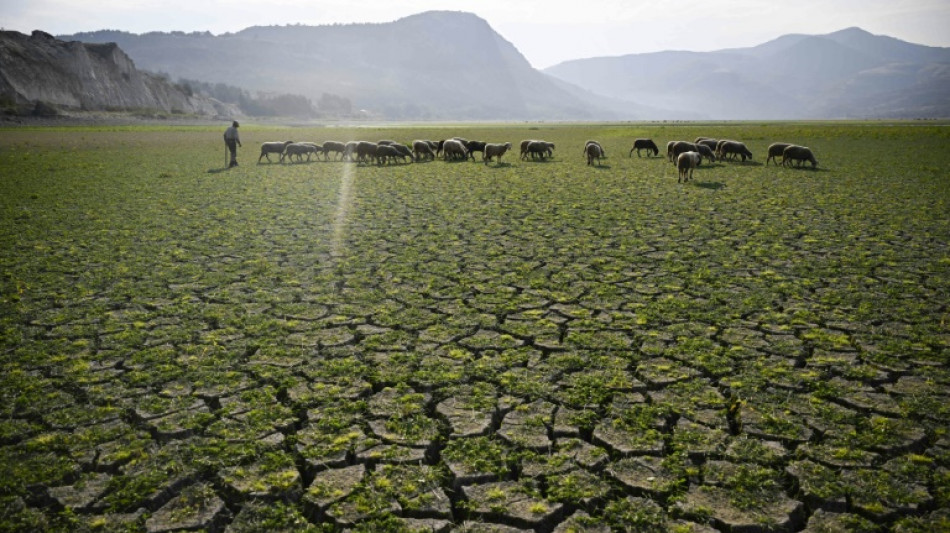
Increasingly intense floods and droughts are a "distress signal" of what is to come as climate change makes the planet's water cycle ever more unpredictable, the United Nations warned Monday.
Last year the world's rivers were their driest for more than 30 years, glaciers suffered their largest loss of ice mass in half a century and there was also a "significant" number of floods, the UN's World Meteorological Organization said in a report.
"Water is the canary in the coalmine of climate change," WMO Secretary-General Celeste Saulo said in a statement accompanying the State of Global Water Resources report.
"We receive distress signals in the form of increasingly extreme rainfall, floods and droughts which wreak a heavy toll on lives, ecosystems and economies," she said.
Saulo said the heating up of the Earth's atmosphere had made the water cycle "more erratic and unpredictable.
Last year was the hottest on record, with high temperatures and widespread dry conditions producing prolonged droughts.
There were also many floods around the world.
These extreme events were influenced in part by naturally-occurring climate conditions including the La Nina and El Nino weather phenomena -- but also and increasingly by human-induced climate change.
"A warmer atmosphere holds more moisture, which is conducive to heavy rainfall. More rapid evaporation and drying of soils worsen drought conditions," Saulo said.
- Massive glacier melt -
Water is either too abundant or insufficient, plunging many countries into increasingly difficult situations.
Last year, Africa was the most heavily impacted continent in terms of human casualties.
In Libya, two dams collapsed due to a major flood in September 2023, claiming more than 11,000 lives and affecting 22 percent of the population, according to the WMO.
Floods also hit the Greater Horn of Africa, the Democratic Republic of Congo, Rwanda, Mozambique and Malawi.
Currently, 3.6 billion people have insufficient access to fresh water at least once a month per year, according to the UN. That figure is expected to rise to more than five billion by 2050.
For the past three years, more than 50 percent of river catchments have been drier than usual.
Meanwhile the inflow to reservoirs has been below normal in many parts of the world over the past half decade.
Rising temperatures also mean glaciers have melted at unprecedented rates, losing more than 600 billion tonnes of water, the worst in 50 years of observations, according to preliminary data for September 2022 to August 2023.
"Melting ice and glaciers threaten long-term water security for many millions of people. And yet we are not taking the necessary urgent action," Saulo said.
In addition to curbing the man-made greenhouse gas emissions that cause global warming, the WMO wants the world's fresh water resources to be monitored better, so early warning systems can reduce the damage to people and wildlife.
"We cannot manage what we do not measure," Saulo stressed.
Stefan Uhlenbrook, director of the WMO's hydrology, water and cryosphere department, stressed the importance of investing in infrastructure to preserve water and protect people from hazards.
But he also highlighted the need to conserve water, particularly for agriculture, which uses 70 percent of the world's fresh water consumption.
He warned returning to a more regular natural water cycle would be difficult.
"The only thing we can do is to stabilise the climate, which is a generational challenge," he said.
P.Keller--VB