Nepalis fear more floods as climate change melts glaciers / Photo: © AFP

 Trump's beef policies irk Texas ranchers, testing their loyalty
 Nvidia, OpenAI CEOs to attend Xi dinner at White House

 Anthropic picks Accenture for in-house AI safety evaluation
 Balogun returns as Monaco beat Lens to continue strong Ligue 1 start

 'Pause' on overt repression in Venezuela, but reforms still needed: HRW

 Global stocks mixed as yen falls despite Bank of Japan rate hike

 Cuba hit with seventh major blackout of the year

 Murray out with concussion so Wentz will start for Vikings

 UN chief 'deeply regrets' US visa refusal to Abbas for annual meeting
 England quick Carse to face no charges over alleged nightclub assault

 Mancini brings nine newcomers into the first squad of his Italy comeback

 Czechs level Davis Cup tie against USA as South Korea eye Finals

 New France boss Zidane confirms Mbappe as captain after naming first squad
 California governor signs order to explore AI 'kill switch'
 Head leads run spree as Australia win Zimbabwe ODI series

 In-form Raphinha wants to finish career at Barcelona

 Warren Buffett steps down as Berkshire Hathaway chairman
 Carrick confident Man Utd can 'work through' tough time

 Mbappe ends Nike partnership to join Swiss brand On

 Liverpool boss Iraola puts Bournemouth love affair on hold

 'A disaster' if Man City do not win says Maresca after flawless start

 Kerry James Marshall: American 'blackness' painter celebrated in Europe

 Spain coach De la Fuente offers 'full support' to people of Ceuta

 Russia seizes assets of Nestle, French firms over West's Ukraine support
 England can build on World Cup 'spirit', says Tuchel

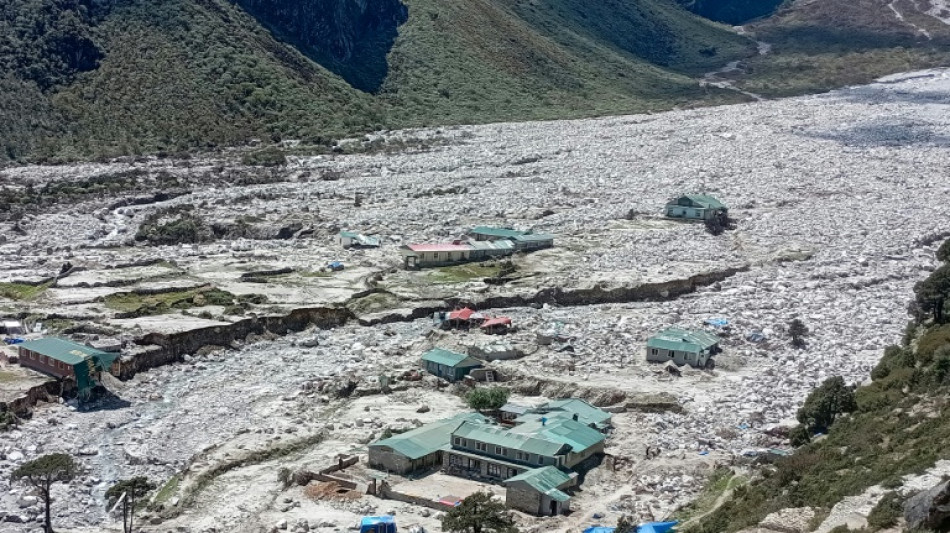
Mingma Rita Sherpa was not home when the muddy torrent roared into his village in Nepal without warning, but when he returned, he did not recognise his once beautiful settlement.
It took just moments for freezing floodwaters to engulf Thame in the foothills of Mount Everest, a disaster that climate change scientists say is an ominous sign of things to come in the Himalayan nation.
"There is no trace of our house... nothing is left," Sherpa said. "It took everything we owned."
Nepal is reeling from its worst flooding in decades after ferocious monsoon rains swelled rivers and inundated entire neighbourhoods in the capital Kathmandu, killing at least 236 people.
Last weekend's disaster was the latest of several disastrous floods to hit the country this year.
Thame was submerged in August by a glacial lake that burst high in the mountains above the small village, famous for its mountaineering residents.
It was once home to Tenzing Norgay Sherpa, the first person to climb the world's highest mountain Everest, along with New Zealander Edmund Hillary.
"We are afraid to return, there are still lakes above," Sherpa said.
"The fertile land is gone. It is hard to see a future there," he added, speaking from the capital Kathmandu, where he has moved.
A glacial lake outburst flood (GLOF) is the sudden release of water collected in former glacier beds.
These lakes are formed by the retreat of glaciers, with the warmer temperatures of human-caused climate change turbocharging the melting of the icy reservoirs.
Glacial lakes are often unstable because they are dammed by ice or loose debris.
- 'Rebuild or relocate' -
Thame was a popular stop during the trekking season, perched at an altitude of 3,800 metres (12,470 feet) beneath soaring snow-capped peaks.
But in August, during the monsoon rains, the village was largely empty.
No one was killed, but the flood destroyed half of the village's 54 homes, a clinic and a hostel. It also wiped out a school started by Hillary.
Sherpa, like many in the village, ran a lodge for foreign trekkers. He also worked as a technician at a hydropower plant, a key source of electricity in the region. That too was damaged.
"Some are trying to rebuild, but the land is not stable," he said. "Parts continue to erode."
Thame's residents are scattered, some staying in neighbouring villages, others in Kathmandu.
Local official Mingma Chiri Sherpa said the authorities were surveying the area to assess the risks.
"Our focus right now is to aid the survivors," he said. "We are working to help the residents rebuild or relocate".
- 'Predict and prepare' -
Experts say that the flood in Thame was part of a frightening pattern. Glaciers are receding at an alarming rate.
Hundreds of glacial lakes formed from glacial melt have appeared in recent decades.
In 2020, more than 2,000 were mapped across Nepal by experts from the Kathmandu-based International Centre for Integrated Mountain Development (ICIMOD), with 21 identified as potentially dangerous.
Nepal has drained lakes in the past, and is planning to drain at least four more.
ICIMOD geologist Sudan Bikash Maharjan examined satellite images of the Thame flood, concluding it was a glacial lake outburst.
"We need to strengthen our monitoring... so that we can, at least to some extent, predict and prepare," he said.
"The risks are there... so our mountain communities must be made aware so they can be prepared".
Scientists warn of a two-stage impact.
Initially, melting glaciers trigger destructive floods. Eventually, the glaciers will dry up, bringing even greater threats.
Glaciers in the wider Himalayan and Hindu Kush ranges provide crucial water for around 240 million people in the mountainous regions.
Another 1.65 billion people depend on them in the South Asian and Southeast Asian river valleys below.
- 'Himalayas have changed' -
Former residents of Thame are raising funds, including Kami Rita Sherpa, who climbed Everest for a record 30th time this year.
Kami Rita Sherpa said the locale had long been a source of pride as a "village of mountaineers", but times had changed.
"The place has no future now", he said. "We are living at risk -- not just Thame, other villages downhill also need to be alert."
The veteran mountaineer said his beloved mountains were under threat.
"The Himalayas have changed," he said. "We have now not only seen the impact of climate change, but experienced its dangerous consequences too."
N.Schaad--VB