Portugal looks to put new twist on cork industry / Photo: © AFP

 Drone owners rush to offload devices ahead of Beijing ban

 Trump's beef policies irk Texas ranchers, testing their loyalty

 Nvidia, OpenAI CEOs to attend Xi dinner at White House

 Anthropic picks Accenture for in-house AI safety evaluation

 Balogun returns as Monaco beat Lens to continue strong Ligue 1 start

 'Pause' on overt repression in Venezuela, but reforms still needed: HRW

 Global stocks mixed as yen falls despite Bank of Japan rate hike

 Cuba hit with seventh major blackout of the year

 Murray out with concussion so Wentz will start for Vikings

 UN chief 'deeply regrets' US visa refusal to Abbas for annual meeting
 England quick Carse to face no charges over alleged nightclub assault

 Mancini brings nine newcomers into the first squad of his Italy comeback

 Czechs level Davis Cup tie against USA as South Korea eye Finals

 New France boss Zidane confirms Mbappe as captain after naming first squad

 California governor signs order to explore AI 'kill switch'

 Head leads run spree as Australia win Zimbabwe ODI series

 In-form Raphinha wants to finish career at Barcelona

 Warren Buffett steps down as Berkshire Hathaway chairman

 Carrick confident Man Utd can 'work through' tough time

 Mbappe ends Nike partnership to join Swiss brand On

 Liverpool boss Iraola puts Bournemouth love affair on hold
 'A disaster' if Man City do not win says Maresca after flawless start
 Kerry James Marshall: American 'blackness' painter celebrated in Europe

 Spain coach De la Fuente offers 'full support' to people of Ceuta

 Russia seizes assets of Nestle, French firms over West's Ukraine support

Portugal, the world's leading cork producer, is finding new uses for the material, from footwear to furniture, as demand for wine bottle stoppers wanes.
Producers highlight the environmentally friendly properties of cork, which is lightweight, recyclable, waterproof and fire-resistant, to encourage its use in diverse settings.
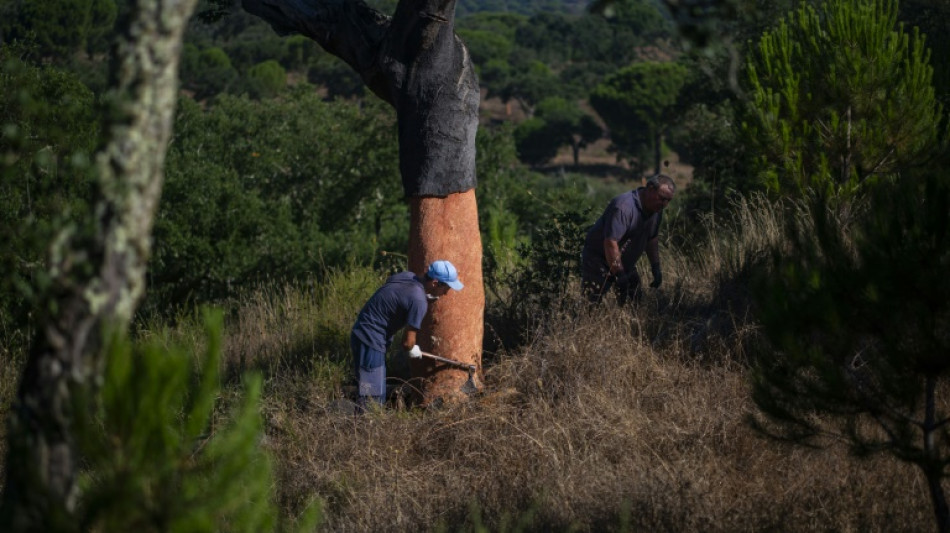
Cork is obtained by stripping the bark of cork oak trees every nine years in a careful process that allows the tree to regenerate and grow, making the industry naturally sustainable.
The material has "a negative carbon footprint because it comes from a tree that captures CO2 day and night", Antonio Rios de Amorim, the CEO of the world's largest cork producer Corticeira Amorim, told AFP.
The push to diversify comes as global sales of wine decline, reducing demand for cork wine stoppers which have long faced competition from cheaper plastic stoppers and screw tops.
"Periods of slowdown must be used to question what we do," said Amorim, whose ancestors founded Corticeira Amorim 154 years ago in the northern village of Mozelos, about 30 kilometres (18 miles) south of second city Porto.
- Booster rockets, metro seats -
Thanks to cork's cell-like structure, the material is elastic and highly impermeable, making it suitable to make shoes as well as ties, pants and other clothes.
Furniture designers are also increasingly drawn to the material.
British designer Tom Dixon has called it a "dream material" and put out a range of dark cork furniture that includes tables, stools and shelves using cork from Portugal.
The Lisbon metro in 2020 replaced the fabric lining on all seats of its train fleet with cork, an easier to maintain material.
Builders have been drawn to the material because of its unique thermal insulation and sound absorption properties.
Cork is also finding its way into space. It is used in thermal protection coating on booster rockets because of its resistance "to strong variations in temperature", said Amorim.
Making wine bottle stoppers, however, remains the main activity for Portugal's cork industry, which employs around 8,000 people.
Corticeira Amorim makes some six billion cork wine bottle stoppers per year, almost all of them for export mainly to Chile, France and the United States.
It accounts for 70 percent of the global market share for cork stoppers and posted sales of 985 million euros (one billion dollars) in 2023, slightly lower than in the previous year.
- Traditional methods -
Cork is made from the bark of the cork oak (Quercus suber) found in countries of the Mediterranean basin.
Portugal is home to about a third of the world's total area dedicated to this tree -- more than any other country -- and accounts for nearly half the world's supply of cork.
There are also plantations in France, Spain, Italy. Algeria, Morocco and Tunisia.
In the province of Ribatejo around 80 kilometres east of Lisbon, cork oaks stretch as far as the eye can see.
The bark is removed from the tree in summer using traditional methods handed down from generation to generation.
It is a highly precise technique "that takes several years to learn", said Nelson Ferreira, a 43-year-old cork bark harvester, adding he takes great care not to damage the tree.
The bark is then taken to Corticeira Amorim's factories in the north of Portugal where it is steam-treated, cut into smaller pieces and then fed into machines that punch out stoppers.
The preservation of cork oaks is crucial for Portugal, which has made them a protected species since it takes an average of 40 years for a tree to start producing cork that can be used by cork makers.
S.Gantenbein--VB