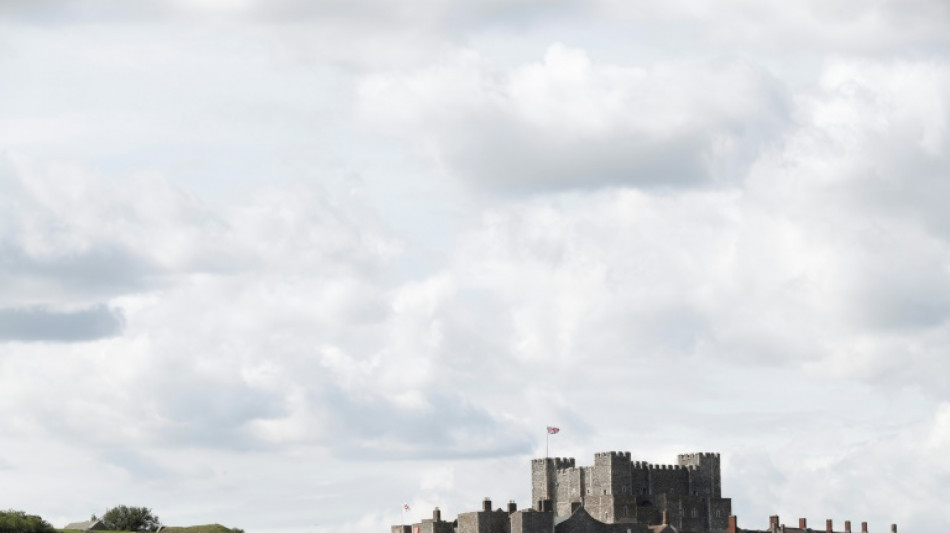
Soldiers' gallows graffiti revealed for first time at English castle / Photo: © AFP

 NFL Giants obtain QB McCarthy from Vikings

 Deal for evicted Spanish pensioner as PM seeks new housing law

 Clippers apologize, warn fans of 'challenges' after Leonard scandal

 Turkish comedian convicted for Erdogan 'insult' freed pending appeal

 Trump announces 'biggest' US steel plant in battleground Iowa

 Olise wonder strike gives Zidane's France win in Belgium

 US stocks fall, bond yields rise as Middle East war drags on

 Trump denies offering to sell arms to China's Xi

 Wemby ready for NBA Spurs to move rivals in climb to top

 Ukraine to postpone some spending amid delays in aid: PM

 Tuchel says Czech Republic game 'not yet a must-win'

 MaXhosa puts South Africa on the Paris fashion map

 Rose, Scott among 2027 World Golf Hall of Fame finalists

 Brunson says NBA champion Knicks can't get satisfaction

 France puts out largest wildfire since 1949

 Real Madrid's Perez summoned over Barcelona referee payments comments

 Oil takes off again, Wall Street dips after Trump rejects Iran truce offer

 AlgoQuant Asset Management Selects Liquid Mercury to Enhance Digital Asset Trading Infrastructure

 UK to reopen refugee resettlement scheme to push 'safe' migration

 Pope urges Europe to help combat 'lies and deceit' in world affairs

 Iranian lawyer Nasrin Sotoudeh wins Council of Europe's rights prize

 French far-right's Bardella denies alleged 2013 antisemitic comments

 Oil up, Wall Street dips after Trump rejects Iran truce offer

 Gakpo withdraws from Netherlands squad

 SpaceX puts Starship megarocket in orbit for first time

Macabre depictions of hangings carved by soldiers guarding England's biggest medieval castle at a time of looming war with France went on display Monday.
The graffiti-covered door -- part of a new exhibition at Dover Castle on the country's south coast -- dates from the late 18th century when soldiers garrisoned there faced the threat of invasion by Napoleon Bonaparte's French forces.
Historian Paul Pattison said scaling a ladder to the top floor of the castle's St John's Tower and seeing the carvings on the long-forgotten door had been an "astonishing discovery".
He said the soldiers' fascination with public execution gave "a unique glimpse into the minds of these soldiers, especially during such a charged period of time".
The door features some 50 pieces of carved graffiti including nine hangings, many initials and two surnames.
There are also a number of dates including 1789, the year of the French Revolution, and 1798.
Pattison, a historian with English Heritage which manages Dover Castle, said the threat of impending invasion would have made strategically important Dover a hive of activity with ships filling the harbour and soldiers a constant presence.
Dover is the closest port to continental Europe and has been a prime target for invaders down the centuries.
- 'Strange and macabre' -
Researchers believe the "strange and macabre repetition" of hangings carved into the door could depict an actual execution in Dover where they would have provided a form of public entertainment during the late 18th century, attended by thousands of people.
In one of the carvings, however, the figure is dressed in military uniform and one of Napoleon's trademark two-cornered bicorne hats, making it possible it was intended to be the French military and political leader himself.
Also carved into the door is a detailed and accurate depiction of a single-masted sailing ship, thought to be an 8-gun cutter which was in use by Britain's Royal Navy at the time.
"What makes this door such an extraordinary object is that it is a rare and precious example of the ordinary person making their mark, whether that be simply for the purpose of killing time or wanting to be remembered," Pattison added.
Dover Castle, which is now visited by more than 350,000 people a year, underwent a wide-ranging modernisation in the 1790s to transform it from an ageing medieval castle into a modern military garrison.
With the ultimately unrealised threat of an invasion from the other side of the Channel growing, it became home to thousands of soldiers.
St John's Tower, with its commanding view over the vulnerable northern end of the castle, would have been guarded by between six and 12 men at any one time, leaving them hours to kill time by carving graffiti with knives or possibly bayonets, according to English Heritage.
The door has been painstakingly conserved and features in the castle's new "Dover Castle Under Siege" exhibition.
The exhibit delves back into the castle's bloody and dramatic 1216-17 siege when it repelled an attack by French and rebel English forces.
Using digital reconstruction, it also reveals the fortress's original entrance from the time, multiple lost towers and long-lost defensive walls.
J.Marty--VB