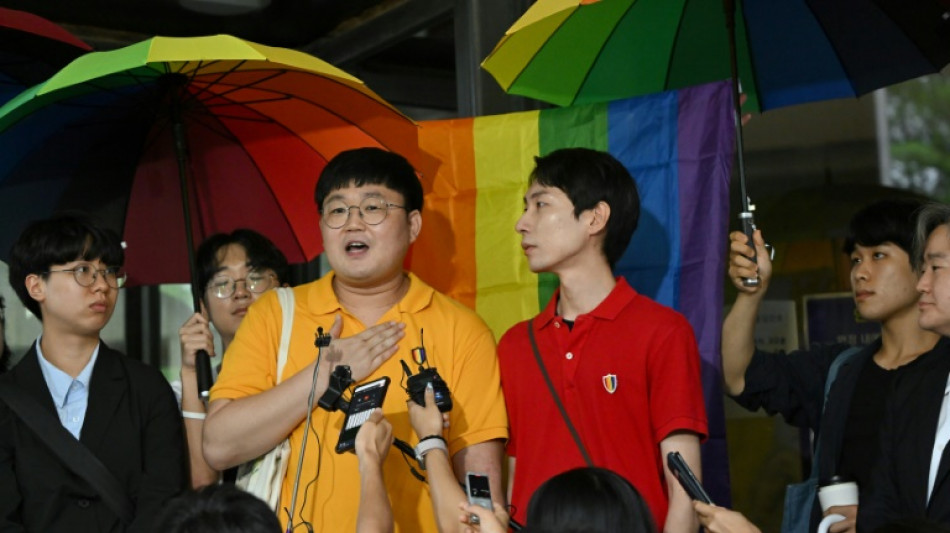
'Better days' ahead for South Korea LGBTQ couples after landmark ruling / Photo: © AFP

 French teens clash with police as school blockades intensify

 FIFA accuses UEFA of 'misinformation campaign' in bid for World Cup papers

 Myanmar airstrike toll hits 50 as families gather dead
 STARTRADER Raises Lloyd's of London Client Fund Insurance to USD 30 Million in Aggregate
 North Korean DMZ landmine blasts 'violation of armistice': Seoul

 Sabalenka 'fresh' for first tournament since losing No.1 spot

 Myanmar airstrike death toll rises to 50: aid workers

 North Korean DMZ landmine blast 'violation of armistice'

 South Korea volleyball team latest to be bussed to wrong Games venue

 Malaysia starts sending Myanmar migrants home

 8.3 mn refugees at risk due to 'severe' funding cuts: UN
 Stocks drop and oil rises as Hormuz hopes fade
 OpenAI cancels release of newest model due to safety concerns

 AI bosses head to White House as safety pressure builds
 Batista sacked as Costa Rica coach after six months

 Flooding, power cuts and evacuations as Hurricane Polo slams Mexico
 NFL Giants obtain QB McCarthy from Vikings

 Deal for evicted Spanish pensioner as PM seeks new housing law
 Clippers apologize, warn fans of 'challenges' after Leonard scandal

 Turkish comedian convicted for Erdogan 'insult' freed pending appeal
 Trump announces 'biggest' US steel plant in battleground Iowa

 Olise wonder strike gives Zidane's France win in Belgium

 US stocks fall, bond yields rise as Middle East war drags on

 Trump denies offering to sell arms to China's Xi
 Wemby ready for NBA Spurs to move rivals in climb to top

When South Korea was run by a military-backed authoritarian government in the 1970s, a "coffee house" where lesbians secretly gathered was an easy target.
The country has progressed from the days of police raids on gay spaces, with the top court ruling on Thursday that same-sex couples are just as eligible for state health insurance benefits as heterosexual common-law partners.
LGBTQ activists like Yoon Kim Myung-woo, who runs one of the oldest lesbian bars in the country, recall the long struggle.
"The police tactical team would show up and just arrest people, accusing the place of being an 'obscene establishment'," the 68-year-old told AFP.
"Many of us had really struggled to live under oppression. We've truly come a long way."
Advocates said the Supreme Court's verdict could pave the way for a law allowing same-sex unions in the country.
But despite the landmark ruling, LGBTQ people tend to live largely under the radar, and an anti-discrimination law has languished in parliament for years due to a lack of consensus among MPs.
Kang In-hye, 35, said that while she was delighted by the ruling, the country still had a long way to go until every LGBTQ person and their partners felt recognised and accepted.
"My partner works for a public institution, where things remain conservative," she told AFP.
Despite the court's decision, "it still remains difficult for (many of) us to openly tell our employer and work colleagues that we're in a common-law relationship with a same-sex partner".
- Demographic crisis -
Thursday's ruling came as South Korea is dealing with a looming demographic crisis, fuelled by the world's lowest birth rates and a rapidly ageing population.
Partly due to plummeting marriage rates, 41 percent of all households are now single-person, official figures show -- with that percentage set to grow in coming decades.
Experts say the country's narrow definition of family, which frowns upon single parenthood and does not recognise non-traditional unions, is partly responsible.
Adoption by legally unmarried individuals, including those in common-law relationships, requires a rigorous review process, and court approvals are extremely rare.
"This ruling is definitely in the right direction toward... more acceptance of diverse forms of family in South Korea," Hyeyoung Woo, a Portland State University sociology professor who researches families in South Korea, told AFP.
The Supreme Court's verdict on Thursday said the National Health Insurance Service "should recognise spousal insurance coverage for same-sex couples", after a gay man sued the agency because it terminated benefits for his partner -- whom he had registered as a dependent -- after discovering they were a gay couple.
The verdict, which cannot be appealed, means common-law spouses of the same sex can now register as dependents on their partners' state health insurance -- something long permitted for heterosexual common-law partners.
The National Health Insurance Service told AFP that it respects the court's decision, and will "review how we can uphold the intent" of the ruling.
- 'Better days' -
Activist Yoon Kim said many South Korean sexual minorities faced legal disadvantages due to the lack of recognition for same-sex unions, and some have lost their deceased partners' savings to their birth families as they had no legal rights to the assets.
The Thursday ruling provided them a "safety net" that could lead to broader protections, she said.
A bill introduced last year sought to expand the legal definition of a family beyond traditional bounds, allowing, for example, non-romantic friends to be legally recognised as family members, entitling them to benefits like tax exemptions and the ability to serve as legal guardians in medical emergencies.
But the proposal faced fierce opposition from conservatives who argued that if passed it would effectively legalise same-sex marriage.
Professor Woo said legislation was failing to keep up with ever-changing family structures and the evolving needs of citizens.
"The traditional forms of family -- heterosexual couple with a breadwinner husband and a stay-in-home wife -- are not reflecting the current demographics in South Korea," she said.
But the country's younger generation remains hopeful.
"I'm still 15 years old, and I can't imagine how those who fought in the system before me and for a long time would feel," Zed, a young LGBTQ person, told AFP, adding the ruling recognised the "meaning of my existence".
"Although this decision is just the beginning, I'm looking forward to better days in my future."
S.Spengler--VB