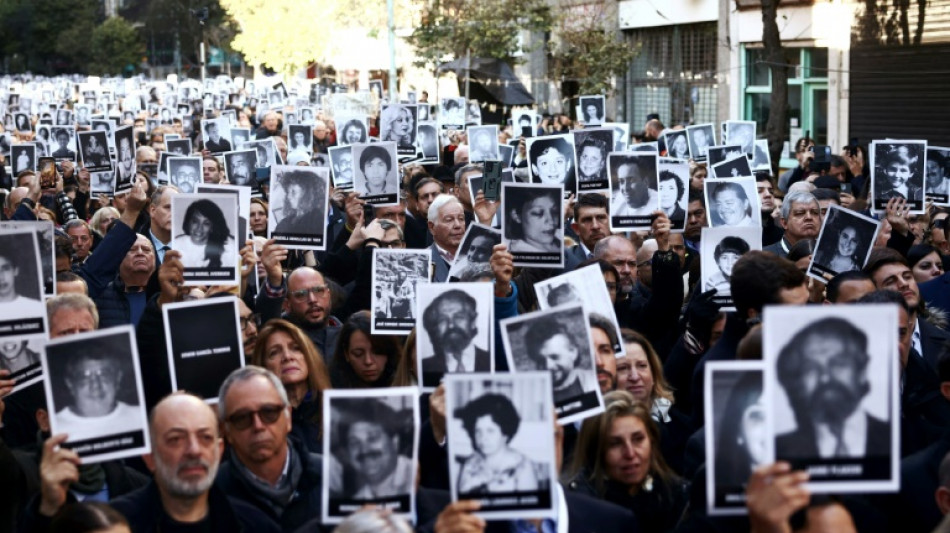
Families demand justice 30 years after deadly Argentina bomb attack / Photo: © AFP

 ALIX LASERS shareholders remove Michael Sobitsch as managing director in view of the circumstances

 Progressive Vision Wins Irish Healthcare Awards 2026 Innovation Prize for Office-Based Cataract Surgery

 Eight-Year-Old Georgia Wins Penrith Valley Public Speaking Competition

 Steven Berkoff on Memory and His New Autobiography 'Shouting At Night'

 Jimmy Carr Confirms 25-Year Estrangement From Father Amid Podcast Reflections

 Arizona Superintendent Tom Horne to Leave Office, Plans Law Practice and Charter School

Hundreds of Argentines gathered in Buenos Aires Thursday to demand justice for the attack on a Jewish community center that killed 85 people 30 years ago to the day.
Loved ones of victims held up photographs of the fallen and placed candles and roses at the site where a truck laden with explosives drove into the Argentine Israelite Mutual Association (AMIA) and detonated on July 18, 1994.
The deadliest attack in the South American country's history injured more than 300 people.
Argentina has the largest Jewish community in Latin America, with some 300,000 members.
"Thirty years without a single person answering for this attack. Thirty years in which the State of Argentina has looked the other way," AMIA president Amos Linetzky told Thursday's gathering, also attended by President Javier Milei.
The Inter-American Court of Human Rights in San Jose, Costa Rica in June found the Argentine state responsible for not preventing, nor properly investigating, the attack.
It also blamed the state for efforts to "cover up and obstruct the investigation," robbing victims and their loved ones of justice.
The 1994 assault has never been claimed or solved, but Argentina and Israel have long suspected Lebanon's Shiite Hezbollah group carried it out at Iran's request.
Argentina has since 2006 sought the arrest of eight Iranians, including then-president Ali Akbar Hashemi Bahramaie Rafsanjani.
In April, an Argentine court blamed Hezbollah for the attack it called a "crime against humanity," and labeled Iran a "terrorist state."
It found that the attack and another on the Israeli embassy in 1992 that killed 29 people were likely triggered by the government under then-president Carlos Menem canceling three contracts with Iran for the supply of nuclear equipment and technology.
After that ruling, Buenos Aires asked Interpol to arrest Iran's Interior Minister Ahmad Vahidi, whom it accuses of masterminding the attack.
Tehran denies any involvement.
L.Wyss--VB

