Cyprus pioneers coral conservation project in the Med / Photo: © AFP

 UN to hold fourth informal poll of secretary-general candidates

 Who are the Emiratis behind crisis-hit Manchester City?

 Singer Angelique Kidjo urges Africans to 'create together'

 Alleged Rihanna mansion shooter mentally fit for trial, says judge
 Mystery over UK airbase scare as police find petrol not explosives

 OpenAI unveils low-cost AI model, a day after shelving Astra upgrade
 Premier League confirms Man City guilty of serious financial breaches
 Brazil's Lula turns to Bad Bunny tune to criticise Trump ahead of polls
 Nigerian dancer eyes world record after seven-day marathon
 Swiss regulator concludes Julius Baer bank probe
 Brazil's patron saint pulled into latest election scrap

 Football overload leaves players near 'breaking point', warns Tebas

 Paris Eiffel Tower says chief to step down after uproar over removing women staff

 Amaze Holdings (NYSE: AMZE) Executes Binding LOI to Acquire BullionFX | Alchemy, a Decentralized Gold-Backed Financial Ecosystem for Valued at US$155 Million
 Clashes between French teens, police as school blockades intensify

 Stocks move sideways despite oil moving lower
 African leaders to gather in Egypt for business summit
 UK decides against charging foreign visitors for museums

 Dallaglio to sell England World Cup winners' medal

 Brazil come from behind to beat Australia 4-2 in friendly

 Ruthless An retains Asian Games badminton crown as Kunlavut triumphs

 Alonso to stay with F1 team Aston Martin in 2027
 China badminton 'still strong' despite Asian Games slump
 'Exceptional' Turner painting shown in Rome before sale

 European stocks climb as oil dips

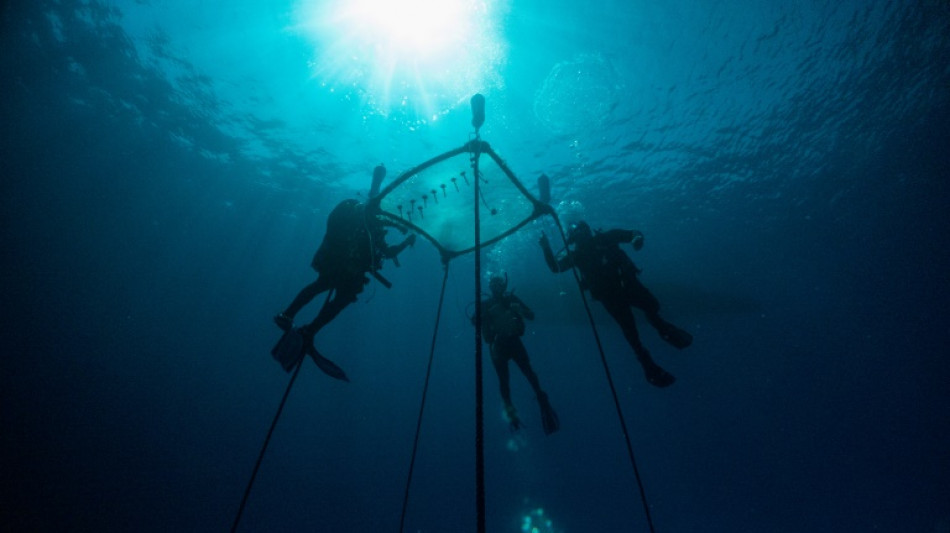
It's a Thursday morning in the tourism hub of Ayia Napa on the southeast coast of Cyprus, and three divers in wetsuits are gluing coral fragments onto numbered pins.
They are preparing to enter the crystal-clear waters and attach the samples to a floating nursery, in a pioneering effort in the Mediterranean to help restore a coral population hit by climate change and unsustainable human activity.
The small fragments of coral have been kept for several weeks at the east Mediterranean island's Department of Fisheries and Marine Research station.
Now they are about to be attached to a net on the underwater nursery some five metres (16 feet) down near Cape Greco.
Louis Hadjioannou, senior associate researcher at the Cyprus Marine and Maritime Institute, is in charge of research into "Cladocora caespitosa".
This species -- also known as cushion coral -- has been declining in the Mediterranean Sea over several years, mainly because of climate change, he said.
And now, he wants to revive it.
The 41-year-old told AFP that in order to do so, the first step is to try to grow the coral in a different underwater habitat "so that we can test whether it is working".
He said an Israeli expert had the idea of using floating nurseries to keep the corals away from potential threats, such as predators.
Cladocora caespitosa is found in shallow waters in Cyprus, generally rocky areas at a depth of up to four metres "where tourists potentially can trample on them", Hadjioannou said.
- 'Good results' -
By having them floating, you can exclude certain stress factors, including predators and extreme weather conditions.
"It's a pilot study so we will continue monitoring them on a systematic basis," he said.
"And in a year's time we will know basically if the corals are doing well on the nurseries or not."
This type of floating structure was first created in 2000 at the northern tip of the Red Sea near Israel's border with Jordan, said Buki Rinkevich, the Israeli expert behind the idea.
It has been tested worldwide, including in Singapore, Thailand, the Philippines, Mauritius, the Seychelles, Zanzibar, Colombia and Jamaica.
Floating nurseries have produced "good results" with around 100 different species of coral, said Rinkevich, of the National Institute of Oceanography in Haifa.
Hadjioannou said two floating nurseries have been deployed in separate marine protected areas off Cyprus, near Cape Greco and Ayia Napa.
The blocks to which they are moored are at depths of 11 and 17 metres respectively.
At the end of June, 10 coral fragments were installed on each floating nursery, and are being analysed every month or two to check on their condition.
"The plan is to install at least a hundred coral fragments on each floating nursery for this case study," Hadjioannou said.
- EU-funded project -
If the samples are doing well after a year has passed, "we will collect the coral fragments and transplant them on natural reefs".
Manos Moraitis, 36, a biologist and associate researcher at the Cyprus Marine and Maritime Institute, said the operation is part of the EU-funded EFFECTIVE project for advancing marine monitoring, restoration, and observation efforts.
Coral reefs are among the planet's richest and most diverse ecosystems, and home to innumerable aquatic species.
They provide balance and support biodiversity by allowing many species to co-exist, but they are also very sensitive to changes in the environment.
Cypriot marine ecosystems are as much threatened by climate change as they are by mass tourism, coastal development and agricultural pollution.
Hadjioannou said that after a heatwave in 2015, up to 40 percent of the corals they were studying were affected by mortality.
"With the increase of the climatic crisis... it's forecasted that an even higher percentage of the live tissue of the coral will die," he said.
"If we are successful, the ultimate goal is to scale up, to try to replicate these coral nurseries in other regions" of the Mediterranean and to deploy more in Cyprus.
M.Schneider--VB